


![[Marketing] Questao Topo - deslogado](https://storage.estuda.com.br/banners/0_6b7ebee90b03af1c560c73bb8bcce34a_banner_deslogado_70_dias.png)
Questões de Inglês
19.971 Questões
Questão 35 81073
UNITAU Medicina 2012
Choose the alternative which DOES NOT contain the reference to the words in bold typeface in the sentence below, withdrawn from the text:
“As dean of Harvard Business School, the idea of teaching these skills is of great importance for Nohria.”
Questão 33 81071
UNITAU Medicina 2012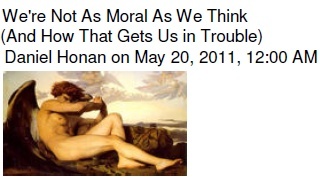
What's the Big Idea?
Nearly any man can stand adversity, said Lincoln, but "if you want to test a man's character, give him power." America's 16th president certainly knew a lot about that. Consider Lincoln's frustrations with the egomaniacal commander George B. McClellan, who was just one in a long succession of incompetent generals Lincoln ended up firing.
Numerous bankers, politicians, athletes and celebrities have proven Lincoln true, time and again. And yet, that does not necessarily make all of these people bad, per se, argues Nitin Nohria in his interview with Big Think.
Nohria, the dean of Harvard Business School, is not looking to create excuses for mistakes or immoral actions. Instead, Nohria is trying to get us to think beyond the "knee-jerk reaction" of simply labeling a person good or evil, as if a character flaw is the only thing that motivates us to do bad things, or that the only kind of person capable of moral failure is simply a "bad seed."
Nohria argues that overconfidence in our own moral capacity is what really gets us into trouble. In other words, since we are so often convinced that we will "never be led astray," when we actually face a complex moral choice we lack the critical skills necessary to do the right thing. What's the significance?
As dean of Harvard Business School, the idea of teaching these skills is of great importance for Nohria. In fact, Nohria has promoted an MBA oath that pledges socially responsible leadership. Like the Hippocratic Oath in medicine, the MBA oath is a "professional credo for MBA graduates." The oath has been embraced globally and has been signed by over 5,000 students.
If we are to expect the next generation of business leaders--not to mention the future leaders in all fields--to truly honor such a commitment, students must be given the tools to properly evaluate the situations that challenge their moral judgment. Then, in Lincoln's words, the better angels of our nature might prevail.
Nitin Nohria: Whenever we see examples of ethical or moral failure, our knee-jerk reaction is to say that was a bad person. We like to sort the world into good people who had stable and enduringly strong, positive characters, and bad people who had weak or frail characters. And this belief that somehow our behavior or our conduct is largely shaped by who we are and our true selves is, I think, one of the great assumptions that we need to challenge if we have to get a better handle on what leads people to go astray.
Lincoln was once asked, what is a measure of a person’s character? And he says, you know, “My experience is that most people think that the true measure of a person’s character is how they respond to adversity. “I have found,” Lincoln said, “that the real test of a person’s character is to give them power. And I have been surprised how often I have been disappointed by people’s character when they have been given power.”
The overconfidence that people have in their own moral capacity is one of the things that we have to be very careful about. Most people think I am good; I have the proper moral compass. I will never be led astray. That form of moral over confidence, I think, is sometimes what gets people into trouble when they find themselves in situations where the pressures are so great that they are led astray. Thinking hard about what it is about situations that are more likely to tempt us and what it is that are about situations that are more likely to give us moral courage is, in my view, one of the most important things that we need to understand.
This is in no way intended to excuse or provide or or not hold people accountable when they commit a mistake. I just think that we always end up focusing on the character of the person as if there was a bad seed that they always were rather than recognizing that people change.… that they find themselves in circumstances where they can be frail and where their own sense of moral confidence can fail them. So I am much more inclined, and this is one of the things we are trying to teach at Harvard Business School is through cases to allow people to see that there are circumstances in which, if you have very, very high powered incentives that are tied to particular measures, you may be tempted at the margin to gain to achieve those measures.
http://bigthink.com/ideas
Choose the alternative which contains a CORRECT STATEMENT in relation to the text:
Questão 32 81070
UNITAU Medicina 2012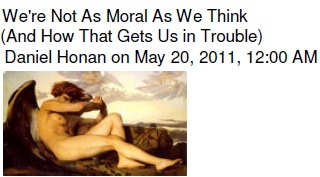
What's the Big Idea?
Nearly any man can stand adversity, said Lincoln, but "if you want to test a man's character, give him power." America's 16th president certainly knew a lot about that. Consider Lincoln's frustrations with the egomaniacal commander George B. McClellan, who was just one in a long succession of incompetent generals Lincoln ended up firing.
Numerous bankers, politicians, athletes and celebrities have proven Lincoln true, time and again. And yet, that does not necessarily make all of these people bad, per se, argues Nitin Nohria in his interview with Big Think.
Nohria, the dean of Harvard Business School, is not looking to create excuses for mistakes or immoral actions. Instead, Nohria is trying to get us to think beyond the "knee-jerk reaction" of simply labeling a person good or evil, as if a character flaw is the only thing that motivates us to do bad things, or that the only kind of person capable of moral failure is simply a "bad seed."
Nohria argues that overconfidence in our own moral capacity is what really gets us into trouble. In other words, since we are so often convinced that we will "never be led astray," when we actually face a complex moral choice we lack the critical skills necessary to do the right thing. What's the significance?
As dean of Harvard Business School, the idea of teaching these skills is of great importance for Nohria. In fact, Nohria has promoted an MBA oath that pledges socially responsible leadership. Like the Hippocratic Oath in medicine, the MBA oath is a "professional credo for MBA graduates." The oath has been embraced globally and has been signed by over 5,000 students.
If we are to expect the next generation of business leaders--not to mention the future leaders in all fields--to truly honor such a commitment, students must be given the tools to properly evaluate the situations that challenge their moral judgment. Then, in Lincoln's words, the better angels of our nature might prevail.
Nitin Nohria: Whenever we see examples of ethical or moral failure, our knee-jerk reaction is to say that was a bad person. We like to sort the world into good people who had stable and enduringly strong, positive characters, and bad people who had weak or frail characters. And this belief that somehow our behavior or our conduct is largely shaped by who we are and our true selves is, I think, one of the great assumptions that we need to challenge if we have to get a better handle on what leads people to go astray.
Lincoln was once asked, what is a measure of a person’s character? And he says, you know, “My experience is that most people think that the true measure of a person’s character is how they respond to adversity. “I have found,” Lincoln said, “that the real test of a person’s character is to give them power. And I have been surprised how often I have been disappointed by people’s character when they have been given power.”
The overconfidence that people have in their own moral capacity is one of the things that we have to be very careful about. Most people think I am good; I have the proper moral compass. I will never be led astray. That form of moral over confidence, I think, is sometimes what gets people into trouble when they find themselves in situations where the pressures are so great that they are led astray. Thinking hard about what it is about situations that are more likely to tempt us and what it is that are about situations that are more likely to give us moral courage is, in my view, one of the most important things that we need to understand.
This is in no way intended to excuse or provide or or not hold people accountable when they commit a mistake. I just think that we always end up focusing on the character of the person as if there was a bad seed that they always were rather than recognizing that people change.… that they find themselves in circumstances where they can be frail and where their own sense of moral confidence can fail them. So I am much more inclined, and this is one of the things we are trying to teach at Harvard Business School is through cases to allow people to see that there are circumstances in which, if you have very, very high powered incentives that are tied to particular measures, you may be tempted at the margin to gain to achieve those measures.
http://bigthink.com/ideas
Choose the alternative which contains the reference to the pronoun in bold typeface in the sentence below, withdrawn from the text: "American\'s 16th president certainly knew a lot about that."
Questão 31 81069
UNITAU Medicina 2012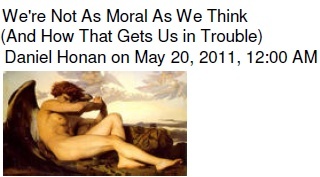
What's the Big Idea?
Nearly any man can stand adversity, said Lincoln, but "if you want to test a man's character, give him power." America's 16th president certainly knew a lot about that. Consider Lincoln's frustrations with the egomaniacal commander George B. McClellan, who was just one in a long succession of incompetent generals Lincoln ended up firing.
Numerous bankers, politicians, athletes and celebrities have proven Lincoln true, time and again. And yet, that does not necessarily make all of these people bad, per se, argues Nitin Nohria in his interview with Big Think.
Nohria, the dean of Harvard Business School, is not looking to create excuses for mistakes or immoral actions. Instead, Nohria is trying to get us to think beyond the "knee-jerk reaction" of simply labeling a person good or evil, as if a character flaw is the only thing that motivates us to do bad things, or that the only kind of person capable of moral failure is simply a "bad seed."
Nohria argues that overconfidence in our own moral capacity is what really gets us into trouble. In other words, since we are so often convinced that we will "never be led astray," when we actually face a complex moral choice we lack the critical skills necessary to do the right thing. What's the significance?
As dean of Harvard Business School, the idea of teaching these skills is of great importance for Nohria. In fact, Nohria has promoted an MBA oath that pledges socially responsible leadership. Like the Hippocratic Oath in medicine, the MBA oath is a "professional credo for MBA graduates." The oath has been embraced globally and has been signed by over 5,000 students.
If we are to expect the next generation of business leaders--not to mention the future leaders in all fields--to truly honor such a commitment, students must be given the tools to properly evaluate the situations that challenge their moral judgment. Then, in Lincoln's words, the better angels of our nature might prevail.
Nitin Nohria: Whenever we see examples of ethical or moral failure, our knee-jerk reaction is to say that was a bad person. We like to sort the world into good people who had stable and enduringly strong, positive characters, and bad people who had weak or frail characters. And this belief that somehow our behavior or our conduct is largely shaped by who we are and our true selves is, I think, one of the great assumptions that we need to challenge if we have to get a better handle on what leads people to go astray.
Lincoln was once asked, what is a measure of a person’s character? And he says, you know, “My experience is that most people think that the true measure of a person’s character is how they respond to adversity. “I have found,” Lincoln said, “that the real test of a person’s character is to give them power. And I have been surprised how often I have been disappointed by people’s character when they have been given power.”
The overconfidence that people have in their own moral capacity is one of the things that we have to be very careful about. Most people think I am good; I have the proper moral compass. I will never be led astray. That form of moral over confidence, I think, is sometimes what gets people into trouble when they find themselves in situations where the pressures are so great that they are led astray. Thinking hard about what it is about situations that are more likely to tempt us and what it is that are about situations that are more likely to give us moral courage is, in my view, one of the most important things that we need to understand.
This is in no way intended to excuse or provide or or not hold people accountable when they commit a mistake. I just think that we always end up focusing on the character of the person as if there was a bad seed that they always were rather than recognizing that people change.… that they find themselves in circumstances where they can be frail and where their own sense of moral confidence can fail them. So I am much more inclined, and this is one of the things we are trying to teach at Harvard Business School is through cases to allow people to see that there are circumstances in which, if you have very, very high powered incentives that are tied to particular measures, you may be tempted at the margin to gain to achieve those measures.
http://bigthink.com/ideas
Choose the alternative which contains an INCORRECT STATEMENT in relation to the first paragraph of the text:
Questão 45 80251
FMABC 2012New stem cell method makes functioning liver cells
Oct 12, 2011
By Kate Kelland
LONDON (Reuters) - British scientists have developed a new stem cell technique for growing working liver cells which could eventually avoid the need for costly and risky liver transplants. A team of researchers led by the Sanger Institute and the University of Cambridge used cuttingedge methods to correct a genetic mutation in stem cells derived from a patient's skin biopsy, and then grew them into fresh liver cells.
By putting the new liver cells into mice, they showed they were fully functioning. "We have developed new systems to target genes and correct defects in patient cells," said Allan Bradley, director of the Sanger Institute. At a briefing about the work, Bradley said the technique the first success of its kind leaves behind no trace of the genetic manipulation, except for the gene correction. "These are early steps, but if this technology can be taken into treatment, it will offer great possible benefits for patients," he added.
Stem cells are the body's master cells, the source for all other cells. Scientists say they could transform medicine, providing treatments for blindness, spinal cord and other severe injuries, and new cells for damaged organs. Research is focused on two main forms embryonic stem cells, which are harvested from embryos, and reprogrammed cells, also known as induced pluripotent stem cells or iPS cells, which are reprogrammed from ordinary skin or blood cells.
When they were first discovered in 2006, iPS cells looked like a perfect solution to the ethical debate over the use of embryonic stem cells because they are made in a lab from ordinary skin or blood cells. Embryonic stem cells are usually harvested from leftover embryos at fertility clinics and their use is opposed by many religious groups.
But in recent years, concerns have been raised that iPS cells may not be as "clean" or as capable as embryonic cells. Last year, a group led by Robert Lanza, of the U.S. firm Advanced Cell Technology, compared batches of iPS cells with embryonic stem cells and noticed the iPS cells died more quickly and were much less able to grow and expand.
http://uk.reuters.com/article/2011/10/12/us-stemcells-liver-idUKTRE79B5GI20111012. Adaptado.
No trecho do segundo parágrafo do texto – leaves behind no trace of the genetic manipulation, except for the gene correction. – a expressão except for pode ser substituída, sem alteração de sentido, por
Questão 44 80248
FMABC 2012New stem cell method makes functioning liver cells
Oct 12, 2011
By Kate Kelland
LONDON (Reuters) - British scientists have developed a new stem cell technique for growing working liver cells which could eventually avoid the need for costly and risky liver transplants. A team of researchers led by the Sanger Institute and the University of Cambridge used cuttingedge methods to correct a genetic mutation in stem cells derived from a patient's skin biopsy, and then grew them into fresh liver cells.
By putting the new liver cells into mice, they showed they were fully functioning. "We have developed new systems to target genes and correct defects in patient cells," said Allan Bradley, director of the Sanger Institute. At a briefing about the work, Bradley said the technique the first success of its kind leaves behind no trace of the genetic manipulation, except for the gene correction. "These are early steps, but if this technology can be taken into treatment, it will offer great possible benefits for patients," he added.
Stem cells are the body's master cells, the source for all other cells. Scientists say they could transform medicine, providing treatments for blindness, spinal cord and other severe injuries, and new cells for damaged organs. Research is focused on two main forms embryonic stem cells, which are harvested from embryos, and reprogrammed cells, also known as induced pluripotent stem cells or iPS cells, which are reprogrammed from ordinary skin or blood cells.
When they were first discovered in 2006, iPS cells looked like a perfect solution to the ethical debate over the use of embryonic stem cells because they are made in a lab from ordinary skin or blood cells. Embryonic stem cells are usually harvested from leftover embryos at fertility clinics and their use is opposed by many religious groups.
But in recent years, concerns have been raised that iPS cells may not be as "clean" or as capable as embryonic cells. Last year, a group led by Robert Lanza, of the U.S. firm Advanced Cell Technology, compared batches of iPS cells with embryonic stem cells and noticed the iPS cells died more quickly and were much less able to grow and expand.
http://uk.reuters.com/article/2011/10/12/us-stemcells-liver-idUKTRE79B5GI20111012. Adaptado.
No trecho do primeiro parágrafo – used cutting-edge methods to correct a genetic mutation in stem cells – a expressão cutting-edge methods corresponde, em português, a
06