


![[Marketing] Questao Topo - deslogado](https://storage.estuda.com.br/banners/0_6b7ebee90b03af1c560c73bb8bcce34a_banner_deslogado_70_dias.png)
Questões de Inglês
19.971 Questões
Questão 3 14865460
UFMS PASSE - 2 Etapa 2021-2023Analise the sentence: We haven’t done our homework yet.
Choose one alternative.
Questão 1 14865440
UFMS PASSE - 2 Etapa 2021-2023Analise a sentença: I have something to tell her, but I don’t know if I should or not.
Escolha a alternativa correta.
Questão 20 14704113
UNESP 2 Fase - Conhecimentos Específicos 2021Leia a tira.

(http://afullclassroom.blogspot.com)
A expressão “laugh your head off” equivale, em português, a
Questão 19 14704108
UNESP 2 Fase - Conhecimentos Específicos 2021Leia a tira “Calvin e Haroldo”, de Bill Watterson.

(https://br.pinterest.com)
No último quadrinho, a fala de Calvin revela que ele
Questão 18 14704084
UNESP 2 Fase - Conhecimentos Específicos 2021Leia o texto e examine o mapa.
The UN Atlas of Endangered Languages lists 18 languages with only one remaining speaker in 2010. With about one language disappearing every two weeks, some of these have probably already died off.
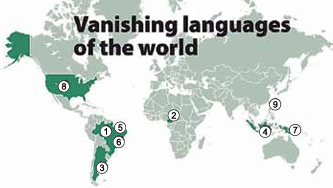
1. Apiaka is spoken by the indigenous people of the same name who live in the northern state of Mato Grosso in Brazil. The critically endangered language belongs to the Tupi language family. As of 2007, there was one remaining speaker.
2. Bikya is spoken in the North-West Region of Cameroon, in western Africa. The last record of a speaker was in 1986, meaning the language could now be extinct.
3. Chana is spoken in Parana, the capital Argentina’s province of Entre Rios. As of 2008, there was only one speaker.
4. Dampal is spoken in Indonesia, near Bangkir. Unesco reported that there was one speaker as of 2000.
5. Diahoi is spoken in Brazil. Those who speak it live on the indigenous lands Diahui, Middle Madeira river, Southern Amazonas State, Municipality of Humaita. As of 2006, there was one speaker left.
6. Kaixana is a language of Brazil. As of 2008, the sole remaining speaker was believed to be 78-year-old Raimundo Avelino, who lives in Limoeiro in the Japura municipality in the state of Amazonas.
7. Laua is spoken in the Central Province of Papua New Guinea. It is part of the Mailuan language group and is nearly extinct, with one speaker documented in 2000.
8. Patwin is a Native American language spoken in the western US. Descendants live outside San Francisco in Cortina and Colusa, California. There was one fluent speaker documented as of 1997.
9. Pazeh is spoken by Taiwan’s indigenous tribe of the same name. Mrs. Pan Jin Yu, 95, was the sole known speaker as of 2008.
(www.csmonitor.com. Adaptado.)
De acordo com o texto e o mapa,
Questão 15 14704073
UNESP 2 Fase - Conhecimentos Específicos 2021Leia o texto para responder à questão.
“Culture is language”:
why an indigenous tongue is thriving in Paraguay
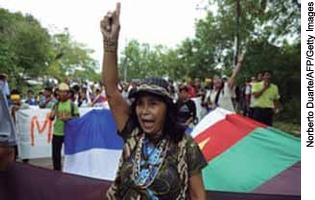
Paraguayan Guaraní — a language descended from several indigenous tongues — remains one of the main languages of 70% of Paraguay’s population.
On a hillside monument in Asunción, a statue of the mythologized indigenous chief Lambaré stands alongside other great leaders from Paraguayan history. The other historical heroes on display are of mixed ancestry, but the idea of a noble indigenous heritage is strong in Paraguay, and — uniquely in the Americas — can be expressed by most of the country’s people in an indigenous language: Paraguayan Guaraní. “Guaraní is our culture — it’s where our roots are,” said Tomasa Cabral, a market vendor in the city.
Elsewhere in the Americas, European colonial languages are pushing native languages towards extinction, but Paraguayan Guaraní — a language descended from several indigenous tongues — remains one of the main languages of 70% of the country’s population. And unlike other widely spoken native tongues — such as Quechua, Aymara or the Mayan languages — it is overwhelmingly spoken by non-indigenous people.
Miguel Verón, a linguist and member of the Academy of the Guaraní Language, said the language had survived partly because of the landlocked country’s geographic isolation and partly because of the “linguistic loyalty” of its people. “The indigenous people refused to learn Spanish,” he said. “The imperial governors had to learn to speak Guaraní.” But while it remains under pressure from Spanish, Paraguayan Guaraní is itself part of the threat looming over the country’s other indigenous languages. Paraguay’s 19 surviving indigenous groups each have their own tongue, but six of them are listed by Unesco as severely or critically endangered.
The benefits of speaking the country’s two official languages were clear. Spanish remains the language of government, and Paraguayan Guaraní is widely spoken in rural areas, where it is a key requisite for many jobs. But the value of maintaining other tongues was incalculable, said Alba Eiragi Duarte, a poet from the Ava Guaraní people. “Our culture is transmitted through our own language: culture is language. When we love our language, we love ourselves.”
(William Costa. www.theguardian.com, 03.09.2020. Adaptado.)
No trecho do segundo parágrafo “And unlike other widely spoken native tongues”, o termo sublinhado expressa
06