


![[Marketing] Questao Topo - deslogado](https://storage.estuda.com.br/banners/0_6b7ebee90b03af1c560c73bb8bcce34a_banner_deslogado_70_dias.png)
Questões de Inglês
19.971 Questões
Questão 30 89601
UEFS Caderno 1 2012/2TEXTO:
We always think “It will never happen to me,” but
disasters can strike, at any time, anywhere — from hotel
fires to train crashes to terrorist attacks. How would you
cope if the unthinkable happened?
5 According to experts, people caught up in disasters
tend to fall into three categories. About 10% to 15%
remain calm and act quickly and efficiently. Another 15%
completely panic, crying and screaming and obstructing
the evacuation. But the vast majority (70%) of people do
10 very little. They are “stunned and confused,” says
psychologist John Leach.
Why is this? Research suggests that under great
stress, our minds take much longer to process
information. So, in a crisis, many people “freeze” just at
15 the moment when they need to act quickly. It also seems
that personality is not a good guide to how people might
react — a normally decisive person may not act quickly
enough in a crisis and vice versa. “Most people go their
entire lives without a disaster,” says Michael Lindell, a
20 professor at Texas A&M University. “So when something
bad happens, they are so shocked they just think, ‘This
can’t possibly be happening to me,’ instead of taking
action.”
OXENDEN, C et Latham-Koenig, C American English File 4B, p. 52 Oxford University Press.
According to the research mentioned in the text, we don’t act as we should when we’re stressed out because our minds
Questão 28 89599
UEFS Caderno 1 2012/2TEXTO:
We always think “It will never happen to me,” but
disasters can strike, at any time, anywhere — from hotel
fires to train crashes to terrorist attacks. How would you
cope if the unthinkable happened?
5 According to experts, people caught up in disasters
tend to fall into three categories. About 10% to 15%
remain calm and act quickly and efficiently. Another 15%
completely panic, crying and screaming and obstructing
the evacuation. But the vast majority (70%) of people do
10 very little. They are “stunned and confused,” says
psychologist John Leach.
Why is this? Research suggests that under great
stress, our minds take much longer to process
information. So, in a crisis, many people “freeze” just at
15 the moment when they need to act quickly. It also seems
that personality is not a good guide to how people might
react — a normally decisive person may not act quickly
enough in a crisis and vice versa. “Most people go their
entire lives without a disaster,” says Michael Lindell, a
20 professor at Texas A&M University. “So when something
bad happens, they are so shocked they just think, ‘This
can’t possibly be happening to me,’ instead of taking
action.”
OXENDEN, C et Latham-Koenig, C American English File 4B, p. 52 Oxford University Press.
It’s stated in the text that, when disasters happen,
Questão 27 89598
UEFS Caderno 1 2012/2TEXTO:
We always think “It will never happen to me,” but
disasters can strike, at any time, anywhere — from hotel
fires to train crashes to terrorist attacks. How would you
cope if the unthinkable happened?
5 According to experts, people caught up in disasters
tend to fall into three categories. About 10% to 15%
remain calm and act quickly and efficiently. Another 15%
completely panic, crying and screaming and obstructing
the evacuation. But the vast majority (70%) of people do
10 very little. They are “stunned and confused,” says
psychologist John Leach.
Why is this? Research suggests that under great
stress, our minds take much longer to process
information. So, in a crisis, many people “freeze” just at
15 the moment when they need to act quickly. It also seems
that personality is not a good guide to how people might
react — a normally decisive person may not act quickly
enough in a crisis and vice versa. “Most people go their
entire lives without a disaster,” says Michael Lindell, a
20 professor at Texas A&M University. “So when something
bad happens, they are so shocked they just think, ‘This
can’t possibly be happening to me,’ instead of taking
action.”
OXENDEN, C et Latham-Koenig, C American English File 4B, p. 52 Oxford University Press.
The alternative that summarizes the main idea of this text is
Questão 25 89596
UEFS Caderno 1 2012/2TEXTO:
Thickening glaciers
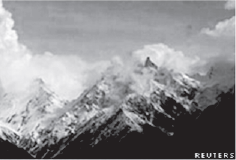
A team of scientists has shown that the glaciers in
one of Asia’s major mountain ranges are defying the
general tendency towards shrinkage, and have in fact
expanded slightly over the last few years. The range in
5 question is the Karakoram, which straddles Pakistan,
India and China on the north-western end of the
Himalayas.
Glacial decline and the gradual loss of polar ice
caps has been a worrying trend over recent decades,
10 but scientists have been aware of an apparently curious
anomaly with the Karakoram, which contains some of
the world’s biggest mountains including the second
highest, K2. It has about 20,000 square kilometers of
glaciers, accounting for three percent of the total area of
15 ice outside the Antarctic and Greenland ice sheets.
Now a team of French scientists has carried out a
detailed survey over a large area of the range using
sophisticated remote-sensing measurements. Writing in
the scientific journal, Nature, they say they found that in
20 the first years of this century the Karakoram’s glaciers
had actually expanded by a small amount, while in the
neighboring Himalayas they’d been shrinking.
It’s unclear why this is happening, but it seems that by
a quirk in the weather pattern that’s not fully understood,
25 less heat is being delivered to the Karakoram and the
mountains are receiving heavier falls of snow.
Thickening glaciers. Disponível em: . Acesso em: 21 jul. 2012.
The only false cognate from the text is in alternative
Questão 24 89595
UEFS Caderno 1 2012/2TEXTO:
Thickening glaciers
A team of scientists has shown that the glaciers in
one of Asia’s major mountain ranges are defying the
general tendency towards shrinkage, and have in fact
expanded slightly over the last few years. The range in
5 question is the Karakoram, which straddles Pakistan,
India and China on the north-western end of the
Himalayas.
Glacial decline and the gradual loss of polar ice
caps has been a worrying trend over recent decades,
10 but scientists have been aware of an apparently curious
anomaly with the Karakoram, which contains some of
the world’s biggest mountains including the second
highest, K2. It has about 20,000 square kilometers of
glaciers, accounting for three percent of the total area of
15 ice outside the Antarctic and Greenland ice sheets.
Now a team of French scientists has carried out a
detailed survey over a large area of the range using
sophisticated remote-sensing measurements. Writing in
the scientific journal, Nature, they say they found that in
20 the first years of this century the Karakoram’s glaciers
had actually expanded by a small amount, while in the
neighboring Himalayas they’d been shrinking.
It’s unclear why this is happening, but it seems that by
a quirk in the weather pattern that’s not fully understood,
25 less heat is being delivered to the Karakoram and the
mountains are receiving heavier falls of snow.
Thickening glaciers. Disponível em: . Acesso em: 21 jul. 2012.
The French scientists involved in the survey mentioned in the text are using
Questão 18 89283
ACAFE Medicina 2012/2The United Nations Conference on Sustainable Development
Published by DSEWPaC - Australian Government (The text below has been slightly modified to better suit the exam)
1. The United Nations Conference on Sustainable Development will take place in Rio de Janeiro, Brazil, from 20 to 22 June 2012. Also referred to as Rio+20, the conference is convened under the authority of the United Nations General Assembly.
2. The Rio+20 Conference is an important step in ongoing international efforts to accelerate progress towards achieving sustainable development globally. The conference will mark the 20th anniversary of the 1992 UN Conference on Environment and Development in Rio de Janeiro (the Earth Summit).
3. It will also mark the 10th anniversary of the 2002 World Summit on Sustainable Development in Johannesburg.
4. The 1992 and 2002 summits were headline international events ____ key drivers of the sustainable development agenda. Similarly, Rio+20 presents an opportunity ____ re-direct and re-energise political commitment ____ the three pillars ____ sustainable development: economic growth, social improvement and environmental protection.
5. The objectives of the Rio+20 Conference are to:
• secure renewed political commitment to sustainable development
• assess the progress to date and the remaining gaps in the implementation of the outcomes of the major summits on sustainable development
• address new and emerging challenges.
6. The conference will focus on two themes:
• a green economy in the context of sustainable development and poverty eradication
• the institutional framework for sustainable development
7. It is expected that tens of thousands of people will be involved in the Rio+20 Conference and the many related side events, including heads of state and senior representatives from nongovernmental organisations from around the world.
What do secure, assess and address have in common as they appear in the fifth paragraph of the text?
06