


![[Marketing] Questao Topo - deslogado](https://storage.estuda.com.br/banners/0_6b7ebee90b03af1c560c73bb8bcce34a_banner_deslogado_70_dias.png)
Questões de Inglês
19.971 Questões
Questão 27 174432
UEL 2° Fase 2012
Phonetic Clues Hint Language Is Africa-Born
A researcher analyzing the sounds in languages spoken around the world has detected an ancient signal that points to southern Africa as the place where modern human language originated.
The finding fits well with the evidence from fossil skulls and DNA that modern humans originated in Africa. It also implies, though does not prove, that modern language originated only once, an issue of considerable controversy among linguists.
The detection of such an ancient signal in language is surprising. Because words change so rapidly, many linguists think that languages cannot be traced very far back in time. The oldest language tree so far reconstructed, that of the Indo-European family, which includes English, goes back 9,000 years at most.
Quentin D. Atkinson, a biologist at the University of Auckland in New Zealand, has shattered this time barrier, if his claim is correct, by looking not at words but at phonemes - the consonants, vowels and tones that are the simplest elements of language. Dr. Atkinson has found a simple but striking pattern in some 500 languages spoken throughout the world: a language area uses fewer phonemes the farther that early humans had to travel from Africa to reach it
(Adaptado de: . Acesso em: 1 ago. 2011.)
Na frase: “It also implies, though does not prove, that modern language originated only once, an issue of considerable controversy among linguists.” (2º parágrafo), though indica:
Questão 25 174427
UEL 2° Fase 2012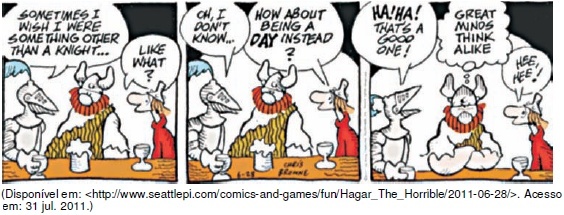
As palavras like e alike, utilizadas na tirinha, referem-se respectivamente a
Questão 24 174425
UEL 2° Fase 2012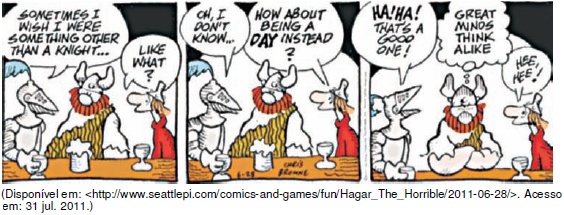
A comicidade da tirinha reside
I. no fato de Hagar (ao centro) sentir-se intelectualmente inferior a seus companheiros.
II. no conflito existente entre a nobreza do cavaleiro e a rudeza dos vikings.
III. na semelhança sonora existente entre duas palavras da língua inglesa.
IV. na conclusão de Hagar sobre a tolice dos personagens que o rodeiam.
Assinale a alternativa CORRETA.
Questão 40 161489
PUC-PR Inverno 2012The anti-social network: avoiding online darkness
By Michael Millar Business reporter, BBC News
A 75-year-old Georgian woman who says she has never even heard of the internet is facing a possible prison sentence for single-handedly cutting off the web to an entire country. Georgian police arrested Hayastan Shakarian after she allegedly hacked through a fibre optic cable that runs through Georgia to Armenia, while digging for copper.
With one stroke, the pensioner plunged 90% of internet users in Armenia into online darkness for nearly 12 hours.
The episode is a timely reminder that all it takes in our hi-tech world to shut down thousands of companies for a day is a determined old lady with a spade. Research carried out in October 2010 by Avanti Communications offered a snapshot of just how fundamental the internet had become to businesses. The survey of companies worldwide suggested only 1% could function adequately without the internet.More than a quarter (27%) of those surveyed said they could not function at all if the internet went down, and one in five said a week without being online would be the death of their company. Some solutions on offer are quite straightforward. One network provider, Geo, runs all its cable through the Victorian sewers in London. This solves one of the major problems that makes telecoms lines in many countries susceptible to being cut - they are laid on top of utility pipes. Not only does this mean they are mere centimetres under the ground - but whenever repairs are done to utilities, the workmen have to get past the fibre optic wires first, meaning inevitable incidences of cuts. Other technologies on offer to providers - which will in turn help their customer stay connected - are mindboggling. For example, a company called OptaSense offers to stop potential breaks in service by listening to any threats as they approach.Using advanced sonar techniques, the company converts the fibre optic cable carrying the precious internet signal into an acoustic microphone.It can then tell the network provider exactly what is getting too close for comfort - be it a vehicle, human footsteps, digging or drilling. Avanti Communications is one of a handful of companies that offer 24-hour instantaneous back-up via a dedicated satellite.It launched its first satellite in November, which covers Europe, and plans to launch one covering the Middle East and India next year. Chief executive David Williams says satellite technology will play an ever more important role in communications networks. "Fibre optic cable costs around £150 per metre to dig, so building cable networks is incredibly expensive," he says."But one satellite can cover the whole of Europe - so wherever you are, it can get to you."
The future of networks is causing sleepless nights for IT professionals and policy makers alike.
The appetite for data across the globe is growing at an extraordinary rate and is putting an immense strain on the system. "A lot of the basis of the internet today was invented 30 years ago," says Tim Fritzley, InTune Networks chief executive. "In the 90's when people were envisioning the first part of the web even the most optimistic ones never saw anything like social networking." "They didn't see 10% of what is going on now," he says. InTune is working with the Irish government to vastly increase network capability worldwide by enabling a single strand of fibre to carry not just one signal from one operator, but data from up to 80 telecoms and TV companies at once. Developers are working furiously to make sure our increasing hunger for data does not mean a collapse of the system. But whether this will protect users from marauding pensioners looking for copper remains to be seen.
Adapted from http://www.bbc.co.uk/, 21 April 2011.
In English many words are formed by suffixation. In grammar, a suffix (also postfix, ending) is an affix which is placed at the end of a word. Suffixes can carry grammatical information (inflectional suffixes), or lexical information (derivational suffixes).
Source: http://www.slideshare.net/.
The word sleepless in the sentence “The future of networks is causing sleepless nights for IT professionals...” from the text is an example of a word formed by suffixation.
Select the word that is not formed by suffixation:
Questão 19 157475
CESGRANRIO 2012Text II
Discover Magazine: Environment 10 Things You Didn’t Know About...Fire
by Lee Aundra Keany From the October 2011 issue; published online October 7, 2011
1 - Fire is an event, not a thing. Heating wood
or other fuel, releases volatile vapors that can
rapidly combust with oxygen in the air; the resulting
incandescent bloom of gas further heats the fuel,
releasing more vapors and perpetuating the cycle.
2 - Most of the fuels we use derive their energy
from trapped solar rays. In photosynthesis, sunlight
and heat yield chemical energy (in the form of wood
or fossil fuel). Contrastingly, fire uses chemical energy
to produce light and heat.
3 - Assuming stable fuel, heat, and oxygen
levels, a default house fire will double in size at every
minute.
4 - Earth is the only known planet where fire can
burn. Everywhere else: scarce oxygen.
5 - Spontaneous combustion is real. Some fuel
sources can generate their own heat—by rotting, for
instance. Pistachios have so much natural oil and are
so prone to heat-generating fat decomposition that
the International Maritime Dangerous Goods Code
regards them as dangerous.
6 - Oxygen supply influences the color of
the flame. A low-oxygen fire is made up of lots of
uncombusted fuel particles and will give off a yellow
glow. A high-oxygen fire sets off a blue flame. So
candle flames are blue at the bottom because that’s
where they take up fresh air, and yellow at the top
because the rising fumes from below cut down on the
oxygen supply from the upper part of the flame.
7 - Fire can make water. Place a cold spoon
over a candle and you will observe the water vapor
condense on the metal. This is because like most
organic materials, including wood and gasoline,
candle wax contains hydrogen, which bonds with
oxygen and amounts to H2O when it burns.
8 - We’ve been at this a long time: Charred
bones and wood ash indicate that early hominids were
tending the first intentional fires more than 400,000
years ago.
9 - Nature’s been at it awhile, too. A coal seam
about 140 miles north of Sydney, Australia, has been
burning by some estimates for 500,000 years.
10 - A good burn in history: The 1666 Great Fire
of London destroyed 80 percent of the city but also
ended an outbreak of bubonic plague that had killed
more than 65,000 people the previous year. The fire
fried the rats and fleas that carried Yersinia pestis, the
plague-causing bacterium.
Available at <http://ad.doubleclick.net/jump/site125. tmus/environment;tile=2;sz=123x32;ord=123456789?” target=”_blank”> Retrieved on: Dec. 02, 2011. Adapted.
In Text II, the word in parentheses describes the idea expressed by the expressions in
Questão 17 157471
CESGRANRIO 2012Text II
Discover Magazine: Environment 10 Things You Didn’t Know About...Fire
by Lee Aundra Keany From the October 2011 issue; published online October 7, 2011
1 - Fire is an event, not a thing. Heating wood
or other fuel, releases volatile vapors that can
rapidly combust with oxygen in the air; the resulting
incandescent bloom of gas further heats the fuel,
releasing more vapors and perpetuating the cycle.
2 - Most of the fuels we use derive their energy
from trapped solar rays. In photosynthesis, sunlight
and heat yield chemical energy (in the form of wood
or fossil fuel). Contrastingly, fire uses chemical energy
to produce light and heat.
3 - Assuming stable fuel, heat, and oxygen
levels, a default house fire will double in size at every
minute.
4 - Earth is the only known planet where fire can
burn. Everywhere else: scarce oxygen.
5 - Spontaneous combustion is real. Some fuel
sources can generate their own heat—by rotting, for
instance. Pistachios have so much natural oil and are
so prone to heat-generating fat decomposition that
the International Maritime Dangerous Goods Code
regards them as dangerous.
6 - Oxygen supply influences the color of
the flame. A low-oxygen fire is made up of lots of
uncombusted fuel particles and will give off a yellow
glow. A high-oxygen fire sets off a blue flame. So
candle flames are blue at the bottom because that’s
where they take up fresh air, and yellow at the top
because the rising fumes from below cut down on the
oxygen supply from the upper part of the flame.
7 - Fire can make water. Place a cold spoon
over a candle and you will observe the water vapor
condense on the metal. This is because like most
organic materials, including wood and gasoline,
candle wax contains hydrogen, which bonds with
oxygen and amounts to H2O when it burns.
8 - We’ve been at this a long time: Charred
bones and wood ash indicate that early hominids were
tending the first intentional fires more than 400,000
years ago.
9 - Nature’s been at it awhile, too. A coal seam
about 140 miles north of Sydney, Australia, has been
burning by some estimates for 500,000 years.
10 - A good burn in history: The 1666 Great Fire
of London destroyed 80 percent of the city but also
ended an outbreak of bubonic plague that had killed
more than 65,000 people the previous year. The fire
fried the rats and fleas that carried Yersinia pestis, the
plague-causing bacterium.
Available at <http://ad.doubleclick.net/jump/site125. tmus/environment;tile=2;sz=123x32;ord=123456789?” target=”_blank”> Retrieved on: Dec. 02, 2011. Adapted.
In Text II, the word in parentheses describes the idea expressed by the word in bold-face type in
06