


![[Marketing] Questao Topo - deslogado](https://storage.estuda.com.br/banners/0_6b7ebee90b03af1c560c73bb8bcce34a_banner_deslogado_70_dias.png)
Questões de Inglês
19.971 Questões
Questão 39 238389
UESB Caderno 1 2012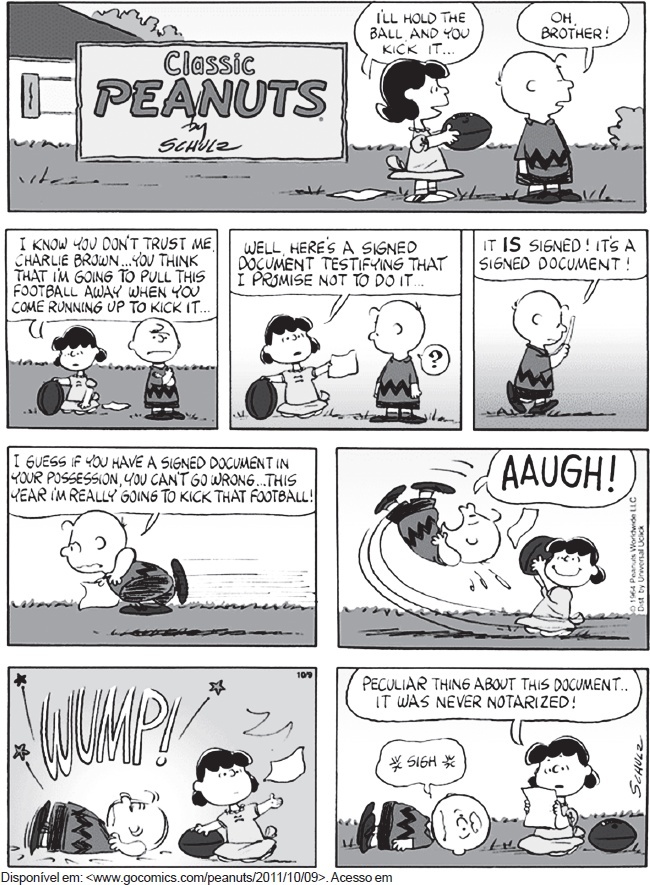
“It was never notarized!” (8th picture)
This sentence means that the document
Questão 38 238388
UESB Caderno 1 2012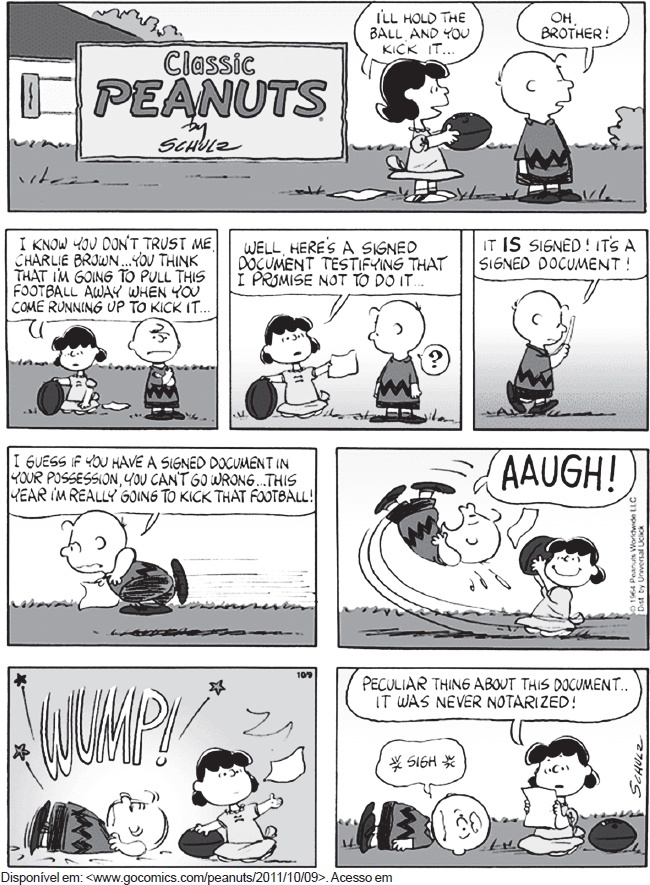
The suitable adjective to describe the girl in this comic strip is
Questão 37 238387
UESB Caderno 1 2012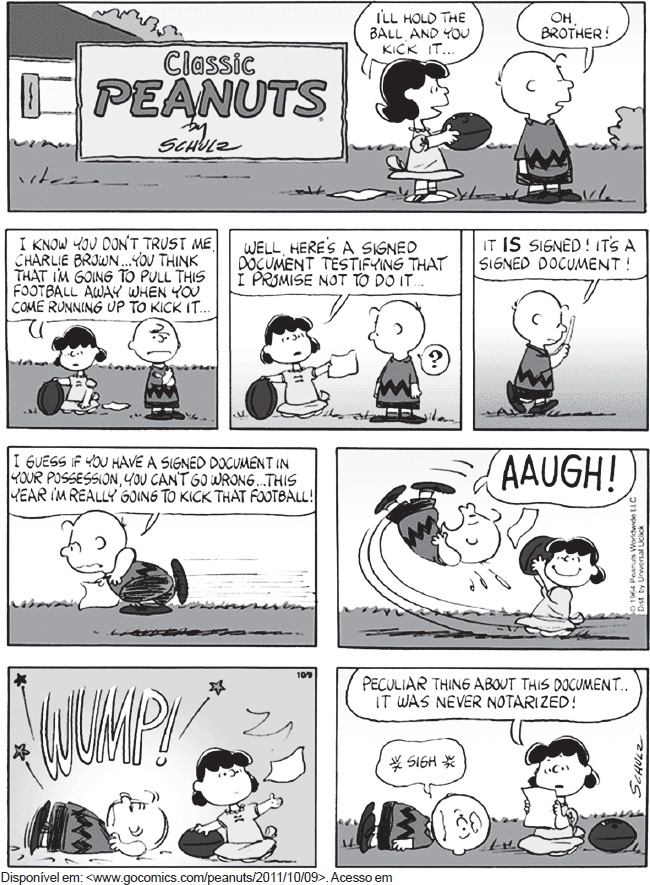
Fill in the parentheses with T (True) or F (False).
Based on the cartoon, it’s correct to say:
( ) So far, the boy has never managed to kick that football.
( ) This isn’t the first time the girl has dared the boy to kick the ball.
( ) The boy doesn’t seem to trust signed documents.
( ) The girl is making fun of the boy.
According to the comic strip, the correct sequence, from top to bottom, is
Questão 36 238382
UESB Caderno 1 2012TEXTO:
Higher Learning
For more than two decades, as the cost of college has climbed at twice the rate of inflation, critics have argued that
bloated bureaucracies, overpaid faculty, and unnecessary amenities are inflating tuition. Yet in a new book — Why Does
College Cost So Much? — economists Robert Archibald and David Feldman argue that college isn’t actually overpriced.
The reason: although the total cost of attending an in-state, four-year public university has nearly doubled
[5] to $16,140 since 2000, the benefits that come with it have increased considerably, too. Indeed, over the same period of
time, the difference in wages between those who attend college and those who don’t has climbed by 20 percent.
Yet in the aftermath of the recession, a more important question is who’s losing out in the process? Even though aid
packages have risen by more than 50 percent since 2000, one recent study found that college enrollment could fall by 3.6
percent due to the housing crisis, which has made it harder for families to finance their children’s education.
[10] “The prices are rising precisely at the time when minorities and lower-income families are having the most trouble
meeting costs,” says Rucker Johnson, a professor of public policy at the University of California, Berkeley. In other words,
college may still be a good deal, but its price is rising at a time when fewer people can afford it.
By Joel Schectman. Higher Learning. Newsweek, December 6, 2010, p. 12.
Considering language use in the text, it’s correct to say:
Questão 35 238379
UESB Caderno 1 2012TEXTO:
Higher Learning
For more than two decades, as the cost of college has climbed at twice the rate of inflation, critics have argued that
bloated bureaucracies, overpaid faculty, and unnecessary amenities are inflating tuition. Yet in a new book — Why Does
College Cost So Much? — economists Robert Archibald and David Feldman argue that college isn’t actually overpriced.
The reason: although the total cost of attending an in-state, four-year public university has nearly doubled
[5] to $16,140 since 2000, the benefits that come with it have increased considerably, too. Indeed, over the same period of
time, the difference in wages between those who attend college and those who don’t has climbed by 20 percent.
Yet in the aftermath of the recession, a more important question is who’s losing out in the process? Even though aid
packages have risen by more than 50 percent since 2000, one recent study found that college enrollment could fall by 3.6
percent due to the housing crisis, which has made it harder for families to finance their children’s education.
[10] “The prices are rising precisely at the time when minorities and lower-income families are having the most trouble
meeting costs,” says Rucker Johnson, a professor of public policy at the University of California, Berkeley. In other words,
college may still be a good deal, but its price is rising at a time when fewer people can afford it.
By Joel Schectman. Higher Learning. Newsweek, December 6, 2010, p. 12.
The only false cognate is in alternative
Questão 34 238378
UESB Caderno 1 2012TEXTO:
Higher Learning
For more than two decades, as the cost of college has climbed at twice the rate of inflation, critics have argued that
bloated bureaucracies, overpaid faculty, and unnecessary amenities are inflating tuition. Yet in a new book — Why Does
College Cost So Much? — economists Robert Archibald and David Feldman argue that college isn’t actually overpriced.
The reason: although the total cost of attending an in-state, four-year public university has nearly doubled
[5] to $16,140 since 2000, the benefits that come with it have increased considerably, too. Indeed, over the same period of
time, the difference in wages between those who attend college and those who don’t has climbed by 20 percent.
Yet in the aftermath of the recession, a more important question is who’s losing out in the process? Even though aid
packages have risen by more than 50 percent since 2000, one recent study found that college enrollment could fall by 3.6
percent due to the housing crisis, which has made it harder for families to finance their children’s education.
[10] “The prices are rising precisely at the time when minorities and lower-income families are having the most trouble
meeting costs,” says Rucker Johnson, a professor of public policy at the University of California, Berkeley. In other words,
college may still be a good deal, but its price is rising at a time when fewer people can afford it.
By Joel Schectman. Higher Learning. Newsweek, December 6, 2010, p. 12.
About “although” (l. 4) and “Even though” (l. 7), it’s correct to say that they
06