


![[Marketing] Questao Topo - deslogado](https://storage.estuda.com.br/banners/0_6b7ebee90b03af1c560c73bb8bcce34a_banner_deslogado_70_dias.png)
Questões de Inglês
19.971 Questões
Questão 15 311608
UFVJM 2012/2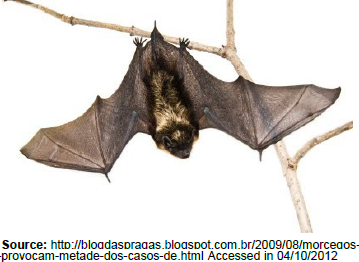
[1] Culling vampire bats in South American nations does not curb the spread of rabies, in fact it
could actually be counterproductive, a study suggests. Until now, it had been assumed that controlling
bat numbers would, in turn, control the spread of the rabies virus. Researchers say rabies is found in
most bat populations, but vampire bats - which feed on mammals' blood - are responsible for most
[5] infections."We found that rabies is there no matter what," said co-author Daniel Streicker, an ecologist
at the University of Georgia, US."The size of the bat colony didn't predict the proportion of bats that
were exposed to the virus."That's important because if there is no relationship between bat population
density and rabies, then reducing the bat population won't reduce rabies transmission within bats."
For about three decades, the main focus in Peru to halt the spread of the virus - which is
[10] transmitted from animals to humans or livestock, and results in death if left untreated - has been to
cull common vampire bats (Desmodus rotundus) using poisons, or even explosives. The researchers,
writing in their paper, explained that the data they collected over a 40-month period from 20 sampling
sites revealed that culling was not having the desired effect. In fact, Dr Streicker explained, the
findings suggested that culling had a potentially counterproductive impact."In areas that were
[15] sporadically culled during the course of the study, we saw an increase in the proportion of bats
exposed to rabies," he said. Colonies that were frequently culled had slightly lower rates, the study
showed, yet the ones that had never been culled had the lowest rates of all. It is suggested that
increasing levels of human encroachment into areas with vampire bat populations has exacerbated
the problem. Dr Streicker and the team said the study would continue for another two years, with the
[20] goal of developing a scientific-based solution. The researchers hope the findings will help deliver a
more effective method to protect public health and agricultural interests from the virus.
Source: http://www.bbc.co.uk/news/science-environment-18408660 Accessed in June 2012.
Glossary:
• Curb: conter, frear
• Cull:abater
• Researchers: pesquisadores
• Spread: disseminação, avanço
• Rabies: raiva
• Livestock: gado
• Poisons: venenos
• Encroachment: invasão
• Halt: parar, deter
• Sampling: amostra
• Increase: aumento
• Slightly: ligeiramente, levemente
• Low: baixo
• Goal: meta
The study revealed that
Questão 14 311607
UFVJM 2012/2
[1] Culling vampire bats in South American nations does not curb the spread of rabies, in fact it
could actually be counterproductive, a study suggests. Until now, it had been assumed that controlling
bat numbers would, in turn, control the spread of the rabies virus. Researchers say rabies is found in
most bat populations, but vampire bats - which feed on mammals' blood - are responsible for most
[5] infections."We found that rabies is there no matter what," said co-author Daniel Streicker, an ecologist
at the University of Georgia, US."The size of the bat colony didn't predict the proportion of bats that
were exposed to the virus."That's important because if there is no relationship between bat population
density and rabies, then reducing the bat population won't reduce rabies transmission within bats."
For about three decades, the main focus in Peru to halt the spread of the virus - which is
[10] transmitted from animals to humans or livestock, and results in death if left untreated - has been to
cull common vampire bats (Desmodus rotundus) using poisons, or even explosives. The researchers,
writing in their paper, explained that the data they collected over a 40-month period from 20 sampling
sites revealed that culling was not having the desired effect. In fact, Dr Streicker explained, the
findings suggested that culling had a potentially counterproductive impact."In areas that were
[15] sporadically culled during the course of the study, we saw an increase in the proportion of bats
exposed to rabies," he said. Colonies that were frequently culled had slightly lower rates, the study
showed, yet the ones that had never been culled had the lowest rates of all. It is suggested that
increasing levels of human encroachment into areas with vampire bat populations has exacerbated
the problem. Dr Streicker and the team said the study would continue for another two years, with the
[20] goal of developing a scientific-based solution. The researchers hope the findings will help deliver a
more effective method to protect public health and agricultural interests from the virus.
Source: http://www.bbc.co.uk/news/science-environment-18408660 Accessed in June 2012.
Glossary:
• Curb: conter, frear
• Cull:abater
• Researchers: pesquisadores
• Spread: disseminação, avanço
• Rabies: raiva
• Livestock: gado
• Poisons: venenos
• Encroachment: invasão
• Halt: parar, deter
• Sampling: amostra
• Increase: aumento
• Slightly: ligeiramente, levemente
• Low: baixo
• Goal: meta
The word “they” in line 12 refers to
Questão 13 311606
UFVJM 2012/2
[1] Culling vampire bats in South American nations does not curb the spread of rabies, in fact it
could actually be counterproductive, a study suggests. Until now, it had been assumed that controlling
bat numbers would, in turn, control the spread of the rabies virus. Researchers say rabies is found in
most bat populations, but vampire bats - which feed on mammals' blood - are responsible for most
[5] infections."We found that rabies is there no matter what," said co-author Daniel Streicker, an ecologist
at the University of Georgia, US."The size of the bat colony didn't predict the proportion of bats that
were exposed to the virus."That's important because if there is no relationship between bat population
density and rabies, then reducing the bat population won't reduce rabies transmission within bats."
For about three decades, the main focus in Peru to halt the spread of the virus - which is
[10] transmitted from animals to humans or livestock, and results in death if left untreated - has been to
cull common vampire bats (Desmodus rotundus) using poisons, or even explosives. The researchers,
writing in their paper, explained that the data they collected over a 40-month period from 20 sampling
sites revealed that culling was not having the desired effect. In fact, Dr Streicker explained, the
findings suggested that culling had a potentially counterproductive impact."In areas that were
[15] sporadically culled during the course of the study, we saw an increase in the proportion of bats
exposed to rabies," he said. Colonies that were frequently culled had slightly lower rates, the study
showed, yet the ones that had never been culled had the lowest rates of all. It is suggested that
increasing levels of human encroachment into areas with vampire bat populations has exacerbated
the problem. Dr Streicker and the team said the study would continue for another two years, with the
[20] goal of developing a scientific-based solution. The researchers hope the findings will help deliver a
more effective method to protect public health and agricultural interests from the virus.
Source: http://www.bbc.co.uk/news/science-environment-18408660 Accessed in June 2012.
Glossary:
• Curb: conter, frear
• Cull:abater
• Researchers: pesquisadores
• Spread: disseminação, avanço
• Rabies: raiva
• Livestock: gado
• Poisons: venenos
• Encroachment: invasão
• Halt: parar, deter
• Sampling: amostra
• Increase: aumento
• Slightly: ligeiramente, levemente
• Low: baixo
• Goal: meta
According to the text, the researchers want to
Questão 12 311605
UFVJM 2012/2
[1] Culling vampire bats in South American nations does not curb the spread of rabies, in fact it
could actually be counterproductive, a study suggests. Until now, it had been assumed that controlling
bat numbers would, in turn, control the spread of the rabies virus. Researchers say rabies is found in
most bat populations, but vampire bats - which feed on mammals' blood - are responsible for most
[5] infections."We found that rabies is there no matter what," said co-author Daniel Streicker, an ecologist
at the University of Georgia, US."The size of the bat colony didn't predict the proportion of bats that
were exposed to the virus."That's important because if there is no relationship between bat population
density and rabies, then reducing the bat population won't reduce rabies transmission within bats."
For about three decades, the main focus in Peru to halt the spread of the virus - which is
[10] transmitted from animals to humans or livestock, and results in death if left untreated - has been to
cull common vampire bats (Desmodus rotundus) using poisons, or even explosives. The researchers,
writing in their paper, explained that the data they collected over a 40-month period from 20 sampling
sites revealed that culling was not having the desired effect. In fact, Dr Streicker explained, the
findings suggested that culling had a potentially counterproductive impact."In areas that were
[15] sporadically culled during the course of the study, we saw an increase in the proportion of bats
exposed to rabies," he said. Colonies that were frequently culled had slightly lower rates, the study
showed, yet the ones that had never been culled had the lowest rates of all. It is suggested that
increasing levels of human encroachment into areas with vampire bat populations has exacerbated
the problem. Dr Streicker and the team said the study would continue for another two years, with the
[20] goal of developing a scientific-based solution. The researchers hope the findings will help deliver a
more effective method to protect public health and agricultural interests from the virus.
Source: http://www.bbc.co.uk/news/science-environment-18408660 Accessed in June 2012.
Glossary:
• Curb: conter, frear
• Cull:abater
• Researchers: pesquisadores
• Spread: disseminação, avanço
• Rabies: raiva
• Livestock: gado
• Poisons: venenos
• Encroachment: invasão
• Halt: parar, deter
• Sampling: amostra
• Increase: aumento
• Slightly: ligeiramente, levemente
• Low: baixo
• Goal: meta
The word “yet” in line 17 can be best replaced by
Questão 11 311602
UFVJM 2012/2
[1] Culling vampire bats in South American nations does not curb the spread of rabies, in fact it
could actually be counterproductive, a study suggests. Until now, it had been assumed that controlling
bat numbers would, in turn, control the spread of the rabies virus. Researchers say rabies is found in
most bat populations, but vampire bats - which feed on mammals' blood - are responsible for most
[5] infections."We found that rabies is there no matter what," said co-author Daniel Streicker, an ecologist
at the University of Georgia, US."The size of the bat colony didn't predict the proportion of bats that
were exposed to the virus."That's important because if there is no relationship between bat population
density and rabies, then reducing the bat population won't reduce rabies transmission within bats."
For about three decades, the main focus in Peru to halt the spread of the virus - which is
[10] transmitted from animals to humans or livestock, and results in death if left untreated - has been to
cull common vampire bats (Desmodus rotundus) using poisons, or even explosives. The researchers,
writing in their paper, explained that the data they collected over a 40-month period from 20 sampling
sites revealed that culling was not having the desired effect. In fact, Dr Streicker explained, the
findings suggested that culling had a potentially counterproductive impact."In areas that were
[15] sporadically culled during the course of the study, we saw an increase in the proportion of bats
exposed to rabies," he said. Colonies that were frequently culled had slightly lower rates, the study
showed, yet the ones that had never been culled had the lowest rates of all. It is suggested that
increasing levels of human encroachment into areas with vampire bat populations has exacerbated
the problem. Dr Streicker and the team said the study would continue for another two years, with the
[20] goal of developing a scientific-based solution. The researchers hope the findings will help deliver a
more effective method to protect public health and agricultural interests from the virus.
Source: http://www.bbc.co.uk/news/science-environment-18408660 Accessed in June 2012.
Glossary:
• Curb: conter, frear
• Cull:abater
• Researchers: pesquisadores
• Spread: disseminação, avanço
• Rabies: raiva
• Livestock: gado
• Poisons: venenos
• Encroachment: invasão
• Halt: parar, deter
• Sampling: amostra
• Increase: aumento
• Slightly: ligeiramente, levemente
• Low: baixo
• Goal: meta
The study mentioned in the text is mainly about
Questão 71 300927
UFRR Módulo 3 2012
Despite the growing catalog of extrasolar planets, data so far do not alter estimates that we are effectively on our own
Howard A. Smith
There has often been the assumption, even amongst astrophysicists, that because the universe is infinitely large, there must be somewhere else in it a planet with conditions hospitable to intelligent life. Recent surveys locating a number of extrasolar planets may seem to bolster this conclusion. The author, however, argues that the new data only reinforces the conclusion that humans are alone in the universe, at least for all practical purposes. Smith points out that even if we were to wait for signals that would not reach us for 100 human generations, we still would not be able to detect any messages from farther than 1,250 light-years away, a relatively small pocket of the universe. He goes on to extrapolate from available data on extrasolar planets to conclude that the number of even vaguely suitable stars with possible habitable planets within that distance is slight-and even then, the chances of life evolving to intelligence are much slimmer. He concludes by considering how humans should respond to the idea that even if there is intelligent life somewhere out there, we'll likely never know about it.
(http://www.americanscientist.org/issues/feature/ZO1 1/4/ alone-in-the- universe)
In the last sentence, the underlined word in “we'll likely never know about it.” indicates:
06