


![[Marketing] Questao Topo - deslogado](https://storage.estuda.com.br/banners/0_6b7ebee90b03af1c560c73bb8bcce34a_banner_deslogado_70_dias.png)
Questões de Inglês
19.971 Questões
Questão 31 696528
UNCISAL 1° Dia 2012
De acordo com a tira acima, o garoto
Questão 50 602956
UCPEL Inverno 2012Leia o texto e responda a pergunta.
[1] HOW MEN AND WOMEN MANAGE THEIR SOCIAL NETWORKS DIFFERENTLY
[2] A new study of online behavior reveals that men and women organize their social networks very differently.
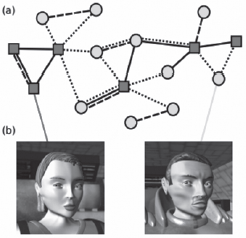
[3] One of the interesting insights that social networks offer is the
[4] difference between male and female behaviour.
[5] In the past, behavioural differences have been hard to measure.
[6] Experiments could only be done on limited numbers of
[7] individuals and even then, the process of measurement often
[8] distorted people’s behaviour.
[9] That’s all changed with the advent of massive online
[10] participation in gaming, professional and friendship networks.
[11] For the first time, it has become possible to quantify exactly
[12] how the genders differ in their approach to things like risk and
[13] communication.
[14] Earlier this year, for example, we looked at a remarkable study
[15] of a mobile phone network that demonstrated the different
[16] reproductive strategies that men and women employ throughout
[17] their lives, as revealed by how often they call friends, family and potential mates.
[18] Today, Michael Szell and Stefan Thurner at the Medical University of Vienna in Austria say they’ve found significant
[19] differences in the way men and women manage their social networks in an online game called Pardus with over
[20] 300,000 players. In this game, players explore various solar systems in a virtual universe. On the way, they can
[21] mark other players as friends or enemies, exchange messages, gain wealth by trading or doing battle but can also
[22] be killed.
[23] The interesting thing about online games is that almost every action of every player is recorded, mostly without the
[24] players being consciously aware of this. That means measurement bias is minimal.
[25] The networks of friends and enemies that are set up also differ in an important way from those on social networking
[26] sites such as Facebook. That’s because players can neither see nor influence other players’ networks. This prevents
[27] the kind of clustering and herding behaviour that sometimes dominates other social networks.
[28] Szell and Thurner say the data reveals clear and significant differences between men and women in Pardus. For
[29] example, men and women interact with the opposite sex differently. ”Males reciprocate friendship requests from
[30] females faster than vice versa and hesitate to reciprocate hostile actions of females,” say Szell and Thurner. Women
[31] are also significantly more risk averse than men as measured by the amount of fighting they engage in and their
[32] likelihood of dying. They are also more likely to be friends with each other than men.
[33] These results are more or less as expected. More surprising is the finding that women tend to be more wealthy than
[34] men, probably because they engage more in economic than destructive behaviour.
[35] One obvious problem is that of gender swapping: men who play as women and vice versa. Szell and Thurner say that
[36] other studies have shown that around ten per cent of online gaming populations engage in gender swapping. They
[37] say there’s no reason to think this would be any different in Pardus and that it shouldn’t affect the results.
[38] A more serious problem could be the well known phenomenon that women tend to receive better treatment in maledominated
[39] online gaming communities. Indeed, Szell and Thurner say they can see evidence of this in their data.
[40] That’s something they’ll need to look into in more detail.
Technology Review published by MIT, 23/05/2012
Adapted from http://www.technologyreview.com/blog/arxiv/27870/
O pronome “They” destacado na linha 36 refere-se a
Questão 47 602947
UCPEL Inverno 2012Leia o texto e responda a pergunta.
[1] HOW MEN AND WOMEN MANAGE THEIR SOCIAL NETWORKS DIFFERENTLY
[2] A new study of online behavior reveals that men and women organize their social networks very differently.
[3] One of the interesting insights that social networks offer is the
[4] difference between male and female behaviour.
[5] In the past, behavioural differences have been hard to measure.
[6] Experiments could only be done on limited numbers of
[7] individuals and even then, the process of measurement often
[8] distorted people’s behaviour.
[9] That’s all changed with the advent of massive online
[10] participation in gaming, professional and friendship networks.
[11] For the first time, it has become possible to quantify exactly
[12] how the genders differ in their approach to things like risk and
[13] communication.
[14] Earlier this year, for example, we looked at a remarkable study
[15] of a mobile phone network that demonstrated the different
[16] reproductive strategies that men and women employ throughout
[17] their lives, as revealed by how often they call friends, family and potential mates.
[18] Today, Michael Szell and Stefan Thurner at the Medical University of Vienna in Austria say they’ve found significant
[19] differences in the way men and women manage their social networks in an online game called Pardus with over
[20] 300,000 players. In this game, players explore various solar systems in a virtual universe. On the way, they can
[21] mark other players as friends or enemies, exchange messages, gain wealth by trading or doing battle but can also
[22] be killed.
[23] The interesting thing about online games is that almost every action of every player is recorded, mostly without the
[24] players being consciously aware of this. That means measurement bias is minimal.
[25] The networks of friends and enemies that are set up also differ in an important way from those on social networking
[26] sites such as Facebook. That’s because players can neither see nor influence other players’ networks. This prevents
[27] the kind of clustering and herding behaviour that sometimes dominates other social networks.
[28] Szell and Thurner say the data reveals clear and significant differences between men and women in Pardus. For
[29] example, men and women interact with the opposite sex differently. ”Males reciprocate friendship requests from
[30] females faster than vice versa and hesitate to reciprocate hostile actions of females,” say Szell and Thurner. Women
[31] are also significantly more risk averse than men as measured by the amount of fighting they engage in and their
[32] likelihood of dying. They are also more likely to be friends with each other than men.
[33] These results are more or less as expected. More surprising is the finding that women tend to be more wealthy than
[34] men, probably because they engage more in economic than destructive behaviour.
[35] One obvious problem is that of gender swapping: men who play as women and vice versa. Szell and Thurner say that
[36] other studies have shown that around ten per cent of online gaming populations engage in gender swapping. They
[37] say there’s no reason to think this would be any different in Pardus and that it shouldn’t affect the results.
[38] A more serious problem could be the well known phenomenon that women tend to receive better treatment in maledominated
[39] online gaming communities. Indeed, Szell and Thurner say they can see evidence of this in their data.
[40] That’s something they’ll need to look into in more detail.
Technology Review published by MIT, 23/05/2012
Adapted from http://www.technologyreview.com/blog/arxiv/27870/
De acordo com o artigo, Pardus é:
Questão 50 602525
UCPEL Verão 2012Leia o texto e responda a pergunta.
[1] SMASHING THE CUBICLES
[2] By designing new spaces around tablets, smart phones, and social technologies, companies can operate with far
[3] fewer desks.

[4] The quick expansion of social and mobile
[5] technologies is creating a widely distributed
[6] workforce. To better suit employees who come into
[7] offices more sporadically, some companies and
[8] design firms are testing radically new and more
[9] efficient configurations for physical offices, betting
[10] that improved technology will make the experiment
[11] more successful than similar ones in the 1990s.
[12] A project at the headquarters of Cisco Systems in
[13] San Jose, California, for example, overthrows
[14] decades-old conventions about office space.
[15] Called Connected Workplace, it replaces
[16] individual cubicles with open clusters of wheeled
[17] desks that belong to groups, not individuals; personal belongings are largely confined to lockers.
[18] There are no PCs at the desks, because employees use mobile technologies. Rick Hutley, a Cisco vice president,
[19] chooses his desk according to which colleagues are present and what’s on the day’s agenda. Then he docks his
[20] tablet to a desktop port that includes a phone handset. The tablet handles voice and video calls whether it’s docked
[21] or mobile, and it can be used to share documents at meetings.
[22] It can also be plugged into a monitor and keyboard to be used like a full PC. “You can walk around with your entire
[23] world with you in this device,” Hutley says. “My laptop would often stay on my desk, but the tablet never does.” If he
[24] needs to make a private voice or video call, he can step into one of the rooms at the edges of the cluster.
[25] Cisco’s vision is an example of a broader effort to reshape office technologies and environments. “We used to have
[26] boring stuff at work and more interesting technology at home,” says Prith Banerjee, leader of Hewlett-Packard’s
[27] research arm. “Now office technology will make use of the same cool experiences and interfaces.”
[28] Such changes could save a lot of money. Cisco’s project, for example, was launched after an internal study found
[29] that cubicles were vacant two-thirds of the time while people roamed the campus or worked remotely. Company
[30] calculations show that the building used for the project can accommodate 140 employees, up from 88 in designs
[31] used in traditional Cisco buildings, and that real-estate costs should drop by 37 percent.
[32] Over the long term, Cisco hopes to save on health costs, too, because people who move around more frequently are
[33] less likely to suffer health problems. The company is planning to study whether the more mature technology of today
[34] can conquer resistance that hobbled previous attempts to build offices with little private space.
[35] By Tom Simonite / Massachusetts, Technology Review, MIT, September/October 2011
[36] Adapted from http://www.technologyreview.com/business/38407/?p1=Mag_story1
O trecho “cubicles were vacant two-thirds of the time while people roamed the campus or worked remotely.” (linha 29) está escrito no Passado Simples (Simple Past). Qual opção abaixo apresenta a forma correta do trecho no Presente Simples (Simple Present)?
Questão 49 602251
UCPEL Fevereiro 2012Leia o texto e responda a pergunta.
[1] BEATING PROCRASTINATION – MANAGE YOUR TIME. GET IT ALL DONE.
[2] If you’ve found yourself putting off important tasks over and over again, you’re not alone. In fact, most people
[3] procrastinate to some degree - but some are so chronically affected by procrastination that it disrupts their careers
[4] and thwarts even their best efforts. The key to controlling and ultimately combating this destructive habit is to understand
[5] how and why it happens (even to the best of us) and to take a few simple steps to better manage your time and
[6] outcomes.
[7] Overcoming procrastination
[8] In a nutshell, you procrastinate when you put off things that you should be focusing on right now, usually in favor of
[9] doing something that is more enjoyable or that you’re more comfortable doing.
[10] Sometimes this happens when someone does not understand the difference between urgency and importance. The
[11] prevailing belief here: We all have the same amount of time in every day and procrastinators spend this time fully, but
[12] do not invest it wisely. Instead, procrastinators focus so much on urgent issues that they have little or no time left for
[13] the important tasks, despite the unpleasant outcomes this may bring about.
[14] Other causes of procrastination can be as simple as waiting for the “right” mood or the “right” time to tackle the
[15] important task at hand; a fear of failure or success; underdeveloped decision-making skills; poor organizational
[16] skills; or perfectionism.
[17] How to combat procrastination
[18] Whatever the reason behind procrastination, it must be recognized, dealt with and controlled before you miss
[19] opportunities or your career is derailed. Part of the solution is to develop good organizational and personal effectiveness
[20] habits. This helps you establish the right priorities, and manage your time in such a way that you make the most of the
[21] opportunities open to you.
[22] The other part of the solution can be as simple as applying this rule of thumb: If you’re not working (directly or
[23] indirectly) to progress your top priority projects, you’re probably procrastinating. And, when you’re doing something
[24] important, such as working on your top-priority project or task, and something urgent comes up, recognize that this
[25] will take time away from this important work.
[26] To do this, it is imperative to understand the difference between urgency and importance. While immediate action is
[27] needed for urgent tasks, they generally only tangentially affect the truly important things in your life. Important things,
[28] on the other hand, are likely to be the actions that serve to broaden you, build your career, or achieve something of
[29] real human significance to you. These important actions are often easy to pinpoint, for they are the ones that help you
[30] achieve your goals.
[31] With proper planning and some self-discipline, many urgent matters disappear altogether or, when they do surface,
[32] your planning and discipline makes them less urgent and easier to deal with. This means that you waste less of the
[33] valuable time that should be spent on the important things. And, keep in mind that you probably do not have to
[34] handle every urgent matter yourself. Delegate as far as possible, so that you do not get caught up in remedying every
[35] urgent situation. To spend life “firefighting” is a misuse of your “important” time.
By Mind Tools / Essential skills for an excellent careerAdapted from http://www.mindtools.com/pages/article/newHTE_96.htm/
O pronome pessoal “it” destacado na linha 5 substitui
Questão 48 602249
UCPEL Fevereiro 2012Leia o texto e responda a pergunta.
[1] BEATING PROCRASTINATION – MANAGE YOUR TIME. GET IT ALL DONE.
[2] If you’ve found yourself putting off important tasks over and over again, you’re not alone. In fact, most people
[3] procrastinate to some degree - but some are so chronically affected by procrastination that it disrupts their careers
[4] and thwarts even their best efforts. The key to controlling and ultimately combating this destructive habit is to understand
[5] how and why it happens (even to the best of us) and to take a few simple steps to better manage your time and
[6] outcomes.
[7] Overcoming procrastination
[8] In a nutshell, you procrastinate when you put off things that you should be focusing on right now, usually in favor of
[9] doing something that is more enjoyable or that you’re more comfortable doing.
[10] Sometimes this happens when someone does not understand the difference between urgency and importance. The
[11] prevailing belief here: We all have the same amount of time in every day and procrastinators spend this time fully, but
[12] do not invest it wisely. Instead, procrastinators focus so much on urgent issues that they have little or no time left for
[13] the important tasks, despite the unpleasant outcomes this may bring about.
[14] Other causes of procrastination can be as simple as waiting for the “right” mood or the “right” time to tackle the
[15] important task at hand; a fear of failure or success; underdeveloped decision-making skills; poor organizational
[16] skills; or perfectionism.
[17] How to combat procrastination
[18] Whatever the reason behind procrastination, it must be recognized, dealt with and controlled before you miss
[19] opportunities or your career is derailed. Part of the solution is to develop good organizational and personal effectiveness
[20] habits. This helps you establish the right priorities, and manage your time in such a way that you make the most of the
[21] opportunities open to you.
[22] The other part of the solution can be as simple as applying this rule of thumb: If you’re not working (directly or
[23] indirectly) to progress your top priority projects, you’re probably procrastinating. And, when you’re doing something
[24] important, such as working on your top-priority project or task, and something urgent comes up, recognize that this
[25] will take time away from this important work.
[26] To do this, it is imperative to understand the difference between urgency and importance. While immediate action is
[27] needed for urgent tasks, they generally only tangentially affect the truly important things in your life. Important things,
[28] on the other hand, are likely to be the actions that serve to broaden you, build your career, or achieve something of
[29] real human significance to you. These important actions are often easy to pinpoint, for they are the ones that help you
[30] achieve your goals.
[31] With proper planning and some self-discipline, many urgent matters disappear altogether or, when they do surface,
[32] your planning and discipline makes them less urgent and easier to deal with. This means that you waste less of the
[33] valuable time that should be spent on the important things. And, keep in mind that you probably do not have to
[34] handle every urgent matter yourself. Delegate as far as possible, so that you do not get caught up in remedying every
[35] urgent situation. To spend life “firefighting” is a misuse of your “important” time.
By Mind Tools / Essential skills for an excellent careerAdapted from http://www.mindtools.com/pages/article/newHTE_96.htm/
O verbo procrastinate (linha 3) significa
06