


![[Marketing] Questao Topo - deslogado](https://storage.estuda.com.br/banners/0_6b7ebee90b03af1c560c73bb8bcce34a_banner_deslogado_70_dias.png)
Questões de Inglês
19.971 Questões
Questão 7 76290
FATEC 2013/2Welcome to Work for Water! It’s the place where students and job seekers can explore green careers, and utilities1 will find a clearinghouse of resources for recruiting in the wonderful world of water. Developed by the American Water Works Association and Water Environment Federation, the world’s leading technical experts on drinking water and water quality, this site is packed with resources to find jobs or prepare for rewarding careers in protecting public health and the environment. Learn about what it takes to work for water and get a great job for a great cause!
(workforwater.org Acesso em 13.03.2013. Adaptado)
utilities1: refere-se ao setor de serviços públicos, como fornecimento de gás, eletricidade ou transporte.
O website Work for Water oferece oportunidades de empregos para aqueles interessados em “green careers” (carreiras verdes), um setor do mercado de trabalho em franca ascensão atualmente no cenário econômico mundial.
De acordo com o texto, é correto afirmar que
Questão 93 75951
ENEM 2° Dia (Amarela) 2013After prison blaze kills hundreds in Honduras, UN warns on overcrowding
15 February 2012
A United Nations human rights official today called on Latin American countries to tackle the problem of prison overcrowding in the wake of an overnight fire at a jail in Honduras that killed hundreds of inmates. More than 300 prisoners are reported to have died in the blaze at the prison, located north of the capital, Tegucigalpa, with dozens of others still missing and presumed dead. Antonio Maldonado, human rights adviser for the UN system in Honduras, told UN Radio today that overcrowding may have contributed to the death toll. “But we have to wait until a thorough investigation is conducted so we can reach a precise cause,” he said. “But of course there is a problem of overcrowding in the prison system, not only in this country, but also in many other prisons in Latin America.”
Disponível em: www.un.org. Acesso em: 22 fev. 2012 (adaptado)
Os noticiários destacam acontecimentos diários, que são veiculados em jornal impresso, rádio, televisão e internet.
Nesse texto, o acontecimento reportado é a
Questão 91 75949
ENEM 2° Dia (Amarela) 2013Calvin and Hobbes by Bill Watterson
February 24,2012

A partir da leitura dessa tirinha, infere-se que o discurso de Calvin teve um efeito diferente do pretendido, uma vez que ele
Questão 24 75801
FDF 2013Brazil: Slum campaign on human rights ahead of police operation
5 November 2012
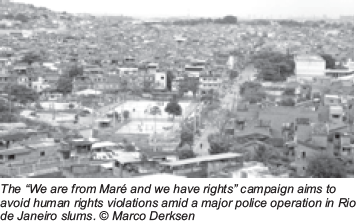
Tens of thousands of residents in one of Rio de Janeiro's biggest favelas are being targeted by Amnesty International and NGO partners to ensure they know their human rights ahead of a police operation to retake the area from armed criminal= gangs.
Beginning on 6 November, Amnesty International and local NGOs Redes de Desenvolvimento da Maré and Observatório de Favelas will distribute some 50,000 information packs to people living in slums in the Maré area of the Brazilian city. The campaign – “We are from Maré and we have rights” – is aimed at avoiding the kinds of human rights violations that have taken place during similar recent operations when Police Pacification Units (Unidade de Polícia Pacificadora, UPP) moved into Rio's favelas.
“We want to break with the notion that anything goes because there's a 'war' against organized crime – this includes putting an end to violating the rights of residents of the communities where the UPPs move in,” said Átila Roque, Amnesty International's Brazil Director. “Police operations to pacify high-crime areas can only be justified if they can guarantee the rights of all citizens, startingwith the slum-dwellers.”
The information packs that are being distributed by the NGOs include information on the slum-dwellers' rights and duties if they are approached by police officers – in the street or at home.Asign included in the pack lists police actions deemed unacceptable – including entering homes without a warrant, discriminating against individuals on any basis, or putting the lives of residents at risk by using firearms in densely populated areas.
The organizations recognize that Rio de Janeiro's police have a duty to carry out their jobs, but urge them to treat Maré residents with respect and civility. The campaign is part ongoing efforts by civil society groups to work together with Rio de Janeiro's slumdwellers to improve awareness about human rights. “The purpose of the campaign is to empower people in the favelas so they can play their part of in ensuring their own safety and that of their neighbours,” said Eliana Silva, Director of Redes de Desenvolvimento da Maré.
The federal and state governments have been working together to “pacify” high-crime areas in Rio de Janeiro's favelas, with the aim of installing 40 UPPs in high-crime areas by 2014. Besides bringing law and order to areas previously under the control of criminal gangs and militias – in some cases for upwards of two decades – the programme aims to bring much-needed social services to some of the city's most impoverished areas.
The Maré area – made up of 16 separate favelas – is home to 130,000 people, making it more populous than 80 per cent of Brazilian cities. “Our basic assumption is that the city should be for everyone. We can't tolerate a police officer treating residents differently on the basis of their colour, sexual preference, physical appearance or social class – whether it's in Maré or in better-off areas of the city,” said Jaílson Silva, Coordinator-General of Observatório de Favelas. “We want people to take ownership of the city and be aware of their rights as a first step towards everyone being able to circulate freely with security, beginning in their own neighbourhoods.”
www.amnesty.org/en/news/brazil-slum-campaign-human-rightsahead-police-operation-2012-11-05
No trecho do último parágrafo - Our basic assumption is that the city should be for everyone. - a expressão should be pode ser substituída, sem alteração de sentido, por
Questão 23 75800
FDF 2013Brazil: Slum campaign on human rights ahead of police operation
5 November 2012
Tens of thousands of residents in one of Rio de Janeiro's biggest favelas are being targeted by Amnesty International and NGO partners to ensure they know their human rights ahead of a police operation to retake the area from armed criminal= gangs.
Beginning on 6 November, Amnesty International and local NGOs Redes de Desenvolvimento da Maré and Observatório de Favelas will distribute some 50,000 information packs to people living in slums in the Maré area of the Brazilian city. The campaign – “We are from Maré and we have rights” – is aimed at avoiding the kinds of human rights violations that have taken place during similar recent operations when Police Pacification Units (Unidade de Polícia Pacificadora, UPP) moved into Rio's favelas.
“We want to break with the notion that anything goes because there's a 'war' against organized crime – this includes putting an end to violating the rights of residents of the communities where the UPPs move in,” said Átila Roque, Amnesty International's Brazil Director. “Police operations to pacify high-crime areas can only be justified if they can guarantee the rights of all citizens, startingwith the slum-dwellers.”
The information packs that are being distributed by the NGOs include information on the slum-dwellers' rights and duties if they are approached by police officers – in the street or at home.Asign included in the pack lists police actions deemed unacceptable – including entering homes without a warrant, discriminating against individuals on any basis, or putting the lives of residents at risk by using firearms in densely populated areas.
The organizations recognize that Rio de Janeiro's police have a duty to carry out their jobs, but urge them to treat Maré residents with respect and civility. The campaign is part ongoing efforts by civil society groups to work together with Rio de Janeiro's slumdwellers to improve awareness about human rights. “The purpose of the campaign is to empower people in the favelas so they can play their part of in ensuring their own safety and that of their neighbours,” said Eliana Silva, Director of Redes de Desenvolvimento da Maré.
The federal and state governments have been working together to “pacify” high-crime areas in Rio de Janeiro's favelas, with the aim of installing 40 UPPs in high-crime areas by 2014. Besides bringing law and order to areas previously under the control of criminal gangs and militias – in some cases for upwards of two decades – the programme aims to bring much-needed social services to some of the city's most impoverished areas.
The Maré area – made up of 16 separate favelas – is home to 130,000 people, making it more populous than 80 per cent of Brazilian cities. “Our basic assumption is that the city should be for everyone. We can't tolerate a police officer treating residents differently on the basis of their colour, sexual preference, physical appearance or social class – whether it's in Maré or in better-off areas of the city,” said Jaílson Silva, Coordinator-General of Observatório de Favelas. “We want people to take ownership of the city and be aware of their rights as a first step towards everyone being able to circulate freely with security, beginning in their own neighbourhoods.”
www.amnesty.org/en/news/brazil-slum-campaign-human-rightsahead-police-operation-2012-11-05
“The purpose of the campaign is to empower people in the favelas so they can play their part of in ensuring their own safety and that of their neighbours,”
A palavra so indica uma ideia de
Questão 22 75799
FDF 2013Brazil: Slum campaign on human rights ahead of police operation
5 November 2012
Tens of thousands of residents in one of Rio de Janeiro's biggest favelas are being targeted by Amnesty International and NGO partners to ensure they know their human rights ahead of a police operation to retake the area from armed criminal= gangs.
Beginning on 6 November, Amnesty International and local NGOs Redes de Desenvolvimento da Maré and Observatório de Favelas will distribute some 50,000 information packs to people living in slums in the Maré area of the Brazilian city. The campaign – “We are from Maré and we have rights” – is aimed at avoiding the kinds of human rights violations that have taken place during similar recent operations when Police Pacification Units (Unidade de Polícia Pacificadora, UPP) moved into Rio's favelas.
“We want to break with the notion that anything goes because there's a 'war' against organized crime – this includes putting an end to violating the rights of residents of the communities where the UPPs move in,” said Átila Roque, Amnesty International's Brazil Director. “Police operations to pacify high-crime areas can only be justified if they can guarantee the rights of all citizens, startingwith the slum-dwellers.”
The information packs that are being distributed by the NGOs include information on the slum-dwellers' rights and duties if they are approached by police officers – in the street or at home.Asign included in the pack lists police actions deemed unacceptable – including entering homes without a warrant, discriminating against individuals on any basis, or putting the lives of residents at risk by using firearms in densely populated areas.
The organizations recognize that Rio de Janeiro's police have a duty to carry out their jobs, but urge them to treat Maré residents with respect and civility. The campaign is part ongoing efforts by civil society groups to work together with Rio de Janeiro's slumdwellers to improve awareness about human rights. “The purpose of the campaign is to empower people in the favelas so they can play their part of in ensuring their own safety and that of their neighbours,” said Eliana Silva, Director of Redes de Desenvolvimento da Maré.
The federal and state governments have been working together to “pacify” high-crime areas in Rio de Janeiro's favelas, with the aim of installing 40 UPPs in high-crime areas by 2014. Besides bringing law and order to areas previously under the control of criminal gangs and militias – in some cases for upwards of two decades – the programme aims to bring much-needed social services to some of the city's most impoverished areas.
The Maré area – made up of 16 separate favelas – is home to 130,000 people, making it more populous than 80 per cent of Brazilian cities. “Our basic assumption is that the city should be for everyone. We can't tolerate a police officer treating residents differently on the basis of their colour, sexual preference, physical appearance or social class – whether it's in Maré or in better-off areas of the city,” said Jaílson Silva, Coordinator-General of Observatório de Favelas. “We want people to take ownership of the city and be aware of their rights as a first step towards everyone being able to circulate freely with security, beginning in their own neighbourhoods.”
www.amnesty.org/en/news/brazil-slum-campaign-human-rightsahead-police-operation-2012-11-05
“The purpose of the campaign is to empower people in the favelas so they can play their part of in ensuring their own safety and that of their neighbours,”
A palavra that refere-se a
06