


![[Marketing] Questao Topo - deslogado](https://storage.estuda.com.br/banners/0_6b7ebee90b03af1c560c73bb8bcce34a_banner_deslogado_70_dias.png)
Questões de Inglês
19.971 Questões
Questão 22 76594
UFU 2° Dia 2013/2TEXT 1
It is not money nor uninformed reform that makes schools better
EDUCATION is the handmaiden of economic growth: teach future workers well, it is argued, and they will go on to invigorate the economy. No surprise then that the OECD, a club of mostly rich countries, goes to great lengths to discover how the school systems in its member countries are doing. Education ministers are already anxiously awaiting the next issue of its PISA study, which is due to be published on December 7th. As happens every three years, this will detail and rank the reading, mathematics and science skills of 15-year-olds in each country.
But even more important than ranking school systems is knowing how to make them better. That is the aim of another new study, to be released on November 29th by McKinsey. The consultancy selected school systems where it has seen standards rise and identified what they had in common. Countries can make rapid progress, it argues, if they do the right thing—and at the right time.
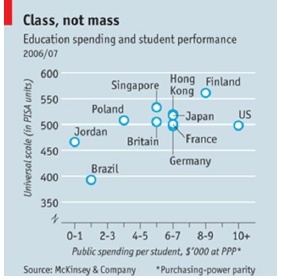
For starters, McKinsey says, throwing money at education does not seem to do much good, at least in those countries that already send all their young people to school (see chart). America, for example, increased its spending on schools by 21% between 2000 and 2007, while Britain pumped in 37% more funds. Yet in this period, according to PISA, standards in both countries slipped.
Many school systems that were not showered with extra funds did much better. Schools in the state of Saxony, in Germany, in Latvia, Lithuania, Slovenia and Poland have all raised their games. Even poor countries such as Chile and Ghana have made progress.
What separates the big spenders from the improvers, McKinsey found, is the awareness that different types of school system respond to radically different types of reform. In countries where schools mainly seek to teach pupils to read, write and grasp some basic maths, centralization seems to work. All teachers should be directed to teach the same lessons from the same textbooks.
Countries where schools have already attained a higher standard should become pickier in choosing teachers. Another study by McKinsey in 2007 concluded that making teaching a high-status profession was what boosted standards. For instance, schools could recruit teachers from among the best university graduates, an idea that was part of a series of measures published in England on November 24th.
At the very top of the global educational league table — where only a handful of countries or systems within them manage to attain really high standards — decentralization is the name of the game. The authorities hand control over to teachers, most of whom are highly educated and motivated, so they can learn from each other and follow the best practices. When it comes to getting the very best grades, it seems that teacher still knows best.
Disponível em: .
Based on the text and on the PISA chart, we can infer that the relationship between public spending and quality in education is more efficient in
Questão 21 76593
UFU 2° Dia 2013/2Based on the text, it is possible to state that
I.The Brazilian educational system needs improvement.
II.educated workers can lead to stronger economies.
III.uninformed reforms can make schools better.
IV.schools in Slovenia have become better.
V.Poland has stimulated spending in education.
TEXT 1
It is not money nor uninformed reform that makes schools better
EDUCATION is the handmaiden of economic growth: teach future workers well, it is argued, and they will go on to invigorate the economy. No surprise then that the OECD, a club of mostly rich countries, goes to great lengths to discover how the school systems in its member countries are doing. Education ministers are already anxiously awaiting the next issue of its PISA study, which is due to be published on December 7th. As happens every three years, this will detail and rank the reading, mathematics and science skills of 15-year-olds in each country.
But even more important than ranking school systems is knowing how to make them better. That is the aim of another new study, to be released on November 29th by McKinsey. The consultancy selected school systems where it has seen standards rise and identified what they had in common. Countries can make rapid progress, it argues, if they do the right thing—and at the right time.
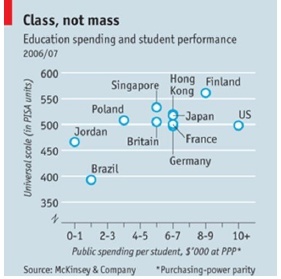
For starters, McKinsey says, throwing money at education does not seem to do much good, at least in those countries that already send all their young people to school (see chart). America, for example, increased its spending on schools by 21% between 2000 and 2007, while Britain pumped in 37% more funds. Yet in this period, according to PISA, standards in both countries slipped.
Many school systems that were not showered with extra funds did much better. Schools in the state of Saxony, in Germany, in Latvia, Lithuania, Slovenia and Poland have all raised their games. Even poor countries such as Chile and Ghana have made progress.
What separates the big spenders from the improvers, McKinsey found, is the awareness that different types of school system respond to radically different types of reform. In countries where schools mainly seek to teach pupils to read, write and grasp some basic maths, centralization seems to work. All teachers should be directed to teach the same lessons from the same textbooks.
Countries where schools have already attained a higher standard should become pickier in choosing teachers. Another study by McKinsey in 2007 concluded that making teaching a high-status profession was what boosted standards. For instance, schools could recruit teachers from among the best university graduates, an idea that was part of a series of measures published in England on November 24th.
At the very top of the global educational league table — where only a handful of countries or systems within them manage to attain really high standards — decentralization is the name of the game. The authorities hand control over to teachers, most of whom are highly educated and motivated, so they can learn from each other and follow the best practices. When it comes to getting the very best grades, it seems that teacher still knows best.Disponível em: <www.economist.com>.
Assinale a alternativa que contém somente afirmativas corretas.
Questão 29 76367
FATEC 2013/1In (1)Higher Education, a Focus on Technology
By STEVE LOHR
The education gap facing the nation’s work force is evident in the numbers. Most new jobs will require more than a high school education, yet fewer than half of Americans under 30 have a (2)postsecondary degree of any kind. Recent state budget cuts, education experts agree, promise to make closing that gap even more difficult.
The Bill and Melinda Gates Foundation, the William and Flora Hewlett Foundation, and four nonprofit education organizations are beginning an ambitious initiative to address that challenge by accelerating the development and use of online learning tools.
An initial $20 million round of money, from the Gates Foundation, will be for postsecondary online courses, particularly ones tailored for community colleges and low-income young people. Another round of grants, for high school programs, is scheduled for next year.
Just how effective technology can be in improving education — by making students more effective, more engaged learners — is a subject of debate. To date, education research shows that good teachers matter a lot, class size may be less important than once thought and nothing improves student performance as much as one-on-one human tutoring.
If technology is well designed, experts say, it can help tailor the learning experience to individual students, facilitate studentteacher collaboration, and assist teachers in monitoring student performance each day and in quickly fine-tuning lessons.
The potential benefits of technology are greater as students become older, more independent learners. Making that point, Mr. Gates said in an interview that for children from kindergarten to about fifth grade “the idea that you stick them in front of a computer is (3)ludicrous.”
(www.nytimes.com/2010/10/11/technology/11online.html Acesso em: 20.09.2012. Adaptado)
(1)higher education: educação superior.
(2)postsecondary: termo que se refere aos cursos feitos após o high school ou, no modelo educacional brasileiro, o Ensino Médio.
(3)ludicrous: ridícula, absurda.
No mesmo trecho do terceiro parágrafo – (...) particularly ones tailored for community colleges and low-income young people. – a palavra tailored pode ser substituída, sem alteração do sentido do texto, por
Questão 28 76366
FATEC 2013/1In (1)Higher Education, a Focus on Technology
By STEVE LOHR
The education gap facing the nation’s work force is evident in the numbers. Most new jobs will require more than a high school education, yet fewer than half of Americans under 30 have a (2)postsecondary degree of any kind. Recent state budget cuts, education experts agree, promise to make closing that gap even more difficult.
The Bill and Melinda Gates Foundation, the William and Flora Hewlett Foundation, and four nonprofit education organizations are beginning an ambitious initiative to address that challenge by accelerating the development and use of online learning tools.
An initial $20 million round of money, from the Gates Foundation, will be for postsecondary online courses, particularly ones tailored for community colleges and low-income young people. Another round of grants, for high school programs, is scheduled for next year.
Just how effective technology can be in improving education — by making students more effective, more engaged learners — is a subject of debate. To date, education research shows that good teachers matter a lot, class size may be less important than once thought and nothing improves student performance as much as one-on-one human tutoring.
If technology is well designed, experts say, it can help tailor the learning experience to individual students, facilitate studentteacher collaboration, and assist teachers in monitoring student performance each day and in quickly fine-tuning lessons.
The potential benefits of technology are greater as students become older, more independent learners. Making that point, Mr. Gates said in an interview that for children from kindergarten to about fifth grade “the idea that you stick them in front of a computer is (3)ludicrous.”
(www.nytimes.com/2010/10/11/technology/11online.html Acesso em: 20.09.2012. Adaptado)
(1)higher education: educação superior.
(2)postsecondary: termo que se refere aos cursos feitos após o high school ou, no modelo educacional brasileiro, o Ensino Médio.
(3)ludicrous: ridícula, absurda.
No terceiro parágrafo, o pronome ones em – (...) particularly ones tailored for community colleges and low-income young people. – refere-se a
Questão 27 76365
FATEC 2013/1In (1)Higher Education, a Focus on Technology
By STEVE LOHR
The education gap facing the nation’s work force is evident in the numbers. Most new jobs will require more than a high school education, yet fewer than half of Americans under 30 have a (2)postsecondary degree of any kind. Recent state budget cuts, education experts agree, promise to make closing that gap even more difficult.
The Bill and Melinda Gates Foundation, the William and Flora Hewlett Foundation, and four nonprofit education organizations are beginning an ambitious initiative to address that challenge by accelerating the development and use of online learning tools.
An initial $20 million round of money, from the Gates Foundation, will be for postsecondary online courses, particularly ones tailored for community colleges and low-income young people. Another round of grants, for high school programs, is scheduled for next year.
Just how effective technology can be in improving education — by making students more effective, more engaged learners — is a subject of debate. To date, education research shows that good teachers matter a lot, class size may be less important than once thought and nothing improves student performance as much as one-on-one human tutoring.
If technology is well designed, experts say, it can help tailor the learning experience to individual students, facilitate studentteacher collaboration, and assist teachers in monitoring student performance each day and in quickly fine-tuning lessons.
The potential benefits of technology are greater as students become older, more independent learners. Making that point, Mr. Gates said in an interview that for children from kindergarten to about fifth grade “the idea that you stick them in front of a computer is (3)ludicrous.”
(www.nytimes.com/2010/10/11/technology/11online.html Acesso em: 20.09.2012. Adaptado)
(1)higher education: educação superior.
(2)postsecondary: termo que se refere aos cursos feitos após o high school ou, no modelo educacional brasileiro, o Ensino Médio.
(3)ludicrous: ridícula, absurda.
A opinião de Bill Gates acerca do uso de tecnologia para ensinar crianças, do jardim da infância à quinta série, é de que
Questão 26 76364
FATEC 2013/1In (1)Higher Education, a Focus on Technology
By STEVE LOHR
The education gap facing the nation’s work force is evident in the numbers. Most new jobs will require more than a high school education, yet fewer than half of Americans under 30 have a (2)postsecondary degree of any kind. Recent state budget cuts, education experts agree, promise to make closing that gap even more difficult.
The Bill and Melinda Gates Foundation, the William and Flora Hewlett Foundation, and four nonprofit education organizations are beginning an ambitious initiative to address that challenge by accelerating the development and use of online learning tools.
An initial $20 million round of money, from the Gates Foundation, will be for postsecondary online courses, particularly ones tailored for community colleges and low-income young people. Another round of grants, for high school programs, is scheduled for next year.
Just how effective technology can be in improving education — by making students more effective, more engaged learners — is a subject of debate. To date, education research shows that good teachers matter a lot, class size may be less important than once thought and nothing improves student performance as much as one-on-one human tutoring.
If technology is well designed, experts say, it can help tailor the learning experience to individual students, facilitate studentteacher collaboration, and assist teachers in monitoring student performance each day and in quickly fine-tuning lessons.
The potential benefits of technology are greater as students become older, more independent learners. Making that point, Mr. Gates said in an interview that for children from kindergarten to about fifth grade “the idea that you stick them in front of a computer is (3)ludicrous.”
(www.nytimes.com/2010/10/11/technology/11online.html Acesso em: 20.09.2012. Adaptado)
(1)higher education: educação superior.
(2)postsecondary: termo que se refere aos cursos feitos após o high school ou, no modelo educacional brasileiro, o Ensino Médio.
(3)ludicrous: ridícula, absurda.
De acordo com o texto, é correto afirmar que
06