


![[Marketing] Questao Topo - deslogado](https://storage.estuda.com.br/banners/0_6b7ebee90b03af1c560c73bb8bcce34a_banner_deslogado_70_dias.png)
Questões de Inglês
19.971 Questões
Questão 56 83828
UFRGS 1° Dia FIS - LIT- ENG 2013[1] An Amazonian tribe has been discovered
that has no concept of time or dates.
The Amondawa people of Brazil do not
even have words for "time", "week", "month"
[5] or "year", said Chris Sinha, of the University
of Portsmouth.
He argues that it is the first time scientists
have been able to prove time is not a deeply
entrenched universal human concept, as
[10] previously thought.
According to Professor Sinha we can now
say without doubt that there is at least one
language and culture which does not have a
concept of time as something that can be
[15] measured, counted or talked about in the
abstract, which doesn't mean that the
Amondawa are "people outside time": they
live in a world of events, rather than seeing
events as being embedded in time.
[20] There are no words for such concepts as
"next week" or "last year", only divisions of
day and night and rainy and dry seasons. It
was also found nobody in the community has
an age. …….. , they change their names to
[25] reflect their life-stage and position within their
society. For example, a little child will give up
his or her name to a newborn sibling and take
on a new one.
Professor Sinha said: "We have so many
[30] metaphors for time and its passing - we think
of time as a 'thing' - we say 'the weekend is
nearly gone', 'she's coming up to her exams',
'I haven't got the time', and so on, and we
think such statements are objective, but they
[35] aren't. We've created these metaphors and
they have become the way we think. The
Amondawa don't talk like this and don't think
like this, unless they learn another language.
For these fortunate people time isn't money,
[40] they aren't racing against the clock to
complete anything, and nobody is discussing
next week or next year. You could say they
enjoy a certain freedom".
Adaptado de: Daily Mail, 20 mai 2011. Disponível em: <http://www.dailymail.co.uk/sciencetech/article-1389070/Amazon-Amondawa-tribe-age-words-like-month-year-dont-exist.html#ixzz25dEZL89p>. Acesso em: 05 set. 2012.
Assinale com V (verdadeiro) ou F (falso) as seguintes afirmações sobre segmentos do texto.
( ) O pronome which (l. 13) refere-se a one language and culture (l. 12-13).
( ) O pronome they (l. 17) refere-se a the Amondawa (l. 16-17).
( ) O pronome its (l. 30) refere-se a time (l. 30).
( ) O pronome they (l. 42) refere-se a next week or next year (l. 42).
A sequência correta de preenchimento dos parênteses, de cima para baixo, é
Questão 55 83827
UFRGS 1° Dia FIS - LIT- ENG 2013[1] An Amazonian tribe has been discovered
that has no concept of time or dates.
The Amondawa people of Brazil do not
even have words for "time", "week", "month"
[5] or "year", said Chris Sinha, of the University
of Portsmouth.
He argues that it is the first time scientists
have been able to prove time is not a deeply
entrenched universal human concept, as
[10] previously thought.
According to Professor Sinha we can now
say without doubt that there is at least one
language and culture which does not have a
concept of time as something that can be
[15] measured, counted or talked about in the
abstract, which doesn't mean that the
Amondawa are "people outside time": they
live in a world of events, rather than seeing
events as being embedded in time.
[20] There are no words for such concepts as
"next week" or "last year", only divisions of
day and night and rainy and dry seasons. It
was also found nobody in the community has
an age. …….. , they change their names to
[25] reflect their life-stage and position within their
society. For example, a little child will give up
his or her name to a newborn sibling and take
on a new one.
Professor Sinha said: "We have so many
[30] metaphors for time and its passing - we think
of time as a 'thing' - we say 'the weekend is
nearly gone', 'she's coming up to her exams',
'I haven't got the time', and so on, and we
think such statements are objective, but they
[35] aren't. We've created these metaphors and
they have become the way we think. The
Amondawa don't talk like this and don't think
like this, unless they learn another language.
For these fortunate people time isn't money,
[40] they aren't racing against the clock to
complete anything, and nobody is discussing
next week or next year. You could say they
enjoy a certain freedom".
Adaptado de: Daily Mail, 20 mai 2011. Disponível em: <http://www.dailymail.co.uk/sciencetech/article-1389070/Amazon-Amondawa-tribe-age-words-like-month-year-dont-exist.html#ixzz25dEZL89p>. Acesso em: 05 set. 2012.
Assinale a alternativa que apresenta a tradução mais adequada para o trecho scientists have been able to prove (l. 07-08).
Questão 54 83826
UFRGS 1° Dia FIS - LIT- ENG 2013[1] An Amazonian tribe has been discovered
that has no concept of time or dates.
The Amondawa people of Brazil do not
even have words for "time", "week", "month"
[5] or "year", said Chris Sinha, of the University
of Portsmouth.
He argues that it is the first time scientists
have been able to prove time is not a deeply
entrenched universal human concept, as
[10] previously thought.
According to Professor Sinha we can now
say without doubt that there is at least one
language and culture which does not have a
concept of time as something that can be
[15] measured, counted or talked about in the
abstract, which doesn't mean that the
Amondawa are "people outside time": they
live in a world of events, rather than seeing
events as being embedded in time.
[20] There are no words for such concepts as
"next week" or "last year", only divisions of
day and night and rainy and dry seasons. It
was also found nobody in the community has
an age. …….. , they change their names to
[25] reflect their life-stage and position within their
society. For example, a little child will give up
his or her name to a newborn sibling and take
on a new one.
Professor Sinha said: "We have so many
[30] metaphors for time and its passing - we think
of time as a 'thing' - we say 'the weekend is
nearly gone', 'she's coming up to her exams',
'I haven't got the time', and so on, and we
think such statements are objective, but they
[35] aren't. We've created these metaphors and
they have become the way we think. The
Amondawa don't talk like this and don't think
like this, unless they learn another language.
For these fortunate people time isn't money,
[40] they aren't racing against the clock to
complete anything, and nobody is discussing
next week or next year. You could say they
enjoy a certain freedom".
Adaptado de: Daily Mail, 20 mai 2011. Disponível em: <http://www.dailymail.co.uk/sciencetech/article-1389070/Amazon-Amondawa-tribe-age-words-like-month-year-dont-exist.html#ixzz25dEZL89p>. Acesso em: 05 set. 2012.
Considere o trecho abaixo e as subsequentes propostas de sua reescrita.
An Amazonian tribe has been discovered that has no concept of time or dates (l. 01-02).
I - An Amazonian tribe that has no concept of time or dates has been discovered.
II - An Amazonian tribe which has no concept of time or dates has been discovered.
III - An Amazonian tribe what has no concept of time or dates has been discovered.
Quais propostas são gramaticalmente corretas e preservam o sentido do trecho original?
Questão 53 83825
UFRGS 1° Dia FIS - LIT- ENG 2013[1] An Amazonian tribe has been discovered
that has no concept of time or dates.
The Amondawa people of Brazil do not
even have words for "time", "week", "month"
[5] or "year", said Chris Sinha, of the University
of Portsmouth.
He argues that it is the first time scientists
have been able to prove time is not a deeply
entrenched universal human concept, as
[10] previously thought.
According to Professor Sinha we can now
say without doubt that there is at least one
language and culture which does not have a
concept of time as something that can be
[15] measured, counted or talked about in the
abstract, which doesn't mean that the
Amondawa are "people outside time": they
live in a world of events, rather than seeing
events as being embedded in time.
[20] There are no words for such concepts as
"next week" or "last year", only divisions of
day and night and rainy and dry seasons. It
was also found nobody in the community has
an age. …….. , they change their names to
[25] reflect their life-stage and position within their
society. For example, a little child will give up
his or her name to a newborn sibling and take
on a new one.
Professor Sinha said: "We have so many
[30] metaphors for time and its passing - we think
of time as a 'thing' - we say 'the weekend is
nearly gone', 'she's coming up to her exams',
'I haven't got the time', and so on, and we
think such statements are objective, but they
[35] aren't. We've created these metaphors and
they have become the way we think. The
Amondawa don't talk like this and don't think
like this, unless they learn another language.
For these fortunate people time isn't money,
[40] they aren't racing against the clock to
complete anything, and nobody is discussing
next week or next year. You could say they
enjoy a certain freedom".
Adaptado de: Daily Mail, 20 mai 2011. Disponível em: <http://www.dailymail.co.uk/sciencetech/article-1389070/Amazon-Amondawa-tribe-age-words-like-month-year-dont-exist.html#ixzz25dEZL89p>. Acesso em: 05 set. 2012.
Assinale a alternativa que apresenta uma inferência correta em relação ao conteúdo do texto.
Questão 40 80965
UNITAU Medicina 2013TIME FOR ADVENTURE
Amanda and Stephanie have been best friends since they were five. After going to college in Boston, they feel it’s now time to start living on the edge! Amanda, a law graduate, and Stephanie, a major in arts, both have one place in mind: Greece! Their parents have given them this trip to celebrate their achievements, they are on cloud nine. The girls have everything planned: Stephanie’s older brother has a friend from college that lives in Greece, Alexandros, who’s smart, cute and very single, and who’s volunteered to help them. Amanda thinks he’s sweet as pie but she is one hundred percent devoted to her high-school sweetheart, Chad. So that leaves the game open for Stephanie. Will she be able to concentrate on the tip, or be head over heels for Alexandros?
(Adapted from: Seleções – Reader’s Digest – Outubro 2012)
Associe as expressões, em negrito no texto, a seus respectivos sinônimos.
Agora, assinale a alternativa CORRETA, correspondente à associação dos sinônimos.
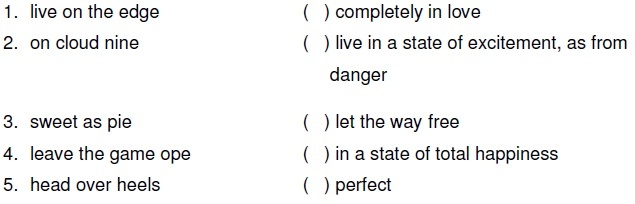
Questão 39 80964
UNITAU Medicina 2013TIME FOR ADVENTURE
Amanda and Stephanie have been best friends since they were five. After going to college in Boston, they feel it’s now time to start living on the edge! Amanda, a law graduate, and Stephanie, a major in arts, both have one place in mind: Greece! Their parents have given them this trip to celebrate their achievements, they are on cloud nine. The girls have everything planned: Stephanie’s older brother has a friend from college that lives in Greece, Alexandros, who’s smart, cute and very single, and who’s volunteered to help them. Amanda thinks he’s sweet as pie but she is one hundred percent devoted to her high-school sweetheart, Chad. So that leaves the game open for Stephanie. Will she be able to concentrate on the tip, or be head over heels for Alexandros?
(Adapted from: Seleções – Reader’s Digest – Outubro 2012)
Assinale a alternativa mais adequada, de acordo com o texto.
06