


![[Marketing] Questao Topo - deslogado](https://storage.estuda.com.br/banners/0_6b7ebee90b03af1c560c73bb8bcce34a_banner_deslogado_70_dias.png)
Questões de Inglês
19.971 Questões
Questão 35 97368
Unioeste 1ª Fase 2013Brazil biologists investigate penguin deaths
Brazilian biologists are investigating the deaths of more than 500 penguins found washed up on the beaches of Rio Grande do Sul state.
Autopsies are being conducted on some of the birds to determine the cause of death.
Researchers said the penguins appeared to have been well-fed, with no apparent injuries and no oil on their bodies.
Similar incidents in the past have been blamed on shifting ocean currents and colder temperatures.
Magellanic Penguins migrate to southern Brazil from Patagonia every year during the southern winter.
Last week dozens of young penguins were rescued from beaches in Rio de Janeiro after straying far beyond their normal range.
The birds delighted beach-goers, but scientists said their health was suffering in the tropical waters. Brazil's environment agency is preparing to fly those penguins back to the south.
http://www.bbc.co.uk/news/world-latin-america-18838918.
“Have been blamed” encontra-se no
Questão 53 95853
UFTM 2013/2Up Close With Sebastião Salgado, Brazil’s Legendary Photographer-Activist
By Fernanda Ezabella (Folha de S.Paulo/Worldcrunch)
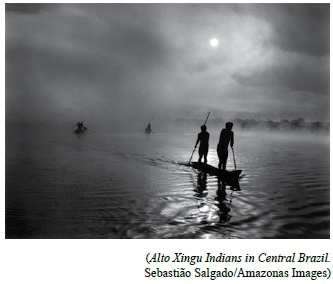
Sebastião Salgado’s blue eyes have seen a bit of everything in this world – and this might not even be an exaggeration. For the past eight years in particular, the 69-year-old Brazilian photographer has travelled to more than 30 isolated regions of the world, collecting images of dozens of remote tribes, endangered animals and unusual landscapes.
The Genesis project is a singular photographic journey that began in 2004 and ended in 2012, at a cost of one million Euros a year. The result will be shown in magazines, books, a documentary by Wim Wenders and a series of exhibitions around the world, each displaying some 250 black-and-white photos.
The first exhibition will open in London on April 11, with former Brazilian President Lula – Salgado’s long-time friend – as special guest. “We want to create a little movement around these photos to provoke a debate on what we need to preserve,” he says. Salgado defends environmental causes through his organization, Instituto Terra. Even after travelling to so many exotic places, Salgado, now living in Paris, still takes vacations in Brazil. Here are excerpts from a conversation Salgado had with Folha, with new details about his travels, photographic techniques and new environmental projects.
• Coldest trip
I visited the Nenets, in the Yamal peninsula, in northern Siberia, Russia. They are a nomadic tribe who raise reindeer in extreme Arctic conditions. When I went there it was spring and weather ranged between -35ºC and -45ºC. I didn’t wash myself for 45 days. They don’t take baths because there is no water. The only way to get water is to break off a piece of ice and warm it in a pot.
• Frozen equipment
I used a Canon, an EOS1 Mark III, a very powerful machine. The problem was the batteries. In the Siberian temperatures, they quickly lost power. On average, I take 2,500 shots per battery, but this time I could only take 300-400 photos before the battery stopped working. I would put it inside my clothes, my assistant would give me another one, I would take 300 more pictures and, when that battery ran out energy, I would take out the other one and it would work again.
• Going digital for the first time
I started Genesis with film and changed to digital. The airport X-Ray scanners degrade the quality of film, and so I decided to change to digital and was quite surprised. Quality was better than the one I had with negatives in medium format. I turned off the screen on the back of the camera, and used my camera as I have always done. When I came back to Paris, I printed contact sheets and edited the photos using a magnifying glass, because I don’t know how to do it in the computer.
• Stone Ages
I met tribes that are still living in the Stone Ages, with working tools such as stone hammers. There were clans of about 10 people living in treetops. They had already seen white people before. They looked towards the direction I had come from and the chief asked me whether I was part of the white people clan that usually came from that direction. Because, for them, the world is all made of clans.
• Brazilian arrows
I met the Zo’e tribe, in Brazil, who were first discovered 15 years ago and live in a state of total purity. You see the guy working with an arrow. He warms it, put some weight on it, a straight feather if he wants a quicker arrow, a rounder one to have it slower. It is the same science as for rockets. And he’s got the same problem as in Cape Canaveral, to recover his rockets. If his ballistic calculations are wrong, he loses his arrow. He takes only 10 arrows with him when he goes hunting, no more than that.
• Activist or photographer?
Photography is my life. When I am taking photos, I am in a deep trance. When I have my camera and am travelling with the Nenets, it’s my life, morning to night. I have taken incredible photos, but my life is also the environment and Instituto Terra.
(www.worldcrunch.com. Adaptado.)
In the last paragraph, one can infer that the most important thing for Sebastião Salgado is
Questão 52 95852
UFTM 2013/2Up Close With Sebastião Salgado, Brazil’s Legendary Photographer-Activist
By Fernanda Ezabella (Folha de S.Paulo/Worldcrunch)
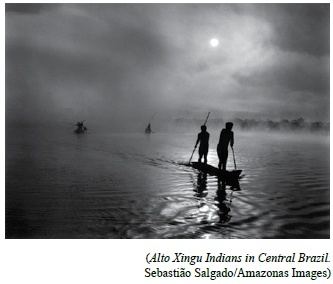
Sebastião Salgado’s blue eyes have seen a bit of everything in this world – and this might not even be an exaggeration. For the past eight years in particular, the 69-year-old Brazilian photographer has travelled to more than 30 isolated regions of the world, collecting images of dozens of remote tribes, endangered animals and unusual landscapes.
The Genesis project is a singular photographic journey that began in 2004 and ended in 2012, at a cost of one million Euros a year. The result will be shown in magazines, books, a documentary by Wim Wenders and a series of exhibitions around the world, each displaying some 250 black-and-white photos.
The first exhibition will open in London on April 11, with former Brazilian President Lula – Salgado’s long-time friend – as special guest. “We want to create a little movement around these photos to provoke a debate on what we need to preserve,” he says. Salgado defends environmental causes through his organization, Instituto Terra. Even after travelling to so many exotic places, Salgado, now living in Paris, still takes vacations in Brazil. Here are excerpts from a conversation Salgado had with Folha, with new details about his travels, photographic techniques and new environmental projects.
• Coldest trip
I visited the Nenets, in the Yamal peninsula, in northern Siberia, Russia. They are a nomadic tribe who raise reindeer in extreme Arctic conditions. When I went there it was spring and weather ranged between -35ºC and -45ºC. I didn’t wash myself for 45 days. They don’t take baths because there is no water. The only way to get water is to break off a piece of ice and warm it in a pot.
• Frozen equipment
I used a Canon, an EOS1 Mark III, a very powerful machine. The problem was the batteries. In the Siberian temperatures, they quickly lost power. On average, I take 2,500 shots per battery, but this time I could only take 300-400 photos before the battery stopped working. I would put it inside my clothes, my assistant would give me another one, I would take 300 more pictures and, when that battery ran out energy, I would take out the other one and it would work again.
• Going digital for the first time
I started Genesis with film and changed to digital. The airport X-Ray scanners degrade the quality of film, and so I decided to change to digital and was quite surprised. Quality was better than the one I had with negatives in medium format. I turned off the screen on the back of the camera, and used my camera as I have always done. When I came back to Paris, I printed contact sheets and edited the photos using a magnifying glass, because I don’t know how to do it in the computer.
• Stone Ages
I met tribes that are still living in the Stone Ages, with working tools such as stone hammers. There were clans of about 10 people living in treetops. They had already seen white people before. They looked towards the direction I had come from and the chief asked me whether I was part of the white people clan that usually came from that direction. Because, for them, the world is all made of clans.
• Brazilian arrows
I met the Zo’e tribe, in Brazil, who were first discovered 15 years ago and live in a state of total purity. You see the guy working with an arrow. He warms it, put some weight on it, a straight feather if he wants a quicker arrow, a rounder one to have it slower. It is the same science as for rockets. And he’s got the same problem as in Cape Canaveral, to recover his rockets. If his ballistic calculations are wrong, he loses his arrow. He takes only 10 arrows with him when he goes hunting, no more than that.
• Activist or photographer?
Photography is my life. When I am taking photos, I am in a deep trance. When I have my camera and am travelling with the Nenets, it’s my life, morning to night. I have taken incredible photos, but my life is also the environment and Instituto Terra.
(www.worldcrunch.com. Adaptado.)
Segundo o texto, a tribo Zo’e
Questão 51 95851
UFTM 2013/2Up Close With Sebastião Salgado, Brazil’s Legendary Photographer-Activist
By Fernanda Ezabella (Folha de S.Paulo/Worldcrunch)
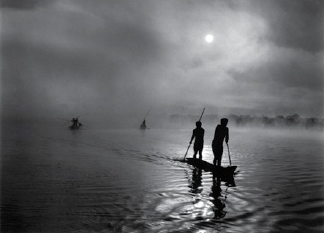
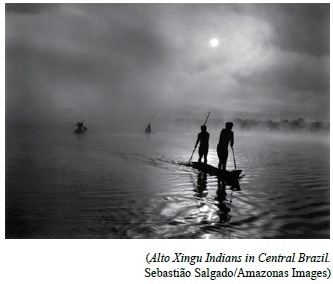
(Alio Xingu Indians in Central Brazil. Sebastião Salgado/Amazonas Images)
Sebastião Salgado’s blue eyes have seen a bit of everything in this world – and this might not even be an exaggeration. For the past eight years in particular, the 69-year-old Brazilian photographer has travelled to more than 30 isolated regions of the world, collecting images of dozens of remote tribes, endangered animals and unusual landscapes.
The Genesis project is a singular photographic journey that began in 2004 and ended in 2012, at a cost of one million Euros a year. The result will be shown in magazines, books, a documentary by Wim Wenders and a series of exhibitions around the world, each displaying some 250 black-and-white photos.
The first exhibition will open in London on April 11, with former Brazilian President Lula – Salgado’s long-time friend – as special guest. “We want to create a little movement around these photos to provoke a debate on what we need to preserve,” he says. Salgado defends environmental causes through his organization, Instituto Terra. Even after travelling to so many exotic places, Salgado, now living in Paris, still takes vacations in Brazil. Here are excerpts from a conversation Salgado had with Folha, with new details about his travels, photographic techniques and new environmental projects.
• Coldest trip
I visited the Nenets, in the Yamal peninsula, in northern Siberia, Russia. They are a nomadic tribe who raise reindeer in extreme Arctic conditions. When I went there it was spring and weather ranged between -35ºC and -45ºC. I didn’t wash myself for 45 days. They don’t take baths because there is no water. The only way to get water is to break off a piece of ice and warm it in a pot.
• Frozen equipment
I used a Canon, an EOS1 Mark III, a very powerful machine. The problem was the batteries. In the Siberian temperatures, they quickly lost power. On average, I take 2,500 shots per battery, but this time I could only take 300-400 photos before the battery stopped working. I would put it inside my clothes, my assistant would give me another one, I would take 300 more pictures and, when that battery ran out energy, I would take out the other one and it would work again.
• Going digital for the first time
I started Genesis with film and changed to digital. The airport X-Ray scanners degrade the quality of film, and so I decided to change to digital and was quite surprised. Quality was better than the one I had with negatives in medium format. I turned off the screen on the back of the camera, and used my camera as I have always done. When I came back to Paris, I printed contact sheets and edited the photos using a magnifying glass, because I don’t know how to do it in the computer.
• Stone Ages
I met tribes that are still living in the Stone Ages, with working tools such as stone hammers. There were clans of about 10 people living in treetops. They had already seen white people before. They looked towards the direction I had come from and the chief asked me whether I was part of the white people clan that usually came from that direction. Because, for them, the world is all made of clans.
• Brazilian arrows
I met the Zo’e tribe, in Brazil, who were first discovered 15 years ago and live in a state of total purity. You see the guy working with an arrow. He warms it, put some weight on it, a straight feather if he wants a quicker arrow, a rounder one to have it slower. It is the same science as for rockets. And he’s got the same problem as in Cape Canaveral, to recover his rockets. If his ballistic calculations are wrong, he loses his arrow. He takes only 10 arrows with him when he goes hunting, no more than that.
• Activist or photographer?
Photography is my life. When I am taking photos, I am in a deep trance. When I have my camera and am travelling with the Nenets, it’s my life, morning to night. I have taken incredible photos, but my life is also the environment and Instituto Terra.
(www.worldcrunch.com. Adaptado.)
No trecho do sétimo parágrafo – the chief asked me whether I was part of the white people clan that usually came from that direction –, a palavra whether equivale, em português, a
Questão 50 95850
UFTM 2013/2Up Close With Sebastião Salgado, Brazil’s Legendary Photographer-Activist
By Fernanda Ezabella (Folha de S.Paulo/Worldcrunch)
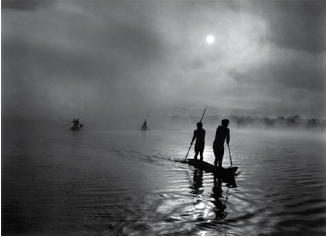
(Alto Xingu Indians in Central Brazil. Sebastião Salgado/Amazonas Images)
Sebastião Salgado’s blue eyes have seen a bit of everything in this world – and this might not even be an exaggeration. For the past eight years in particular, the 69-year-old Brazilian photographer has travelled to more than 30 isolated regions of the world, collecting images of dozens of remote tribes, endangered animals and unusual landscapes.
The Genesis project is a singular photographic journey that began in 2004 and ended in 2012, at a cost of one million Euros a year. The result will be shown in magazines, books, a documentary by Wim Wenders and a series of exhibitions around the world, each displaying some 250 black-and-white photos.
The first exhibition will open in London on April 11, with former Brazilian President Lula – Salgado’s long-time friend – as special guest. “We want to create a little movement around these photos to provoke a debate on what we need to preserve,” he says. Salgado defends environmental causes through his organization, Instituto Terra. Even after travelling to so many exotic places, Salgado, now living in Paris, still takes vacations in Brazil. Here are excerpts from a conversation Salgado had with Folha, with new details about his travels, photographic techniques and new environmental projects.
• Coldest trip
I visited the Nenets, in the Yamal peninsula, in northern Siberia, Russia. They are a nomadic tribe who raise reindeer in extreme Arctic conditions. When I went there it was spring and weather ranged between -35ºC and -45ºC. I didn’t wash myself for 45 days. They don’t take baths because there is no water. The only way to get water is to break off a piece of ice and warm it in a pot.
• Frozen equipment
I used a Canon, an EOS1 Mark III, a very powerful machine. The problem was the batteries. In the Siberian temperatures, they quickly lost power. On average, I take 2,500 shots per battery, but this time I could only take 300-400 photos before the battery stopped working. I would put it inside my clothes, my assistant would give me another one, I would take 300 more pictures and, when that battery ran out energy, I would take out the other one and it would work again.
• Going digital for the first time
I started Genesis with film and changed to digital. The airport X-Ray scanners degrade the quality of film, and so I decided to change to digital and was quite surprised. Quality was better than the one I had with negatives in medium format. I turned off the screen on the back of the camera, and used my camera as I have always done. When I came back to Paris, I printed contact sheets and edited the photos using a magnifying glass, because I don’t know how to do it in the computer.
• Stone Ages
I met tribes that are still living in the Stone Ages, with working tools such as stone hammers. There were clans of about 10 people living in treetops. They had already seen white people before. They looked towards the direction I had come from and the chief asked me whether I was part of the white people clan that usually came from that direction. Because, for them, the world is all made of clans.
• Brazilian arrows
I met the Zo’e tribe, in Brazil, who were first discovered 15 years ago and live in a state of total purity. You see the guy working with an arrow. He warms it, put some weight on it, a straight feather if he wants a quicker arrow, a rounder one to have it slower. It is the same science as for rockets. And he’s got the same problem as in Cape Canaveral, to recover his rockets. If his ballistic calculations are wrong, he loses his arrow. He takes only 10 arrows with him when he goes hunting, no more than that.
• Activist or photographer?
Photography is my life. When I am taking photos, I am in a deep trance. When I have my camera and am travelling with the Nenets, it’s my life, morning to night. I have taken incredible photos, but my life is also the environment and Instituto Terra.
(www.worldcrunch.com. Adaptado.)
No trecho do sexto parágrafo – The airport X-Ray scanners degrade the quality of film, and so I decided to change to digital and was quite surprised. –, a palavra so pode ser substituída, sem alteração de sentido, por
Questão 49 95849
UFTM 2013/2Up Close With Sebastião Salgado, Brazil’s Legendary Photographer-Activist
By Fernanda Ezabella (Folha de S.Paulo/Worldcrunch)
Sebastião Salgado’s blue eyes have seen a bit of everything in this world – and this might not even be an exaggeration. For the past eight years in particular, the 69-year-old Brazilian photographer has travelled to more than 30 isolated regions of the world, collecting images of dozens of remote tribes, endangered animals and unusual landscapes.
The Genesis project is a singular photographic journey that began in 2004 and ended in 2012, at a cost of one million Euros a year. The result will be shown in magazines, books, a documentary by Wim Wenders and a series of exhibitions around the world, each displaying some 250 black-and-white photos.
The first exhibition will open in London on April 11, with former Brazilian President Lula – Salgado’s long-time friend – as special guest. “We want to create a little movement around these photos to provoke a debate on what we need to preserve,” he says. Salgado defends environmental causes through his organization, Instituto Terra. Even after travelling to so many exotic places, Salgado, now living in Paris, still takes vacations in Brazil. Here are excerpts from a conversation Salgado had with Folha, with new details about his travels, photographic techniques and new environmental projects.
• Coldest trip
I visited the Nenets, in the Yamal peninsula, in northern Siberia, Russia. They are a nomadic tribe who raise reindeer in extreme Arctic conditions. When I went there it was spring and weather ranged between -35ºC and -45ºC. I didn’t wash myself for 45 days. They don’t take baths because there is no water. The only way to get water is to break off a piece of ice and warm it in a pot.
• Frozen equipment
I used a Canon, an EOS1 Mark III, a very powerful machine. The problem was the batteries. In the Siberian temperatures, they quickly lost power. On average, I take 2,500 shots per battery, but this time I could only take 300-400 photos before the battery stopped working. I would put it inside my clothes, my assistant would give me another one, I would take 300 more pictures and, when that battery ran out energy, I would take out the other one and it would work again.
• Going digital for the first time
I started Genesis with film and changed to digital. The airport X-Ray scanners degrade the quality of film, and so I decided to change to digital and was quite surprised. Quality was better than the one I had with negatives in medium format. I turned off the screen on the back of the camera, and used my camera as I have always done. When I came back to Paris, I printed contact sheets and edited the photos using a magnifying glass, because I don’t know how to do it in the computer.
• Stone Ages
I met tribes that are still living in the Stone Ages, with working tools such as stone hammers. There were clans of about 10 people living in treetops. They had already seen white people before. They looked towards the direction I had come from and the chief asked me whether I was part of the white people clan that usually came from that direction. Because, for them, the world is all made of clans.
• Brazilian arrows
I met the Zo’e tribe, in Brazil, who were first discovered 15 years ago and live in a state of total purity. You see the guy working with an arrow. He warms it, put some weight on it, a straight feather if he wants a quicker arrow, a rounder one to have it slower. It is the same science as for rockets. And he’s got the same problem as in Cape Canaveral, to recover his rockets. If his ballistic calculations are wrong, he loses his arrow. He takes only 10 arrows with him when he goes hunting, no more than that.
• Activist or photographer?
Photography is my life. When I am taking photos, I am in a deep trance. When I have my camera and am travelling with the Nenets, it’s my life, morning to night. I have taken incredible photos, but my life is also the environment and Instituto Terra.
(www.worldcrunch.com. Adaptado.)
No trecho do quinto parágrafo – I would put it inside my clothes, my assistant would give me another one –, a palavra one referese, no texto, a
06