


![[Marketing] Questao Topo - deslogado](https://storage.estuda.com.br/banners/0_6b7ebee90b03af1c560c73bb8bcce34a_banner_deslogado_70_dias.png)
Questões de Inglês
19.971 Questões
Questão 50 100034
EBMSP Medicina 2013/2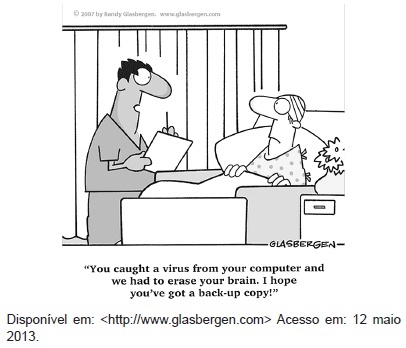
In this cartoon, the doctor is telling the patient
Questão 41 100025
EBMSP Medicina 2013/2Brazilian scientists developed the first intelligent
portable heart monitor in the world, which allows the
remote sending of electrocardiograms, the location
of the patient for relief and early detection of heart
5 problems.
The monitor can detect irregularities without
symptoms that normally could not be felt, causing a
reduction of concern in patients if they suffer a crisis
away from a doctor. It not only measures the heart rate,
10 but also achieves search and make the assessment of
rhythm and alterations.
Also, this device can also identify early-stage
myocardial and rare arrhythmia syndromes. It consists
of a unit slightly larger than a mobile phone that the
15 patient wears around the waist and connected to four
electrodes that are placed on the chest.
The machine, which should reach the market
this year with the name of Nexcor, monitors heart
problems remotely and in real time, through which
20 electrocardiograms will be sent to a central control.
Also it counts with a communicator that allows the
patient to talk to an expert immediately if he doesn’t
feel well.
Disponível em: <http://www.ecuadortimes.net/2013/04/22/brazil-develops-first-intelligent-portable-heart-monitor-world/>. Acesso em: 12 maio 2013.
Considering language use in the text, it’s correct to say:
Questão 40 100024
EBMSP Medicina 2013/2Brazilian scientists developed the first intelligent
portable heart monitor in the world, which allows the
remote sending of electrocardiograms, the location
of the patient for relief and early detection of heart
5 problems.
The monitor can detect irregularities without
symptoms that normally could not be felt, causing a
reduction of concern in patients if they suffer a crisis
away from a doctor. It not only measures the heart rate,
10 but also achieves search and make the assessment of
rhythm and alterations.
Also, this device can also identify early-stage
myocardial and rare arrhythmia syndromes. It consists
of a unit slightly larger than a mobile phone that the
15 patient wears around the waist and connected to four
electrodes that are placed on the chest.
The machine, which should reach the market
this year with the name of Nexcor, monitors heart
problems remotely and in real time, through which
20 electrocardiograms will be sent to a central control.
Also it counts with a communicator that allows the
patient to talk to an expert immediately if he doesn’t
feel well.
Disponível em: <http://www.ecuadortimes.net/2013/04/22/brazil-develops-first-intelligent-portable-heart-monitor-world/>. Acesso em: 12 maio 2013.
According to the text, the only statement that is FALSE about Nexcor is that it
Questão 28 100012
EBMSP Medicina 2013/2The antioxidant myth
A recent Scientific American article challenges the
myth of antioxidants being associated with ageing.
This is not the first time SciAm has covered this topic.
The article challenges current perceived wisdom, not
5 only regarding the effectiveness of antioxidants but of
the underlying theory that oxidative damage causes
ageing. The current evidence tells us that antioxidant
supplementation is not only ineffective, it is harmful.
The science behind the association between
10 oxidative damage and ageing is a classic example
of the Decline Effect. The initial studies showing an
association between decreased life expectancy in
worms and damage from oxygen free radicals have
not been adequately replicated. Later studies showed
15 no such association and more recent studies showed
the opposite effect: longer life span and evidence of
free radicals triggering cellular repair. In other words,
the initial findings “declined” over time.
The clinical research is also against antioxidants.
20 The balance of evidence shows that antioxidant
supplements (such as vitamin A and vitamin E) are
associated with an increase in the rate of early death
(JAMA review, Cochrane review). Those reviews were
from 2007/8. The pervasive nature of these myths and
25 our wish to believe them (our lack of scepticism) is
responsible for the fact that antioxidants are still being
advertised as useful, despite being the opposite.
I think this is also an example of trying to outsmart
nature. While it is established that eating fresh fruit and
30 vegetables is healthy, when we try to get clever and
reckon we know the one magic ingredient responsible
for the benefit, everything falls down. It is a measure of
our hubris that we believed that we could explain the
cause of ageing so simply. As usual, things are more
35 complicated than we thought, and there are always
unintended consequences of any treatment. Instead of
trying to guess and extract a single magic ingredient
from fresh fruit and vegetables, doesn’t it make more
sense to just eat the fruit and vegetables? It’s probably
40 cheaper, and it certainly tastes better.
Disponível em: <http://doctorsskeptic.blogspot.com.br/2013/02/antioxidants -i-don’t-think-so.html>. Acesso em: 12 maio 2013.
According to the text, fill in the parentheses with T (True) or F (False).
The authot states that
( ) The widespread belief that ageing is caused by oxidative damage is now in doubt.
( ) Recent experiments have showed that, in some circumstances, free radicals seem to increase life span.
( ) Most scientists still believe that vitamins play a key role in preserving people’s youth.
( ) Unlikely previously thought, free radicals may actually help in the process of cellular repair.
The correct sequence, from top to bottom, is
Questão 20 99376
FCM PB Medicina 2013/1TEXT II
Scientists say that a common ingredient found in Chinese herbal medicine is responsible for the very high incidence of some cancers and kidney disease in Taiwan. For thousands of years the aristolochia plant with its reddish-yellow flowers has been a support of Chinese herbal medicine. The toxic nature of the plant was discovered in the 1990s when dozens of Belgian women began developing kidney failure and urinary tract cancers. They had been using aristolochia-based slimming aids at clinic.
Now scientists say that the key element, aristolochic acid, is responsible for the very high levels of kidney disease and urinary tract tumors in Taiwan. It’s estimated that about one in three of the population there have used herbal medicines containing the toxin. The country has the world’s highest incidence of cancers of the upper urinary tract – and in their study the scientists say more than half can be directly linked to the ingredient.
While products containing aristolochic acid are banned in many countries, one of the big concerns is China. In 2004 a study suggests Chinese farmers produce enough of the plant to dose 100 million people. Scientists are concerned that in the decades to come, disease caused by the aristolochia will create an international public health problem of considerable magnitude.
Source: Adjusted from BBC.co.uk (http://www.bbc.co.uk/worldservice/, visited on October, 2012)
Read the sentence:
“…disease […] will create an international public health problem of considerable magnitude”
Choose the appropriate passive form for the sentence above:
Questão 18 99374
FCM PB Medicina 2013/1TEXT II
Scientists say that a common ingredient found in Chinese herbal medicine is responsible for the very high incidence of some cancers and kidney disease in Taiwan. For thousands of years the aristolochia plant with its reddish-yellow flowers has been a support of Chinese herbal medicine. The toxic nature of the plant was discovered in the 1990s when dozens of Belgian women began developing kidney failure and urinary tract cancers. They had been using aristolochia-based slimming aids at clinic.
Now scientists say that the key element, aristolochic acid, is responsible for the very high levels of kidney disease and urinary tract tumors in Taiwan. It’s estimated that about one in three of the population there have used herbal medicines containing the toxin. The country has the world’s highest incidence of cancers of the upper urinary tract – and in their study the scientists say more than half can be directly linked to the ingredient.
While products containing aristolochic acid are banned in many countries, one of the big concerns is China. In 2004 a study suggests Chinese farmers produce enough of the plant to dose 100 million people. Scientists are concerned that in the decades to come, disease caused by the aristolochia will create an international public health problem of considerable magnitude.
Source: Adjusted from BBC.co.uk (http://www.bbc.co.uk/worldservice/, visited on October, 2012)
The sentence: “While products containing aristolochic acid are banned in many countries, one of the big concerns is China” means that:
06