


![[Marketing] Questao Topo - deslogado](https://storage.estuda.com.br/banners/0_6b7ebee90b03af1c560c73bb8bcce34a_banner_deslogado_70_dias.png)
Questões de Inglês
19.971 Questões
Questão 30 105234
FAMEVAÇO Tipo A 2013/2New Approach To Improving Treatment For
Multiple Sclerosis And Other Conditions
Main Category: Multiple Sclerosis
Also Included In: Neurology / Neuroscience
Article Date: 21 May 2013 - 0:00 PDT
Working with lab mice models of multiple sclerosis (MS), UC Davis scientists have detected a novel molecular target for the design of drugs that could be safer and more effective than current FDA-approved medications against MS.
The findings of the research study, published online in the journal EMBO Molecular Medicine, could have therapeutic applications for MS as well as cerebral palsy and leukodystrophies, all disorders associated with loss of white matter, which is the brain tissue that carries information between nerve cells in the brain and the spinal cord.
The target, a protein referred to as mitochondrial translocator protein (TSPO), had been previously identified but not linked to MS, an autoimmune disease that strips the protective fatty coating off nerve fibers of the brain and spinal cord. The mitrochronical TSPO is located on the outer surface of mitochondria, cellular structures that supply energy to the cells. Damage to the fatty coating, or myelin, slows the transmission of the nerve signals that enable body movement as well as sensory and cognitive functioning.
The scientists identified mitochondrial TSPO as a potential therapeutic target when mice that had symptoms of MS improved after being treated with the anti-anxiety drug etifoxine, which interacts with mitochondrial TSPO. When etifoxine, a drug clinically available in Europe, was administered to the MS mice before they had clinical signs of disease, the severity of the disease was reduced when compared to the untreated lab animals. When treated at the peak of disease severity, the animals' MS symptoms improved.
"Etifoxine has a novel protective effect against the loss of the sheath that insulates the nerve fibers that transmit the signals from brain cells," said Wenbin Deng, principal investigator of the study and associate professor of biochemistry and molecular medicine at UC Davis.
"Our discovery of etifoxine's effects on an MS animal model suggests that mitochondrial TSPO represents a potential therapeutic target for MS drug development," said Deng.
"Drugs designed to more precisely bind to mitochondrial TSPO may help repair the myelin sheath of MS patients and thereby even help restore the transmission of signals in the central nervous system that enable normal motor, sensory and cognitive functions," he said.
Deng added that better treatments for MS and other demyelinating diseases are needed, especially since current FDA-approved therapies do not repair the damage of immune attacks on the myelin sheath.
The UC Davis research team hopes to further investigate the therapeutic applications of mitochondrial TSPO in drug development for MS and other autoimmune diseases. To identify more efficacious and safer drug candidates, they plan to pursue research grants that will enable them to test a variety of pharmacological compounds that bind to mitochondrial TSPO and other molecular targets in experimental models of MS and other myelin diseases.
http://www.medicalnewstoday.com/releases/260722.php
The text states that TSPO is
Questão 28 105232
FAMEVAÇO Tipo A 2013/2New Approach To Improving Treatment For
Multiple Sclerosis And Other Conditions
Main Category: Multiple Sclerosis
Also Included In: Neurology / Neuroscience
Article Date: 21 May 2013 - 0:00 PDT
Working with lab mice models of multiple sclerosis (MS), UC Davis scientists have detected a novel molecular target for the design of drugs that could be safer and more effective than current FDA-approved medications against MS.
The findings of the research study, published online in the journal EMBO Molecular Medicine, could have therapeutic applications for MS as well as cerebral palsy and leukodystrophies, all disorders associated with loss of white matter, which is the brain tissue that carries information between nerve cells in the brain and the spinal cord.
The target, a protein referred to as mitochondrial translocator protein (TSPO), had been previously identified but not linked to MS, an autoimmune disease that strips the protective fatty coating off nerve fibers of the brain and spinal cord. The mitrochronical TSPO is located on the outer surface of mitochondria, cellular structures that supply energy to the cells. Damage to the fatty coating, or myelin, slows the transmission of the nerve signals that enable body movement as well as sensory and cognitive functioning.
The scientists identified mitochondrial TSPO as a potential therapeutic target when mice that had symptoms of MS improved after being treated with the anti-anxiety drug etifoxine, which interacts with mitochondrial TSPO. When etifoxine, a drug clinically available in Europe, was administered to the MS mice before they had clinical signs of disease, the severity of the disease was reduced when compared to the untreated lab animals. When treated at the peak of disease severity, the animals' MS symptoms improved.
"Etifoxine has a novel protective effect against the loss of the sheath that insulates the nerve fibers that transmit the signals from brain cells," said Wenbin Deng, principal investigator of the study and associate professor of biochemistry and molecular medicine at UC Davis.
"Our discovery of etifoxine's effects on an MS animal model suggests that mitochondrial TSPO represents a potential therapeutic target for MS drug development," said Deng.
"Drugs designed to more precisely bind to mitochondrial TSPO may help repair the myelin sheath of MS patients and thereby even help restore the transmission of signals in the central nervous system that enable normal motor, sensory and cognitive functions," he said.
Deng added that better treatments for MS and other demyelinating diseases are needed, especially since current FDA-approved therapies do not repair the damage of immune attacks on the myelin sheath.
The UC Davis research team hopes to further investigate the therapeutic applications of mitochondrial TSPO in drug development for MS and other autoimmune diseases. To identify more efficacious and safer drug candidates, they plan to pursue research grants that will enable them to test a variety of pharmacological compounds that bind to mitochondrial TSPO and other molecular targets in experimental models of MS and other myelin diseases.
http://www.medicalnewstoday.com/releases/260722.php
The findings of the research study have therapeutic applications for all the following, EXCEPT:
Questão 52 102604
UnP Medicina 2° Dia 2013/1August 23, 2011
Brazil Fights Modern Day Slavery
By Sarah de Sainte Croix, Senior Contributing Reporter
RIO DE JANEIRO, BRAZIL – Last month the Labor Public Ministry (MPT), released its biannual ‘Lista Suja,’ or ‘Dirty List,’ naming and shaming companies that have been found to be exploiting workers. There were 48 new names added to the list, bringing the total to 251. Themajority of the new entrants, sixteen, were based in the Central-West region of Brazil.
This was followed by thirteen employers from the South, eight from each of the Southwest and Northern regions, and three from the Northeast. One new case was found in São Paulo state, while no new cases were identified in Rio de Janeiro state.
According to the UN Special Rapporteur for Contemporary Slavery, Ms. Gulnara Shahinian, one of the most common forms of slavery in today’s Brazil is bonded labor, where workers from poor backgrounds are forced to work as a means of repayment for a loan.
The loan is often to pay for travel expenses incurred in getting to the place of work, and the value of their work is invariably greater than the original sum of money borrowed. The practice is most prevalent in the cattle ranching and the sugar cane industries and the victims are predominantly men and boys aged fifteen and older.
Shahinian explains, “The victims of forced labor work long hours, with little or no pay. They are threatened with, or subjected to, physical, psychological and sometimes sexual violence.”
According to a report published by Anti-Slavery International, a UK based NGO, the consequences for employers whose names are mentioned on the Dirty List include fines, debarment from state benefits (including grants, loans, and agricultural credits), and up to eight years imprisonment.
Furthermore, a National Pact for the Eradication of Slavery exists whose signatories are bound to cease all business relations, direct or indirect, with any company named on the list. Subscribers to the pact include big names such as Walmart, Carrefour, Vale, Pão de Açucar and McDonalds.
Given that many of the Dirty List offenders are mining outfits or agricultural producers, this penalization alone can be enough to put the company out of business. The Dirty List and the National Pact form part of the government’s National Plan for the Eradication of Slavery which was initiated in 2003 by President Lula da Silva with aim of abolishing slave labor in Brazil by 2006.
The plan also included tightening up laws to include degrading working conditions and exhausting shift patterns under the definition of slavery, the creation of a permanent council called CONATRAE to co-ordinate the various governmental departments, NGOs and the federal police in combating slavery, and increasing public awareness.
Shahinian praised the National Plan extensively in her report, saying, “The Government of Brazil has put in place exemplary policies.” However, she continues, “These exemplary actions threaten to be overshadowed…[because] some landowners, businesses and intermediaries have found a way to avoid criminal prosecution by taking advantage of legal loopholes that delay justice and foster impunity.”
On August 17th, a factory in São Paulo producing Zara’s clothing was closed for conditions analogous to slavery. It was reported that Bolivians were brought to Brazil illegally, locked in small apartments and sewed clothes for twelve to fourteen hours a day without hot water for taking showers or food for lunch.
In May this year the MPT conceded that the 2003 reforms were insufficient to eradicate the problem, admitting that around 20,000 people in Brazil still work under conditions tantamount to slavery. Some reports place the number of slaves today at least as 12,000,000 worldwide, with the largest amount in South Asia.
Shahinian’s report recommends passing a constitutional amendment which was first proposed nine years ago known as PEC No. 438/01 under which, land where forced labor had been used would be expropriated, without compensation, and re-distributed. Priority would be given to those workers who had previously been held there in slave-like conditions.
Shahinian said, “Passing this amendment will show that Brazil is indeed strongly committed to fighting slavery.”
Fonte: The Rio Times. Disponível em http://riotimesonline.com/brazil-news/rio-politics/brazilfights- modern-day-slavery/#, consultado em 05/11/2012 (adaptado).
Minority of new names added to the Dirty List are from:
Questão 60 102502
UnP Medicina 2° Dia 2013/2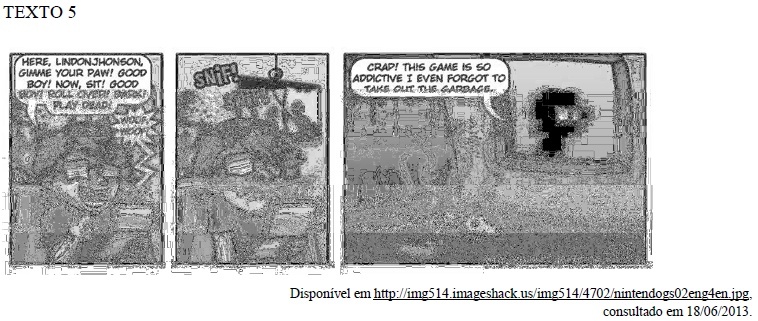
The charge above:
Questão 59 102501
UnP Medicina 2° Dia 2013/2TEXTO 3
Pride (In The Name Of Love)
U2
One man come in the name of love
One man come and go.
One man come here to justify
One man to overthrow.
Refrain:
In the name of love
What more in the name of love.
In the name of love
What more in the name of love.
One man caught on a barbed wire fence
One man here resist
One man washed up on an empty beach
One man betrayed with a kiss.
Refrain
Early morning, April four
Shot rings out in the Memphis sky.
Free at last, they took your life
They could not take your pride.
Refrain
TEXTO 4
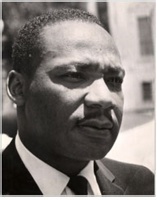
Martin Luther King Jr.
Jan. 15, 1929 to April 4, 1968
“Like anybody, I would
like to live a long life.
Longevity has its place.
But I'm not concerned
about that now. I just
want to do God's will.
And He's allowed me to
go up to the mountain.
And I've looked over. And
I've seen the Promised
Land. I may not get there with you. But I want
you to know tonight, that we, as a people, will
get to the promised land!”
With these words, Dr. Martin Luther King Jr. built a crescendo to his final speech on April 3, 1968. The next day, the civil rights leader was shot and killed on a balcony of the Lorraine Motel in Memphis, Tenn.
The expression “one man” in U2 song:
Questão 57 102499
UnP Medicina 2° Dia 2013/2
The same message meaning is kept if we replace “make up” by:
06