


![[Marketing] Questao Topo - deslogado](https://storage.estuda.com.br/banners/0_6b7ebee90b03af1c560c73bb8bcce34a_banner_deslogado_70_dias.png)
Questões de Inglês
19.971 Questões
Questão 79 6747302
UECE 1ª Fase 2022/1T E X T
Men Fall Behind in College Enrollment. Women Still Play Catch-Up at Work.
The coronavirus upended the lives of
millions of college students. The Wall Street Journal
reported this week that men have been hit
particularly hard — accounting for roughly threefourths of pandemic-driven dropouts — and
depicted an accelerating crisis in male enrollment.
A closer look at historical trends and the
labor market reveals a more complex picture, one
in which women keep playing catch-up in an
economy structured to favor men.
In many ways, the college gender
imbalance is not new. Women have outnumbered
men on campus since the late 1970s. The ratio of
female to male undergraduates increased much
more from 1970 to 1980 than from 1980 to the
present. And the numbers haven’t changed much in
recent decades. In 1992, 55 percent of college
students were women. By 2019, the number had
nudged up to 57.4 percent.
While the shift in the college gender ratio
is often characterized as men “falling behind,” men
are actually more likely to go to college today than
they were when they were the majority, many
decades ago. In 1970, 32 percent of men 18 to 24
were enrolled in college, a level that was most
likely inflated by the opportunity to avoid being
drafted into the Vietnam War. That percentage
dropped to 24 percent in 1978 and then steadily
grew to a stable 37 percent to 39 percent over the
last decade.
The gender ratio mostly changed because
female enrollment increased even faster, more than
doubling over the last half-century.
Because of the change in ratio, some
selective colleges discriminate against women in
admissions to maintain a gender balance, as The
Journal reported. Generally, admissions officials
prefer to limit the disparity to 55 percent female
and 45 percent male. Their reason not to let the
gender ratio drift further toward 2 to 1 is
straightforward: Such a ratio would most likely
cause a decrease in applications.
In a New York Times essay in 2006 titled
“To All the Girls I’ve Rejected,” the dean of
admissions at Kenyon College at the time
explained: “Beyond the availability of dance
partners for the winter formal, gender balance
matters in ways both large and small on a
residential college campus. Once you become
decidedly female in enrollment, fewer males and,
as it turns out, fewer females find your campus
attractive.”
The raw numbers don’t take into account
the varying value of college degrees. Men still
dominate in fields like technology and engineering,
which offer some of the highest salaries for recent
graduates. Perhaps not coincidentally, the
professors in those fields remain overwhelmingly
male.
Women surged into college because they
were able to, but also because many had to. There
are still some good-paying jobs available to men
without college credentials. There are relatively few
for such women. And despite the considerable cost
in time and money of earning a degree, many
female-dominated jobs don’t pay well.
The fact that the male-female wage gap
remains large after more than four decades in
which women outnumbered men in college strongly
suggests that college alone offers a narrow view of
opportunity. Women often seem stuck in place: As
they overcome obstacles and use their degrees to
move into male-dominated fields, the fields offer
less pay in return.
None of this diminishes the significance of
the male decrease in college enrollment and
graduation. Educators view the male-driven dive in
community college enrollment over the last 18
months as a calamity. The pandemic confirmed
what was already known. Higher socioeconomic
classes are deeply embedded in college and will
bear considerable cost and inconvenience to stay
there, even if it means watching lectures on a
laptop in the room above your parent’s garage and
missing a season of parties and football games.
For other people, college attendance is far
more fragile. It does not define their identities and
is not as important as earning a steady paycheck or
starting and nurturing a family. In a time of crisis,
it can be delayed — but the reality is that people
who drop out of college are statistically unlikely to
complete a degree.
Last year, women were less likely than
men to leave community college, despite their
disproportionate responsibility for caregiving and
domestic work, because they no doubt understood
the bleak long-term job prospects for women
without a credential.
www.nytimes.com/Sept.9,2021
In 1970 one reason why there was a boost in young men enrollment in college was the
Questão 35 6712389
UNIFIMES 2022Leia o texto para responder a questão.
Researchers in the US have developed a technological aid: a chest-mounted video camera — linked to a processing unit involving a computer-vision algorithm — and a pair of vibrating wristbands. When the system detects a hazard that the wearer is set to collide with, the wristband on the same side as the hazard vibrates. If the obstacle is straight ahead, both wristbands vibrate. The researchers said the device was not designed to replace canes or guide dogs but rather to provide additional benefits, including helping wearers to avoid hazards above ground level.
Writing in the journal Jama Ophthalmology, the researchers reported that a study of 368 hours of walking video data from 31 blind or partially sighted participants indicates that the approach could be helpful.
After a period of training, each participant used the system for about four weeks, in addition to their cane or guide dog. During this time the system switched unannounced between “active” mode — during which the wristbands vibrated when a hazard was detected — and “silent” mode, where they did not. The researchers then analysed the data to see whether the rate of contacts between the user’s body or cane and the objects identified by the system differed between the two scenarios.
When they looked at a random sample of collision warnings for each participant, they found that such contacts were reduced by 37% when the system was in active mode, taking into account factors including participants’ level of visual acuity.
(Nicola Davis. www.theguardian.com, 22.07.2021. Adaptado.)
O trecho do terceiro parágrafo “during which the wristbands vibrated when a hazard was detected” expressa
Questão 34 6711356
UNIFIMES 2022Leia o texto para responder a questão.
Researchers in the US have developed a technological aid: a chest-mounted video camera — linked to a processing unit involving a computer-vision algorithm — and a pair of vibrating wristbands. When the system detects a hazard that the wearer is set to collide with, the wristband on the same side as the hazard vibrates. If the obstacle is straight ahead, both wristbands vibrate. The researchers said the device was not designed to replace canes or guide dogs but rather to provide additional benefits, including helping wearers to avoid hazards above ground level.
Writing in the journal Jama Ophthalmology, the researchers reported that a study of 368 hours of walking video data from 31 blind or partially sighted participants indicates that the approach could be helpful.
After a period of training, each participant used the system for about four weeks, in addition to their cane or guide dog. During this time the system switched unannounced between “active” mode — during which the wristbands vibrated when a hazard was detected — and “silent” mode, where they did not. The researchers then analysed the data to see whether the rate of contacts between the user’s body or cane and the objects identified by the system differed between the two scenarios.
When they looked at a random sample of collision warnings for each participant, they found that such contacts were reduced by 37% when the system was in active mode, taking into account factors including participants’ level of visual acuity.
(Nicola Davis. www.theguardian.com, 22.07.2021. Adaptado.)
In the excerpt from the second paragraph “indicates that the approach could be helpful.”, the underlined word expresses
Questão 32 6711346
UNIFIMES 2022Leia o texto para responder a questão.
Researchers in the US have developed a technological aid: a chest-mounted video camera — linked to a processing unit involving a computer-vision algorithm — and a pair of vibrating wristbands. When the system detects a hazard that the wearer is set to collide with, the wristband on the same side as the hazard vibrates. If the obstacle is straight ahead, both wristbands vibrate. The researchers said the device was not designed to replace canes or guide dogs but rather to provide additional benefits, including helping wearers to avoid hazards above ground level.
Writing in the journal Jama Ophthalmology, the researchers reported that a study of 368 hours of walking video data from 31 blind or partially sighted participants indicates that the approach could be helpful.
After a period of training, each participant used the system for about four weeks, in addition to their cane or guide dog. During this time the system switched unannounced between “active” mode — during which the wristbands vibrated when a hazard was detected — and “silent” mode, where they did not. The researchers then analysed the data to see whether the rate of contacts between the user’s body or cane and the objects identified by the system differed between the two scenarios.
When they looked at a random sample of collision warnings for each participant, they found that such contacts were reduced by 37% when the system was in active mode, taking into account factors including participants’ level of visual acuity.
(Nicola Davis. www.theguardian.com, 22.07.2021. Adaptado.)
De acordo com o texto, pesquisadores desenvolveram um dispositivo que
Questão 35 6707065
UNIFUNEC 2022Examine a tira Peanuts, de Charles Schulz.
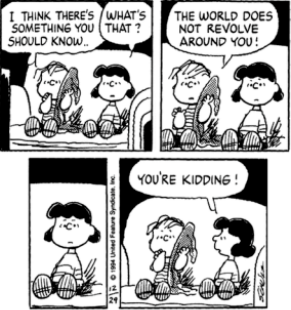
(gocomics.com)
Na tira, a garota é caracterizada como
Questão 33 6707038
UNIFUNEC 2022Leia o texto para responder a questão.
New player in cancer’s spread
When people hear that they might have cancer, perhaps the only thing more frightening than the C word is the M word. Metastatic disease — in which the tumor has traveled beyond its primary place to other spots in the body — is responsible for nine out of every 10 cancer deaths.
Recently an unexpected player in this process has emerged: a common bacterium. Fusobacterium nucleatum, which normally lives harmlessly in the gums, appears to have a role in the spread of some cancers of the colon, esophagus, pancreas and — possibly — breast. Laboratory studies and evidence in patients indicate that the microbe can travel through the blood and infect tumor cells by attaching to a sugar molecule on their surface. There it provokes a range of signals and immune responses known to cause tumor cells to migrate. If further confirmed, the work with F. nucleatum could add to a growing understanding of how the microbiome influences cancer progression and may even point the way to fresh approaches to treatment.
(Claudia Wallis. Scientific American, outubro de 2020. Adaptado.)
No trecho do segundo parágrafo “the work with F. nucleatum could add to a growing understanding of how the microbiome influences cancer progression”, o termo sublinhado expressa
06