


![[Marketing] Questao Topo - deslogado](https://storage.estuda.com.br/banners/0_6b7ebee90b03af1c560c73bb8bcce34a_banner_deslogado_70_dias.png)
Questões de Inglês
19.971 Questões
Questão 34 291701
UPE 1° Fase 1° Dia 2013Texto
Pedal Power
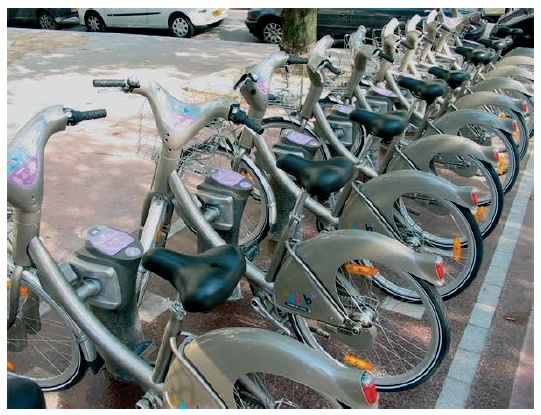
Are you planning a trip to Paris? You can visit the City of Light on a bike!
Every day, Julian gets up, gets dressed and goes to work in Paris, France. He usually goes by car, but this week is different. Julian isn’t taking his car, he’s going by bike.
Julian is one of Paris’s 195,000 users of Vélib’, a bicycle hire network which started in 2007. With Vélib’, people can go to a special station and take a bicycle. They take it where they want to go, and leave it at another station. There are thousands of Vélib’ stations around the city with over 20,000 bicycles at their disposal.
It isn’t only in France. Across Europe, projects like Vélib’ are becoming popular. People are traveling more by bicycle and less by car. There are urban bicycle networks in cities in Spain, England, Austria, Germany, Holland, Denmark and Finland. Other countries across Europe are thinking of similar projects.
‘I think it’s great. The trip to work is not very long, I feel good and it’s cheap’, says Julian.
Pick a Vélib’ up from one station and then leave it at another one near your destination. What could be easier than that?
CLANDFIELD, Lindsay & PICKERING, Kate. Global. Oxford: Macmillan Publishers Limited, 2010. (Adaptado)
When Julian says: ‘It’s great. The trip to work is not long, I feel good and it’s cheap’, he is
Questão 33 291697
UPE 1° Fase 1° Dia 2013Texto
Pedal Power
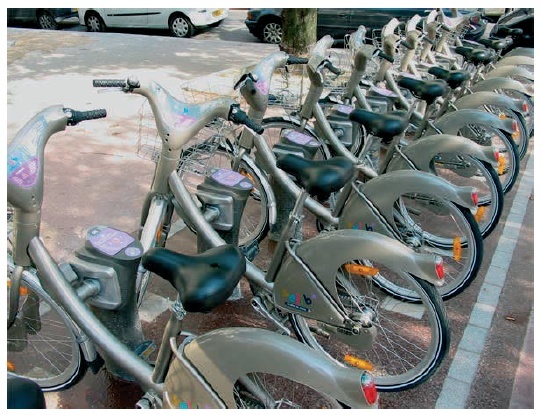
Are you planning a trip to Paris? You can visit the City of Light on a bike!
Every day, Julian gets up, gets dressed and goes to work in Paris, France. He usually goes by car, but this week is different. Julian isn’t taking his car, he’s going by bike.
Julian is one of Paris’s 195,000 users of Vélib’, a bicycle hire network which started in 2007. With Vélib’, people can go to a special station and take a bicycle. They take it where they want to go, and leave it at another station. There are thousands of Vélib’ stations around the city with over 20,000 bicycles at their disposal.
It isn’t only in France. Across Europe, projects like Vélib’ are becoming popular. People are traveling more by bicycle and less by car. There are urban bicycle networks in cities in Spain, England, Austria, Germany, Holland, Denmark and Finland. Other countries across Europe are thinking of similar projects.
‘I think it’s great. The trip to work is not very long, I feel good and it’s cheap’, says Julian.
Pick a Vélib’ up from one station and then leave it at another one near your destination. What could be easier than that?
CLANDFIELD, Lindsay & PICKERING, Kate. Global. Oxford: Macmillan Publishers Limited, 2010. (Adaptado)
Com base no texto, analise os seguintes itens:
I. O projeto Vélib’ é responsável pelo transporte diário de grande parte dos parisienses e, hoje, já supera o uso do carro, dos ônibus e dos trens na França.
II. Vélib’ é um projeto de mobilidade ousado, por isso ainda não encontrou adesão em países importantes da Europa, como Espanha, Inglaterra e Alemanha.
III. Usuários do Vélib’ podem pegar uma bicicleta numa determinada estação, ir para onde desejam e deixá-la em outra, pois há milhares de estações Velib’ em Paris.
IV. No caso do usuário Julian, o Vélib’ só é viável porque ele reside perto do trabalho, mas é desconfortável, além de não ser tão vantajoso quanto se propaga.
V. O projeto Vélib’ teve início em 2007, em Paris, onde o número de usuários chega a 195 000, mas esse serviço de transporte urbano já existe em outros países.
Estão CORRETOS
Questão 50 279746
FACASPER 2013A schematic summary would say as follows: At a founding time, romantic fiction saw the peculiarities of the Brazilian family life under the picturesque and the national identity signs, over which it laid some more or less feuilletonist fabling. The combination, in line with the needs of the young country, was very successful. Although irreverent, the emphasis on mirroring and its somewhat regressive accomplice character formed a positive sign on our particular traits. One generation later, Machado used in a different manner the same thematic, ideological, and aesthetic complexity, this time without the covering mists of local color and patriotic self-congratulation. The large Brazilian family was now observed from the point of view of the enlightened dependent, who was part of it and transformed it into a problem. This is a special system of relationships, with its own structure, resources and problems, which needed to be analyzed. Its difference was a sign of primitiveness, because the tacit measure of the dependent was the Rights of Man, which were effective, in principle, in other regions. The narrator’s fondness shifted to the heroine’s struggles against injustice, which was also portrayed in a feuilletonist fashion. As for the opposing side, it was inevitable that the conflict arrangement, as it developed from book to book, made more visible the negative traits of the landowner. These traits absorbed and reflected precisely, as a fault, the absurd lack of balance between the classes. Using the consequences of this very lack of balance, which gave no signs of internal regeneration, Machado invented the formula that would characterize his mature works and make him a great writer. He did not surrender to the easy delights of romantic picturesqueness. Likewise, he now renounced the unanimous fondness towards the moderate narrator and his good causes.
The new artistic device dealt indirectly with dependents’ frustrations and directly with their abandonment by landowners – the peripheral society incapable of integration resonated. The scope of the formal arrangement, which challenged the secular spirit’s superstitions, especially the trust in progress and in benevolence, is uncomfortable to this day. The insinuating personification of an elite narrator enviably civilized and deeply involved in oppressive relationships, which he arranges and judges himself, is a chess move that disarranges the narrative board, making the game more real. The process challenges readers in every line: it teaches them to think by themselves; to discuss not only the issues, but also their presentation; to consider the narrators and authorities – always the interested party – from a distance, even if they are eloquent; to doubt the civilizing and national commitment of the privileged, particularly in young countries, where this intention plays a major role; to feel an aversion to the imaginary consolations of romanticism, manipulated by the narrative authority to its own benefit. The process teaches, above all, that the combination of the cosmopolitan and the excluded spheres may be stable, without a feasible solution. This demonstration is a juicy one because it illustrates and examines the nation’s “delicious” mechanisms – to use the Machadian term – of the non-bourgeois reproduction of the bourgeois order. However, the demonstration is also universal to some extent, because globally, unlike what it seems, this reproduction is the rule, not the exception.
The heroines of the first novels are not very interesting because their precarious social status is distorted by the romantic cliché. Their vicissitudes, however, stress the antagonistic class traits, whose figure has literary originality. In the novels of the second phase, once the angle is inverted, it is the poor who appear in the subjective mirror of owners, where the prisms are either that of bourgeois individualism or of paternalistic domination, according to the selfish convenience impudence. The dependent becomes extraordinarily relevant in that light. They are portraits of the powerless that get no recognition for the value of work, no rights protected, and no compensation by divine providence. It is the social vacuum generated by modern slavery to freedom without possessions, another issue that, mutatis mutandis, lives on.
In the same line of advanced resonance of the primitiveness, notice how the extra bourgeois aspect of local issues works, and also the narrative relationship itself: at times it is only a shift in the rule; at times it is a movement in its own right, which escapes the dominating definitions and discovers unknown land. To give an idea, compare the part of authority in the definition and dissolution of characters, themselves or others; the relationships between personal separation and the experience of time, between command and insanity – often by the ones in charge; the extra scientific dimensions of science, with its authoritarian and sadistic roles; the overall difference that generates a point of view, etc. In this manner, Machadian fiction and the advanced literature of his time converged – both tried to release other realities under the bourgeois reality. As a mere indication, it is worth mentioning a few similarities, rather at random, in the innovative field, such as Dostoievski, Baudelaire, Henry James, Tchekov, Proust, Kafka, and Borges. Machado’s classical derivations are countless and have led critics to find his merit there, which hinders the understanding of the up-todateness and advanced character of his experimentation.
Choose the alternative that best answers the question: Does the Machadian prose reflect any kind of social criticism?
Questão 49 271150
CESUPA 2013READ THE TEXT BELOW, THEN ANSWER THE FOLLOWING QUESTION.
Skilled Work, Without the Worker
By JOHN MARKOFF
NYTimes: August, 2012
DRACHTEN, the Netherlands — At an electronics factory on the coast of China, hundreds of workers use their hands and specialized tools to assemble electric shavers. That is the old way.
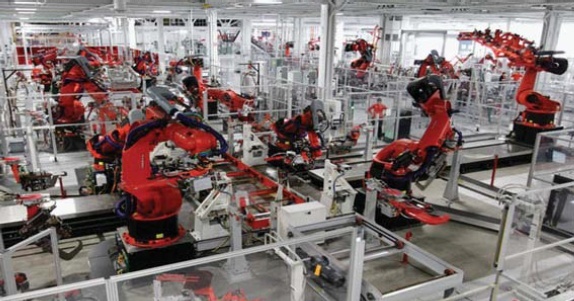
At a sister factory here, in the Dutch countryside, 128 robot arms do the same work with yoga-like flexibility. Video cameras guide them through feats well beyond the capability of the most dexterous human. The arms work so fast that they must be enclosed in glass cages to prevent the people supervising them from being injured. And they do it all without a coffee break — three shifts a day, 365 days a year. All told, the factory here has several dozen workers per shift, about a tenth as many as the one in China.
This is the future. A new wave of robots, far more adept than those now commonly used by automakers and other heavy manufacturers, are replacing workers around the world in both manufacturing and distribution. Factories like the one here in the Netherlands are a striking counterpoint to those used by other electronics giants, which employ hundreds of thousands of low-skilled workers.
Adapted from http://www.nytimes.com/2012/08/19/business/new-wave-of-adept-robots-is-changing-globalindustry.html?ref=technology&_moc.semityn.www
Glossary:
skill - habilidade
tool - ferramenta
to assemble - montar
feat - feito, façanha
to injure - ferir
shift - turno
adept - competente
According to the text, choose the correct alternative in the following question:
According to the text, there are older and modern robots. Older robots have been used in the production of ____.
Questão 48 271147
CESUPA 2013READ THE TEXT BELOW, THEN ANSWER THE FOLLOWING QUESTION.
Skilled Work, Without the Worker
By JOHN MARKOFF
NYTimes: August, 2012
DRACHTEN, the Netherlands — At an electronics factory on the coast of China, hundreds of workers use their hands and specialized tools to assemble electric shavers. That is the old way.
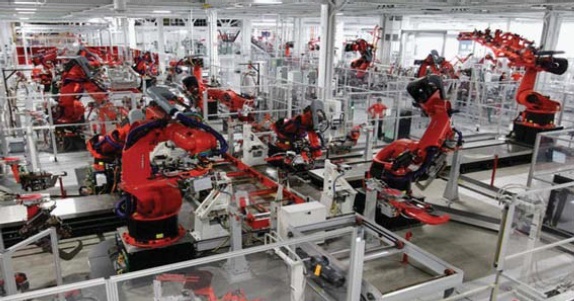
At a sister factory here, in the Dutch countryside, 128 robot arms do the same work with yoga-like flexibility. Video cameras guide them through feats well beyond the capability of the most dexterous human. The arms work so fast that they must be enclosed in glass cages to prevent the people supervising them from being injured. And they do it all without a coffee break — three shifts a day, 365 days a year. All told, the factory here has several dozen workers per shift, about a tenth as many as the one in China.
This is the future. A new wave of robots, far more adept than those now commonly used by automakers and other heavy manufacturers, are replacing workers around the world in both manufacturing and distribution. Factories like the one here in the Netherlands are a striking counterpoint to those used by other electronics giants, which employ hundreds of thousands of low-skilled workers.
Adapted from http://www.nytimes.com/2012/08/19/business/new-wave-of-adept-robots-is-changing-globalindustry.html?ref=technology&_moc.semityn.www
Glossary:
skill - habilidade
tool - ferramenta
to assemble - montar
feat - feito, façanha
to injure - ferir
shift - turno
adept - competente
According to the text, choose the correct alternative in the following question:
In “...supervising them...” (2nd paragraph), them refers to ____.
Questão 40 237148
UESB Caderno 1 2013TEXTO:

The expression “What […] for” (1st picture) is closest in meaning to
06