


![[Marketing] Questao Topo - deslogado](https://storage.estuda.com.br/banners/0_6b7ebee90b03af1c560c73bb8bcce34a_banner_deslogado_70_dias.png)
Questões de Inglês
19.971 Questões
Questão 26 76255
FATEC 2014/1Tooth fairy quantum mechanics
The reason I can’t show you a Higgs boson1 is also the solution to a parental dilemma.
Posted by Jon Butterworth Sunday 23 December 2012 18.36 GMT, theguardian.com
I do sometimes get asked “If you’ve found a Higgs boson, can you show me a picture of it?” Unfortunately, the answer is no. But the reason for this provides a resolution to a severe parental dilemma, and explains why I am in fact sometimes the tooth fairy. Bear with me.
I can’t show you something which is definitely the new boson, but I can show evidence for it, for example in the picture below. It shows the distribution (black dots) of the mass you get when you combine the energy and momenta2 of pairs of photons (particles of light) in the ATLAS detector. The bump shows that there are more of these photon pairs at masses corresponding to around 125 GeV than would be expected from the trend. This excess implies the existence of a particle at about this mass which decays to pairs of photons.
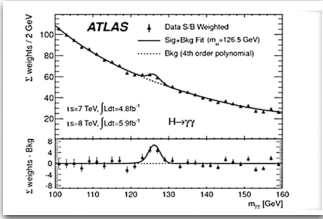
The bump3 in this plot would not be there unless there were a new boson (credit, ATLAS experiment and CERN). The key is that even if I show you a collision event with a pair of photons which exactly gives the “Higgs mass”, i.e. at the top of that peak, it is still not possible to be sure that this exact pair of photons came from a Higgs boson. There may be several possible ways of producing a set of new particles from the incoming ones; but if the resulting set is identical, it is not physically meaningful to say which way occurred.
Now, to the parental dilemma. It is especially acute at this time of year, but if you have children who are losing their milk teeth, it is ever-present. Is the tooth fairy real? What about Father Christmas? Do you spoil the fun or do you lie? Something in me hates the idea of lying to my kids, and undermining4 trust. Here’s my way out. Anything which has the same initial state (tooth) and final state (money) might in fact be an event in which a tooth fairy was present. To put it another way, anything which removes the tooth and delivers money shares such an essential property with a tooth fairy that it can be said to be one (anything removing both teeth and money is probably a dentist. Or possibly a mugger5).
By now, my son doesn’t believe a word of it of course. But in the early days it was the truth. We managed this transition without lies, betrayal and tears because actually, when tiptoeing into the bedroom with a shiny pound coin, I really am the tooth fairy. I am of course also at the same time Dad. This seemed to work, and now he’s older, it’s still fun. It’s not much of stretch to extend this to Father Christmas, and it also explains why sometimes Father Christmas uses the same wrapping paper as your parents - he and they are, in a sense, indistinguishable quantum possibilities for the delivery process.
(theguardian.com/science/life-and-physics/2012/dec/23/tooth-fairy-quantum-mechanics Acesso em: 26.08.2013. Adaptado)
Glossário
1Higgs boson: partícula subatômica teórica que ficou conhecida publicamente após ter sido divulgada como a “partícula de Deus”. Sua existência é associada a pesquisas acerca da origem do universo.
(topics.nytimes.com/top/reference/timestopics/subjects/h/higgs_boson/index.html Acesso em 02.10.2013. Adaptado)
2momenta: plural de momentum – conceito físico associado à quantidade de movimento de uma partícula.
3bump: choque ou elevação.
4undermine: tornar algo gradativamente mais fraco, especialmente a confiança ou autoridade de alguém.
5mugger: assaltante.
Segundo as indicações do texto, o gráfico apresentado
Questão 25 76254
FATEC 2014/1Tooth fairy quantum mechanics
The reason I can’t show you a Higgs boson1 is also the solution to a parental dilemma.
Posted by Jon Butterworth Sunday 23 December 2012 18.36 GMT, theguardian.com
I do sometimes get asked “If you’ve found a Higgs boson, can you show me a picture of it?” Unfortunately, the answer is no. But the reason for this provides a resolution to a severe parental dilemma, and explains why I am in fact sometimes the tooth fairy. Bear with me.
I can’t show you something which is definitely the new boson, but I can show evidence for it, for example in the picture below. It shows the distribution (black dots) of the mass you get when you combine the energy and momenta2 of pairs of photons (particles of light) in the ATLAS detector. The bump shows that there are more of these photon pairs at masses corresponding to around 125 GeV than would be expected from the trend. This excess implies the existence of a particle at about this mass which decays to pairs of photons.
The bump3 in this plot would not be there unless there were a new boson (credit, ATLAS experiment and CERN). The key is that even if I show you a collision event with a pair of photons which exactly gives the “Higgs mass”, i.e. at the top of that peak, it is still not possible to be sure that this exact pair of photons came from a Higgs boson. There may be several possible ways of producing a set of new particles from the incoming ones; but if the resulting set is identical, it is not physically meaningful to say which way occurred.
Now, to the parental dilemma. It is especially acute at this time of year, but if you have children who are losing their milk teeth, it is ever-present. Is the tooth fairy real? What about Father Christmas? Do you spoil the fun or do you lie? Something in me hates the idea of lying to my kids, and undermining4 trust. Here’s my way out. Anything which has the same initial state (tooth) and final state (money) might in fact be an event in which a tooth fairy was present. To put it another way, anything which removes the tooth and delivers money shares such an essential property with a tooth fairy that it can be said to be one (anything removing both teeth and money is probably a dentist. Or possibly a mugger5).
By now, my son doesn’t believe a word of it of course. But in the early days it was the truth. We managed this transition without lies, betrayal and tears because actually, when tiptoeing into the bedroom with a shiny pound coin, I really am the tooth fairy. I am of course also at the same time Dad. This seemed to work, and now he’s older, it’s still fun. It’s not much of stretch to extend this to Father Christmas, and it also explains why sometimes Father Christmas uses the same wrapping paper as your parents - he and they are, in a sense, indistinguishable quantum possibilities for the delivery process.
(theguardian.com/science/life-and-physics/2012/dec/23/tooth-fairy-quantum-mechanics Acesso em: 26.08.2013. Adaptado)
Glossário
1Higgs boson: partícula subatômica teórica que ficou conhecida publicamente após ter sido divulgada como a “partícula de Deus”. Sua existência é associada a pesquisas acerca da origem do universo.
(topics.nytimes.com/top/reference/timestopics/subjects/h/higgs_boson/index.html Acesso em 02.10.2013. Adaptado)
2momenta: plural de momentum – conceito físico associado à quantidade de movimento de uma partícula.
3bump: choque ou elevação.
4undermine: tornar algo gradativamente mais fraco, especialmente a confiança ou autoridade de alguém.
5mugger: assaltante.
De acordo com o texto, é correto afirmar que o bóson de Higgs
Questão 36 76128
UDESC Matutino 2014/1
Check out the meanings below.
I. picture 1= careful with lost girls without wallets.
II. picture 2 = you have to keep dogs on the collar at all times.
III. picture 3 = you can sell it.
IV. picture 4 = you ought to keep off.
V. picture 5 = blind alley street.
Mark the correct alternative according to the meanings from the pictures above.
Questão 32 76124
UDESC Matutino 2014/1Archaeologists use drones to study Peru's ruins
[1] To get a bird's-eye view of ancient sites, archaeologists often turn to planes, helicopters
and even hot air balloons. But today researchers have access to more agile and less
expensive technology to map, explore and protect archaeological treasures: tiny
airborne drones.
[5] In Peru – the home of Machu Picchu and other amazing ruins – the government is
planning to purchase several drones to quickly and cheaply conduct archaeological
surveys in areas targeted for building or development, according to Reuters.
Archaeologists working in the country have already been using small flying robots to
study ancient sites, including the colonial Andean town Machu Llacta, and the San José
[10] de Moro burial grounds, which contain the tombs of Moche priestesses. Some
researchers have even built their own drones for less than $ 2,000, Reuters reported.
"It's like having a scalpel instead of a club," Jeffrey Quilter, an archaeologist at Harvard
University, told the news agency. "You can control it to a very fine degree. You can go
up 3 meters and photograph a room, 300 meters and photograph a site, or you can go
[15] up 3,000 meters and photograph the entire valley."
Cheap and effective drones could be a boon for Peru's culture ministry, which has a
modest budget and is tasked with protecting more than 13,000 archaeological sites that
are threatened by looters, squatters and illegal mining, according to Reuters.
Elsewhere robots have enabled archaeological discovery. A remote-controlled robot the
[20] size of a lawn mower recently found burial chambers inside the Temple of the Feathered
Serpent, an ancient pyramid in Mexico. And in Russia, researchers used a miniature
airborne drone to capture images that could be used to create a 3-D model of an ancient
burial mound.
www.foxnews.com/tech/2013.
Accessed on: 26/08/2013.
The text says:
Questão 30 76122
UDESC Matutino 2014/1Archaeologists use drones to study Peru's ruins
[1] To get a bird's-eye view of ancient sites, archaeologists often turn to planes, helicopters
and even hot air balloons. But today researchers have access to more agile and less
expensive technology to map, explore and protect archaeological treasures: tiny
airborne drones.
[5] In Peru – the home of Machu Picchu and other amazing ruins – the government is
planning to purchase several drones to quickly and cheaply conduct archaeological
surveys in areas targeted for building or development, according to Reuters.
Archaeologists working in the country have already been using small flying robots to
study ancient sites, including the colonial Andean town Machu Llacta, and the San José
[10] de Moro burial grounds, which contain the tombs of Moche priestesses. Some
researchers have even built their own drones for less than $ 2,000, Reuters reported.
"It's like having a scalpel instead of a club," Jeffrey Quilter, an archaeologist at Harvard
University, told the news agency. "You can control it to a very fine degree. You can go
up 3 meters and photograph a room, 300 meters and photograph a site, or you can go
[15] up 3,000 meters and photograph the entire valley."
Cheap and effective drones could be a boon for Peru's culture ministry, which has a
modest budget and is tasked with protecting more than 13,000 archaeological sites that
are threatened by looters, squatters and illegal mining, according to Reuters.
Elsewhere robots have enabled archaeological discovery. A remote-controlled robot the
[20] size of a lawn mower recently found burial chambers inside the Temple of the Feathered
Serpent, an ancient pyramid in Mexico. And in Russia, researchers used a miniature
airborne drone to capture images that could be used to create a 3-D model of an ancient
burial mound.
www.foxnews.com/tech/2013.
Accessed on: 26/08/2013.
The text says:
Questão 29 76121
UDESC Matutino 2014/1Archaeologists use drones to study Peru's ruins
[1] To get a bird's-eye view of ancient sites, archaeologists often turn to planes, helicopters
and even hot air balloons. But today researchers have access to more agile and less
expensive technology to map, explore and protect archaeological treasures: tiny
airborne drones.
[5] In Peru – the home of Machu Picchu and other amazing ruins – the government is
planning to purchase several drones to quickly and cheaply conduct archaeological
surveys in areas targeted for building or development, according to Reuters.
Archaeologists working in the country have already been using small flying robots to
study ancient sites, including the colonial Andean town Machu Llacta, and the San José
[10] de Moro burial grounds, which contain the tombs of Moche priestesses. Some
researchers have even built their own drones for less than $ 2,000, Reuters reported.
"It's like having a scalpel instead of a club," Jeffrey Quilter, an archaeologist at Harvard
University, told the news agency. "You can control it to a very fine degree. You can go
up 3 meters and photograph a room, 300 meters and photograph a site, or you can go
[15] up 3,000 meters and photograph the entire valley."
Cheap and effective drones could be a boon for Peru's culture ministry, which has a
modest budget and is tasked with protecting more than 13,000 archaeological sites that
are threatened by looters, squatters and illegal mining, according to Reuters.
Elsewhere robots have enabled archaeological discovery. A remote-controlled robot the
[20] size of a lawn mower recently found burial chambers inside the Temple of the Feathered
Serpent, an ancient pyramid in Mexico. And in Russia, researchers used a miniature
airborne drone to capture images that could be used to create a 3-D model of an ancient
burial mound.
www.foxnews.com/tech/2013.
Accessed on: 26/08/2013.
Mark the correct alternative which represents the right information about words.
I. “enabled” (line 19) = allow, verb
II. “lawn mower” (line 20) = a machine for cutting grass, noun
III. “site” (line 14) = a spot, noun
IV. “ancient” (line 9) = up to date, verb
V. “quickly” (line 6) = haltingly, adjective
06