


![[Marketing] Questao Topo - deslogado](https://storage.estuda.com.br/banners/0_6b7ebee90b03af1c560c73bb8bcce34a_banner_deslogado_70_dias.png)
Questões de Inglês
19.971 Questões
Questão 92 80764
ENEM 2° Dia (zul) 2014Masters of War
Come you masters of war
You that build all the guns
You that build the death planes
You that build all the bombs
You that hide behind walls
You that hide behind desks
I just want you to know
I can see through your masks.
You that never done nothin’
But build to destroy
You play with my world
Like it’s your little toy
You put a gun in my hand
And you hide from my eyes
And you turn and run farther
When the fast bullets fly.
Like Judas of old
You lie and deceive
A world war can be won
You want me to believe
But I see through your eyes
And I see through your brain
Like I see through the water
That runs down my drain.
BOB DYLAN. The Freewheelin’ Bob Dylan. Nova York: Columbia Records, 1963 (fragmento).
Na letra da canção Masters of War, há questionamentos e reflexões que aparecem na forma de protesto contra
Questão 91 80763
ENEM 2° Dia (zul) 2014A Tall Order
The sky isn’t the limit for an architect building the world's first invisible skyscraper.
Charles Wee, one of the world’s leading high-rise architects, has a confession to make: he’s bored with skyscrapers. After designing more than 30, most of which punctuate the skylines of rapidly expanding Asian cities, he has struck upon a novel concept: the first invisible skyscraper.
As the tallest structure in South Korea, his Infinity Tower will loom over Seoul until somebody pushes a button and it completely disappears.
When he entered a 2004 competition to design a landmark tower, the Korean-American architect rejected the notion of competing with Dubai, Toronto, and Shanghai to reach the summit of man-made summits. “I thought, let’s not jump into this stupid race to build another ‘tallest’ tower,” he says in a phone conversation. “Let’s take an opposite approach — let’s make an anti-tower.”
The result will be a 150-story building that fades from view at the flick of a switch. The tower will effectively function as an enormous television screen, being able to project an exact replica of whatever is happening behind it onto its façade. To the human eye, the building will appear to have melted away.
It will be the most extraordinary achievement of Wee’s stellar architectural career. After graduating from UCLA, he worked under Anthony Lumsden, a prolific Californian architect who helped devise the modern technique of wrapping buildings inside smooth glass skins.
HINES, N. Disponível em: http://mag.newsweek.com. Acesso em: 13 out. 2013 (adaptado)
No título e no subtítulo desse texto, as expressões A Tall Order e The sky isn’t the limit são usadas para apresentar uma matéria cujo tema é:
Questão 30 80313
UNESP 2014/2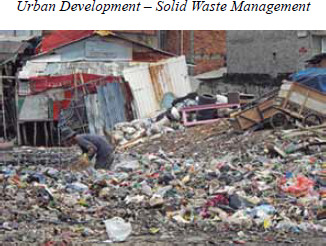
Ask a mayor of a developing country city about his or her most pressing problems, and solid waste management generally will be high on the list. For many cities, solid waste management is their single largest budget item and largest employer.
It is also a critical matter of public health, environmental quality, quality of life, and economic development. A city that cannot effectively manage its waste is rarely able to manage more complex services such as health, education or transportation. And no one wants to live in a city surrounded by garbage.
As the world urbanizes, the situation is becoming more acute. More people mean more garbage, especially in fastgrowing cities where the bulk of waste is generated. We estimate that cities currently generate roughly 1.3 billion tonnes of solid waste per year; with current urbanization trends, this figure will grow to 2.2 billion tonnes per year by 2025 – an increase of 70 percent.
Managing waste will also become more expensive. Expenditures that today total $205 billion will grow to $375 billion. The cost impacts will be most severe in low income countries already struggling to meet basic social and infrastructure needs, particularly for their poorest residents.
Because it is such a major issue, waste management also represents a great opportunity for cities. Managed well, solid waste management practices can reduce greenhouse gas emission levels in a city, including short-lived climate pollutants that are far more potent than carbon dioxide. A city’s ability to keep solid waste out of drainage ditches can also influence whether a neighborhood floods after a heavy storm.
(www.worldbank.org. Adaptado.)
No trecho do último parágrafo – A city’s ability to keep solid waste out of drainage ditches can also influence whether a neighborhood floods after a heavy storm. –, a palavra whether pode ser substituída, sem alteração de sentido, por
Questão 28 80311
UNESP 2014/2
Ask a mayor of a developing country city about his or her most pressing problems, and solid waste management generally will be high on the list. For many cities, solid waste management is their single largest budget item and largest employer.
It is also a critical matter of public health, environmental quality, quality of life, and economic development. A city that cannot effectively manage its waste is rarely able to manage more complex services such as health, education or transportation. And no one wants to live in a city surrounded by garbage.
As the world urbanizes, the situation is becoming more acute. More people mean more garbage, especially in fastgrowing cities where the bulk of waste is generated. We estimate that cities currently generate roughly 1.3 billion tonnes of solid waste per year; with current urbanization trends, this figure will grow to 2.2 billion tonnes per year by 2025 – an increase of 70 percent.
Managing waste will also become more expensive. Expenditures that today total $205 billion will grow to $375 billion. The cost impacts will be most severe in low income countries already struggling to meet basic social and infrastructure needs, particularly for their poorest residents.
Because it is such a major issue, waste management also represents a great opportunity for cities. Managed well, solid waste management practices can reduce greenhouse gas emission levels in a city, including short-lived climate pollutants that are far more potent than carbon dioxide. A city’s ability to keep solid waste out of drainage ditches can also influence whether a neighborhood floods after a heavy storm.
(www.worldbank.org. Adaptado.)
Segundo o texto, o maior impacto do aumento de custos da gestão de resíduos sólidos será sobre
Questão 27 80310
UNESP 2014/2
Ask a mayor of a developing country city about his or her most pressing problems, and solid waste management generally will be high on the list. For many cities, solid waste management is their single largest budget item and largest employer.
It is also a critical matter of public health, environmental quality, quality of life, and economic development. A city that cannot effectively manage its waste is rarely able to manage more complex services such as health, education or transportation. And no one wants to live in a city surrounded by garbage.
As the world urbanizes, the situation is becoming more acute. More people mean more garbage, especially in fastgrowing cities where the bulk of waste is generated. We estimate that cities currently generate roughly 1.3 billion tonnes of solid waste per year; with current urbanization trends, this figure will grow to 2.2 billion tonnes per year by 2025 – an increase of 70 percent.
Managing waste will also become more expensive. Expenditures that today total $205 billion will grow to $375 billion. The cost impacts will be most severe in low income countries already struggling to meet basic social and infrastructure needs, particularly for their poorest residents.
Because it is such a major issue, waste management also represents a great opportunity for cities. Managed well, solid waste management practices can reduce greenhouse gas emission levels in a city, including short-lived climate pollutants that are far more potent than carbon dioxide. A city’s ability to keep solid waste out of drainage ditches can also influence whether a neighborhood floods after a heavy storm.
(www.worldbank.org. Adaptado.)
No trecho do terceiro parágrafo – this figure will grow –, a palavra figure refere-se, no texto, a
Questão 25 80308
UNESP 2014/2
Ask a mayor of a developing country city about his or her most pressing problems, and solid waste management generally will be high on the list. For many cities, solid waste management is their single largest budget item and largest employer.
It is also a critical matter of public health, environmental quality, quality of life, and economic development. A city that cannot effectively manage its waste is rarely able to manage more complex services such as health, education or transportation. And no one wants to live in a city surrounded by garbage.
As the world urbanizes, the situation is becoming more acute. More people mean more garbage, especially in fastgrowing cities where the bulk of waste is generated. We estimate that cities currently generate roughly 1.3 billion tonnes of solid waste per year; with current urbanization trends, this figure will grow to 2.2 billion tonnes per year by 2025 – an increase of 70 percent.
Managing waste will also become more expensive. Expenditures that today total $205 billion will grow to $375 billion. The cost impacts will be most severe in low income countries already struggling to meet basic social and infrastructure needs, particularly for their poorest residents.
Because it is such a major issue, waste management also represents a great opportunity for cities. Managed well, solid waste management practices can reduce greenhouse gas emission levels in a city, including short-lived climate pollutants that are far more potent than carbon dioxide. A city’s ability to keep solid waste out of drainage ditches can also influence whether a neighborhood floods after a heavy storm.
(www.worldbank.org. Adaptado.)
Segundo o texto, a gestão de resíduos sólidos
06