


![[Marketing] Questao Topo - deslogado](https://storage.estuda.com.br/banners/0_6b7ebee90b03af1c560c73bb8bcce34a_banner_deslogado_70_dias.png)
Questões de Inglês
19.971 Questões
Questão 25 7337687
UNIVESP 2022Leia a tirinha.
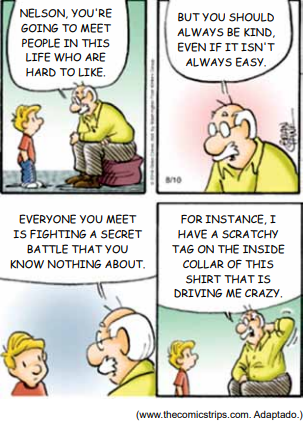
No segundo quadrinho, o homem aconselha o menino a ser sempre
Questão 23 7337683
UNIVESP 2022Leia o texto para responder à questão.
New Zealand will ban the sale of tobacco to its next generation, in a bid to eventually phase out smoking. Anyone born after 2008 will not be able to buy cigarettes or tobacco products in their lifetime, under a law expected to be enacted in 2022. “We want to make sure young people never start smoking,” Health Minister Dr Ayesha Verall said. The move is part of a sweeping crackdown on smoking announced by New Zealand’s Health Ministry.
Doctors and other health experts in the country have welcomed the “world-leading” reforms, which will reduce access to tobacco and restrict nicotine levels in cigarettes. “It will help people quit smoking or switch to less harmful products, and make it much less likely that young people get addicted to nicotine,” said Prof Janet Hook from the University of Otago.
The crackdown has been met with mixed reactions. “I reckon it’s a good move, really,” one man told Reuters news agency. “Because right now there’s a lot of young kids walking around with smokes in their mouth. Public are asking how they’re getting these smokes. And it’s also good for myself too because I can save more money.”
However, others have warned that the move may create a black market for tobacco — something the Health Ministry’s official impact statement does acknowledge, noting “customs will need more resource to enforce border control”. “This is all 100% theory and 0% substance,” Sunny Kaushal, chairman of the Dairy and Business Owners Group, a lobby group for local convenience stores, told New Zealand’s Stuff news site. “There’s going to be a crime wave. Gangs and criminals will fill the gap.”
(www.bbc.com, 09.12.2021. Adaptado.)
No trecho do quarto parágrafo “However, others have warned that the move may create a black market for tobacco”, o termo sublinhado expressa uma
Questão 44 7256392
PUC-PR Verão Medicina 2022De acordo com o texto abaixo, o que se pode afirmar sobre eczema?
Eczema
Medically Reviewed by Stephanie S. Gardner, MD on March 02, 2021
What Is Eczema?
Eczema is a group of conditions that make your skin inflamed or irritated. The most common type is atopic dermatitis or atopic eczema. “Atopic” refers to a person’s tendency to get allergic conditions such as asthma and hay fever. Eczema affects about 10% to 20% of infants and about 3% of adults and children in the U.S. Most children outgrow it by their 10th birthday. Some people continue to have symptoms on and off for life. There’s no cure, but most people can manage their symptoms by getting treatment and by avoiding irritants. Eczema isn’t contagious, so you can’t spread it to another person.
Eczema Symptoms
Eczema looks different for everyone. And your flare-ups won’t always happen in the same area. No matter which part of your skin is affected, eczema is almost always itchy. The itching sometimes starts before the rash. Your skin may also be: red, dry, cracked and leathery.
Disponível em: https://www.webmd.com/skin-problems-and-treatments/eczema/atopic-dermatitis-eczema Access September 9th, 2021
Questão 42 7256358
PUC-PR Verão Medicina 2022Leia o texto abaixo e em seguida escolha a alternativa CORRETA sobre “sundowning”:
How to Manage "Sundowning"
By Brenda Goodman, MA (Medically Reviewed by Christopher Melinosky, MD on December 04, 2019).
When you are with someone who has Alzheimer's disease, you may notice big changes in how they act in the late afternoon or early evening. Doctors call it sundowning, or sundown syndrome.
Fading light seems to be the trigger. The symptoms can get worse as the night goes on and usually get better by morning.
Although you may not be able to stop it completely, you can take steps to help manage this challenging time of day so you both sleep better and are less tired during the day. Let your loved one’s doctor know what changes you have seen, too.
Symptoms
When someone is sundowning, they may be: agitated (upset or anxious), restless, irritable, confused, disoriented, demanding and suspicious. They also may: yell, pace, hear or see things that aren’t there and have mood swings. Up to 1 out of 5 people with Alzheimer’s get sundown syndrome. But it can also happen to older people who don’t have dementia.
Disponível em: https://www.webmd.com/alzheimers/guide/manage-sundowning Access September 9th, 2021
Questão 21 7224247
PUC-Campinas Direito 2022Para responder a questão considere o texto abaixo.
If prisoners are to help with the UK’s labour shortages, they must not be exploited
By Frances Crook
Food manufacturers have called on ministers to alleviate labour shortages by allowing them to employ prisoners. This comes as other firms, from transportation companies to supermarkets, are also finding themselves short of workers for reasons relating to Brexit and the pandemic. Prisoners could indeed help out, if they are given the opportunity to do real work for a real wage – but a lot would need to change to make this happen, not least the prisons.
Very few prisoners have the opportunity to do real work, and many would jump at the chance to get out of their cells and do something useful and social that would give them money to support their families and buy little luxuries like soap, some extra food and even enrol in education programmes.
There are two groups of prisoners who can come to the aid of business. The first and easiest to get working are the 3,000 men and women in England and Wales held in open prisons who have been assessed as low-risk and who are coming to the end of their sentence. Some are already employed outside through the “release on temporary licence” (ROTL) system, which is an important part of the process for the resettlement and rehabilitation of prisoners. It is a key element for the preparation of their safe release as it gives them the chance to organise work, housing and re-establish relationships with families and their communities. The second group are the 40,000 men, and a handful of women, serving long sentences, many of whom will simply idle for years and years unless progress is made.
If prisoners are to be employed to work for private companies, then they should have workers’ rights, be paid the same rate for the job as anyone else, and pay tax and national insurance. They must not be exploited as cheap labour to take on the roles for which companies do not want to raise wages. Public acceptance of such endeavours will depend on prisoners competing fairly with people in the community and not being used to undercut or undermine working conditions.
The barrier to expanding opportunities also lies with the extremely risk-averse attitude in the Prison Service. Currently, prisons are restricted as to how many people may apply for work in the community, but this could easily be expanded. Prisons would need to focus on getting people work-ready, which means providing practical things such as showers, breakfast, transport and encouragement. Companies would prosper, but so would the wider community, as we all know that having a job – along with having somewhere to live and someone to care for you – provides the best hope for successful reintegration after release.
For those serving long sentences, the work available in prisons is dull, demeaning and poorly remunerated. There is perhaps the chance to do a bit of cleaning prison wings for pocket money, but little else. It leads nowhere and, compared with crime, lacks excitement. If we offer the opportunity to long-termers to be gainfully employed during their sentence, they can save for release, pay tax and national insurance and contribute to a pension scheme. They would be citizens, but behind bars.
This can only be done if prisons allow businesses to run independently inside. There are lots of low-security prisons with huge, barely used workshops that could be turned over to manufacturing, packing and processing companies to employ prisoners inside the jail directly. Prisons cannot run businesses, so outside firms must move in. The state should be responsible for security and safety, but there is no reason that private enterprise could not do exactly as it does in the community.
(Adapted from https://www.theguardian.com)
Segundo o texto,
Questão 19 7111506
UEMA PAES 2022Low-Context Versus High-Context Cultures
If you have traveled much, perhaps you have noticed that people in various parts of the world differ in how direct and explicit their language is. You may have spent time in both low- and high-context cultures in your travels, with context here referring to the broad range of factors surrounding every act of communication.
In a low-context culture, people are expected to be direct and to say what they mean. Individuals in lowcontext cultures prefer precise, concrete language for sending and receiving messages, and are unlikely to rely on the context of a message to determine its meaning. The United States is an example of a low-context society, as are Canada, Israel, and most northern European countries.
In contrast, people in a high-context culture — such as Korea and the cultures of Native Americans and the Maori of New Zealand — are taught to speak in a much less direct way. In such cultures, maintaining harmony and avoiding offense are more important than expressing true feelings. Speech is more ambiguous and people convey much more of their meaning through subtle behaviors and contextual cues, such as their facial expressions and tone of voice.
The difference between low-context and high-context cultures is evident in the ways in which people handle criticism and disagreement. In a low-context culture, a supervisor might reprimand an irresponsible employee openly, to make an example of the individual. The supervisor would probably be direct and explicit about the employee’s shortcomings, the company’s expectations for improvement, and the consequences of the employee’s failing to meet those expectations.
In a high-context culture, however, the supervisor probably wouldn’t reprimand the employee publicly for fear that it would put the employee to shame and cause the worker to “lose face.” Criticism in high-context cultures is more likely to take place in private. The supervisor would also likely use more ambiguous language to convey what the employee was doing wrong, “talking around” the issue instead of confronting it directly. To reprimand an employee for repeated absences, for example, a supervisor might point out that responsibility to coworkers is important and that letting down the team would be cause for shame. The supervisor may never actually say that the employee needs to improve his or her attendance record. Instead, the employee would be expected to understand that message by listening to what the supervisor says and paying attention to the supervisor’s body language, tone of voice, and facial expressions.
When people from low- and high-context cultures communicate with one another, the potential for misunderstanding is great. To appreciate that point, imagine that you’ve asked two of your friends to meet you tomorrow evening for a coffee tasting at a popular bookstore cafe. Tina, an American, says, “No, I’ve got a lot of studying to do, but thanks anyway.” Lee, who grew up in South Korea, nods his head and says, “That sounds like fun.” Thus, you’re surprised later when Lee doesn’t show up.
How can you account for those different behaviors? The answer is that people raised in a high-context culture (such as that of South Korea) are often reluctant to say no—even when they mean no—for fear of causing offense. Another person raised in the South Korean culture might have understood from Lee’s facial expression or tone of voice that he didn’t intend to go to the coffee tasting. If you, like Tina, grew up in a low-context society, however, then you probably interpreted his answer and his nods to mean he was accepting your invitation.
Referência Bibliográfica FLOYD, KORY. Communication Matters. New York: McGraw-Hill Education. 2018.
The traits of a person who’s grown up in a low-context culture country is
06