


![[Marketing] Questao Topo - deslogado](https://storage.estuda.com.br/banners/0_6b7ebee90b03af1c560c73bb8bcce34a_banner_deslogado_70_dias.png)
Questões de Inglês
19.971 Questões
Questão 58 97982
FACERES Medicina 2014/2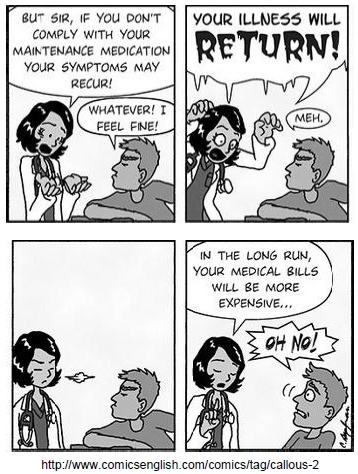
The conditional statement in ―If you don‘t comply with your maintenance medication your symptoms may recur‖ is:
Questão 57 97981
FACERES Medicina 2014/2
According to the comic strip, in which degree is the adjective expressed in ―In the long run, your medical bills will be more expensive‖:
Questão 44 97821
UniCesumar Medicina 2014HEALTH & SCIENCE
The sound of music and other techniques to help kids deal
with pain at the doctor's office
Extracted from The Washington Post
By Jill U. Adams, Published: September 16 in http://www.washingtonpost.com/national/healthscience/
the-sound-of-music-and-other-techniques-to-help-kids-deal-with-pain-at-the-doctorsoffice/
2013/09/16/41ab9f4a-14b2-11e3-880b-7503237cc69d_story.html?hpid=z6
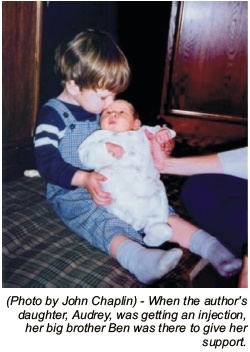
[1] I remember the appointment vividly. My infant daughter waited unknowingly for the
shots; my 2-year-old son, worried, began to sing her favourite song. My son and I got
our faces up close and touched my daughter's hands and belly while the doctor
administered the immunizations in her thigh. Baby Audrey winced momentarily, then
returned to smiling as she gazed up at us. I was amazed, and my son felt empowered.
[2] It turns out that there's science to support our actions. A growing body of research
shows what many parents know instinctively: Music is an effective way to distract
young children from painful medical procedures.
[3] “It's one more tool we have in our handbag to help
children,” said Lisa Hartling, director of the Alberta
Research Center for Health Evidence in Canada,
who has studied the role of music in mitigating
medical-procedure stress in kids.
[4] Hartling co-authored a study this year that
measured the effect of recorded music during the
insertion of an intravenous line. Researchers
monitored pain and distress in 42 children, ages 3
to 11, before and after the procedure. Half received
standard emergency room care; the other half
listened to musical selections played via room
speakers. The IV insertion was distressing to all
kids, but researchers observed twice as many signs
of distress in kids who weren't exposed to music as
in those who were. Pain, as reported by the kids,
increased with the procedure in those who didn't
have the music, but remained low in those who did.
[5] Not just any music will do the trick, according to Hartling. The purpose is to distract
rather than soothe, she explains, and booming, complicated music is most effective at
this. One piece used in the study was “Jupiter” from the symphony “The Planets.” “It's
very energetic, with lots of sounds and themes,” Hartling says.
[6] Other useful techniques include storytelling, guided imagery (talking to kids about a
special place or event), blowing soap bubbles and, not surprisingly, tablet games.
Sipping sugar water, sitting in parents' laps and deep breathing can also help mitigate
children's pain in the doctor's office or the emergency room.
[7] Such distractions might require a rethinking of the doctor visit.
No parágrafo 7, “distractions” refere-se a:
Questão 42 97819
UniCesumar Medicina 2014HEALTH & SCIENCE
The sound of music and other techniques to help kids deal
with pain at the doctor's office
Extracted from The Washington Post
By Jill U. Adams, Published: September 16 in http://www.washingtonpost.com/national/healthscience/
the-sound-of-music-and-other-techniques-to-help-kids-deal-with-pain-at-the-doctorsoffice/
2013/09/16/41ab9f4a-14b2-11e3-880b-7503237cc69d_story.html?hpid=z6
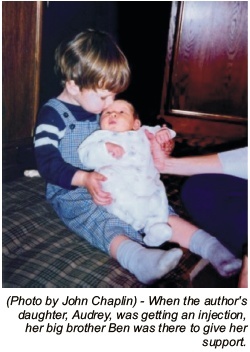
[1] I remember the appointment vividly. My infant daughter waited unknowingly for the
shots; my 2-year-old son, worried, began to sing her favourite song. My son and I got
our faces up close and touched my daughter's hands and belly while the doctor
administered the immunizations in her thigh. Baby Audrey winced momentarily, then
returned to smiling as she gazed up at us. I was amazed, and my son felt empowered.
[2] It turns out that there's science to support our actions. A growing body of research
shows what many parents know instinctively: Music is an effective way to distract
young children from painful medical procedures.
[3] “It's one more tool we have in our handbag to help
children,” said Lisa Hartling, director of the Alberta
Research Center for Health Evidence in Canada,
who has studied the role of music in mitigating
medical-procedure stress in kids.
[4] Hartling co-authored a study this year that
measured the effect of recorded music during the
insertion of an intravenous line. Researchers
monitored pain and distress in 42 children, ages 3
to 11, before and after the procedure. Half received
standard emergency room care; the other half
listened to musical selections played via room
speakers. The IV insertion was distressing to all
kids, but researchers observed twice as many signs
of distress in kids who weren't exposed to music as
in those who were. Pain, as reported by the kids,
increased with the procedure in those who didn't
have the music, but remained low in those who did.
[5] Not just any music will do the trick, according to Hartling. The purpose is to distract
rather than soothe, she explains, and booming, complicated music is most effective at
this. One piece used in the study was “Jupiter” from the symphony “The Planets.” “It's
very energetic, with lots of sounds and themes,” Hartling says.
[6] Other useful techniques include storytelling, guided imagery (talking to kids about a
special place or event), blowing soap bubbles and, not surprisingly, tablet games.
Sipping sugar water, sitting in parents' laps and deep breathing can also help mitigate
children's pain in the doctor's office or the emergency room.
[7] Such distractions might require a rethinking of the doctor visit.
In paragraph 4, Hartling\'s research showed that
Questão 41 97818
UniCesumar Medicina 2014HEALTH & SCIENCE
The sound of music and other techniques to help kids deal
with pain at the doctor's office
Extracted from The Washington Post
By Jill U. Adams, Published: September 16 in http://www.washingtonpost.com/national/healthscience/
the-sound-of-music-and-other-techniques-to-help-kids-deal-with-pain-at-the-doctorsoffice/
2013/09/16/41ab9f4a-14b2-11e3-880b-7503237cc69d_story.html?hpid=z6
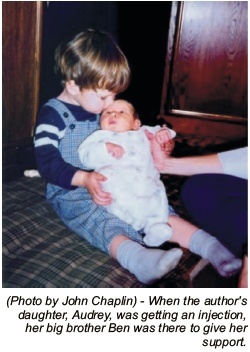
[1] I remember the appointment vividly. My infant daughter waited unknowingly for the
shots; my 2-year-old son, worried, began to sing her favourite song. My son and I got
our faces up close and touched my daughter's hands and belly while the doctor
administered the immunizations in her thigh. Baby Audrey winced momentarily, then
returned to smiling as she gazed up at us. I was amazed, and my son felt empowered.
[2] It turns out that there's science to support our actions. A growing body of research
shows what many parents know instinctively: Music is an effective way to distract
young children from painful medical procedures.
[3] “It's one more tool we have in our handbag to help
children,” said Lisa Hartling, director of the Alberta
Research Center for Health Evidence in Canada,
who has studied the role of music in mitigating
medical-procedure stress in kids.
[4] Hartling co-authored a study this year that
measured the effect of recorded music during the
insertion of an intravenous line. Researchers
monitored pain and distress in 42 children, ages 3
to 11, before and after the procedure. Half received
standard emergency room care; the other half
listened to musical selections played via room
speakers. The IV insertion was distressing to all
kids, but researchers observed twice as many signs
of distress in kids who weren't exposed to music as
in those who were. Pain, as reported by the kids,
increased with the procedure in those who didn't
have the music, but remained low in those who did.
[5] Not just any music will do the trick, according to Hartling. The purpose is to distract
rather than soothe, she explains, and booming, complicated music is most effective at
this. One piece used in the study was “Jupiter” from the symphony “The Planets.” “It's
very energetic, with lots of sounds and themes,” Hartling says.
[6] Other useful techniques include storytelling, guided imagery (talking to kids about a
special place or event), blowing soap bubbles and, not surprisingly, tablet games.
Sipping sugar water, sitting in parents' laps and deep breathing can also help mitigate
children's pain in the doctor's office or the emergency room.
[7] Such distractions might require a rethinking of the doctor visit.
Nos parágrafos 1 e 2, a presença da música faz
Questão 7 97331
Unioeste 2° Dia 2014Climate change "spreads crop pests"
Global warming is helping pests and diseases that attack crops to spread around the world, according to a new study published in the journal Nature Climate Change.
Researchers from the universities of Exeter and Oxford have found that crop pests are moving towards the North and South poles as regions warm.
The researchers looked at more than 600 crop pests from around the world. These included fungi, such as wheat rust, which is devastating harvests in Africa and the Middle East; insects like the mountain pine beetle that's destroying trees in the US; as well as bacteria, viruses and microscopic nematode worms.
They found that over the past 50 years, these destructive species have been on the move. On average, they're spreading 3 km every year, shifting north and south towards the poles.
The scientists say this correlates with warming temperatures, allowing the pests to take hold in areas that were once too cold for them to live in.
Currently, between 10 % and 20% of the world's crops are lost to pests and the team warns that rising global temperatures could make the problem worse. The researchers say that improved surveillance of the problem is needed.
Adapted from: http://www.bbc.co.uk
Os verbos -have been e – thought encontram-se, respectivamente, nos seguintes tempos verbais:
06