


![[Marketing] Questao Topo - deslogado](https://storage.estuda.com.br/banners/0_6b7ebee90b03af1c560c73bb8bcce34a_banner_deslogado_70_dias.png)
Questões de Inglês
19.971 Questões
Questão 77 107197
UFPR 2014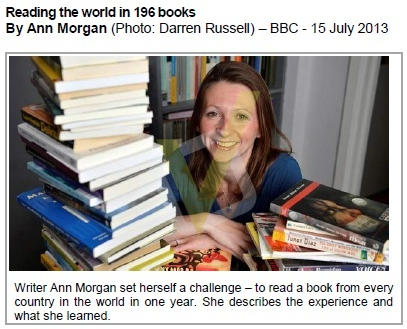
I used to think of myself as a fairly cosmopolitan sort of person, but my bookshelves told a different story. Apart from a few Indian novels and the odd Australian and South African book, my literature collection consisted of British and American titles. Worse still, I hardly ever tackled anything in translation. My reading was confined to stories by English-speaking authors.
So, at the start of 2012, I set myself the challenge of trying to read a book from every country (well, all 195 United Nations (UN) recognised states plus former UN member Taiwan) in a year to find out what I was missing. With no idea how to go about this beyond a sneaking suspicion that I was unlikely to find publications from nearly 200 nations on the shelves of my local bookshop, I decided to ask the planet’s readers for help. I created a blog called A Year of Reading the World and put out an appeal for suggestions of titles that Writer Ann Morgan set herself a I could read in English.
The response was amazing. Before I knew it, people all over the planet were getting in touch with ideas and offers of help. Some posted me books from their home countries. Others did hours of research on my behalf. In addition, several writers, like Turkmenistan’s Ak Welsapar and Panama’s Juan David Morgan, sent me unpublished translations of their novels, giving me a rare opportunity to read works otherwise unavailable to the 62% of Brits who only speak English. Even with such an extraordinary team of bibliophiles behind me, however, sourcing books was no easy task. For a start, with translations making up only around 4.5 per cent of literary works published in the UK and Ireland, getting English versions of stories was tricky.
But the effort was worth it. As I made my way through the planet’s literary landscapes, extraordinary things started to happen. In the hands of gifted writers, I discovered bookpacking offered something a physical traveller could hope to experience only rarely: it took me inside the thoughts of individuals living far away and showed me the world through their eyes. More powerful than a thousand news reports, these stories not only opened my mind to the nuts and bolts of life in other places, but opened my heart to the way people there might feel.
And that in turn changed my thinking. Through reading the stories shared with me by bookish strangers around the globe, I realised I was not an isolated person, but part of a network that stretched all over the planet. One by one, the country names on the list that had begun as an intellectual exercise at the start of the year transformed into vital, vibrant places filled with laughter, love, anger, hope and fear. Lands that had once seemed exotic and remote became close and familiar to me – places I could identify with. At its best, I learned, fiction makes the world real. (adapted from )
Mark the correct alternative, according to the text.
Questão 76 107196
UFPR 2014
I used to think of myself as a fairly cosmopolitan sort of person, but my bookshelves told a different story. Apart from a few Indian novels and the odd Australian and South African book, my literature collection consisted of British and American titles. Worse still, I hardly ever tackled anything in translation. My reading was confined to stories by English-speaking authors.
So, at the start of 2012, I set myself the challenge of trying to read a book from every country (well, all 195 United Nations (UN) recognised states plus former UN member Taiwan) in a year to find out what I was missing. With no idea how to go about this beyond a sneaking suspicion that I was unlikely to find publications from nearly 200 nations on the shelves of my local bookshop, I decided to ask the planet’s readers for help. I created a blog called A Year of Reading the World and put out an appeal for suggestions of titles that Writer Ann Morgan set herself a I could read in English.
The response was amazing. Before I knew it, people all over the planet were getting in touch with ideas and offers of help. Some posted me books from their home countries. Others did hours of research on my behalf. In addition, several writers, like Turkmenistan’s Ak Welsapar and Panama’s Juan David Morgan, sent me unpublished translations of their novels, giving me a rare opportunity to read works otherwise unavailable to the 62% of Brits who only speak English. Even with such an extraordinary team of bibliophiles behind me, however, sourcing books was no easy task. For a start, with translations making up only around 4.5 per cent of literary works published in the UK and Ireland, getting English versions of stories was tricky.
But the effort was worth it. As I made my way through the planet’s literary landscapes, extraordinary things started to happen. In the hands of gifted writers, I discovered bookpacking offered something a physical traveller could hope to experience only rarely: it took me inside the thoughts of individuals living far away and showed me the world through their eyes. More powerful than a thousand news reports, these stories not only opened my mind to the nuts and bolts of life in other places, but opened my heart to the way people there might feel.
And that in turn changed my thinking. Through reading the stories shared with me by bookish strangers around the globe, I realised I was not an isolated person, but part of a network that stretched all over the planet. One by one, the country names on the list that had begun as an intellectual exercise at the start of the year transformed into vital, vibrant places filled with laughter, love, anger, hope and fear. Lands that had once seemed exotic and remote became close and familiar to me – places I could identify with. At its best, I learned, fiction makes the world real. (adapted from )
Which of these statements DOES NOT CORRESPOND to information given in the text about Ann Morgan’s experience?
Questão 14 106972
UNIVAG 2014/1Near-death experiences may not be figment of imagination
Danielle Elliot
August 12, 2013
The brain remains conscious after the heart stops beating, according to University of Michigan researchers. It may even function higher in the moments immediately following cardiac arrest* than it does when the body is in a normal state.
The finding supports the shared experience of nearly 20 percent of people who have survived cardiac arrest. These survivors report having internal visions and heightened perception, known as near-death experiences, but the scientific reality of the experience has long been debated.
In a study published Monday in the Proceedings of the National Academy of Science, the team explains that in a study of nine rats, they observed continued brain activity even after the heart stopped beating and blood flow ceased. Compared to anesthesized and walking states, brain activity and coherence actually increased immediately following cardiac arrest. While the sample size is small, the results were observed in all nine of the rats studied.
“This study, performed in animals, is the first dealing with what happens to the neurophysiological state of the dying brain,” lead study author Jimo Borjigin, Ph.D., associate professor of molecular and integrative physiology and associate professor of neurology at the University of Michigan Medical School, said in a statement.
“It will form the foundation for future human studies investigating mental experiences occurring in the dying brain, including seeing light during cardiac arrest,” she added.
(www.cbsnews.com. Adaptado.)
No trecho do segundo parágrafo – These survivors report having internal visions and heightened perception, known as near-death experiences, but the scientific reality of the experience has long been debated. –, a palavra em destaque pode ser substituída, sem alteração de sentido, por
Questão 11 106969
UNIVAG 2014/1Near-death experiences may not be figment of imagination
Danielle Elliot
August 12, 2013
The brain remains conscious after the heart stops beating, according to University of Michigan researchers. It may even function higher in the moments immediately following cardiac arrest* than it does when the body is in a normal state.
The finding supports the shared experience of nearly 20 percent of people who have survived cardiac arrest. These survivors report having internal visions and heightened perception, known as near-death experiences, but the scientific reality of the experience has long been debated.
In a study published Monday in the Proceedings of the National Academy of Science, the team explains that in a study of nine rats, they observed continued brain activity even after the heart stopped beating and blood flow ceased. Compared to anesthesized and walking states, brain activity and coherence actually increased immediately following cardiac arrest. While the sample size is small, the results were observed in all nine of the rats studied.
“This study, performed in animals, is the first dealing with what happens to the neurophysiological state of the dying brain,” lead study author Jimo Borjigin, Ph.D., associate professor of molecular and integrative physiology and associate professor of neurology at the University of Michigan Medical School, said in a statement.
“It will form the foundation for future human studies investigating mental experiences occurring in the dying brain, including seeing light during cardiac arrest,” she added.(www.cbsnews.com. Adaptado.)
De acordo com o texto, é correto afirmar que
Questão 15 106911
UNIVAG 2014/2Can You Die From Drinking Too Much Soda?
Alexandra Sifferlin
February 08, 2014
Parents of a 5-year-old girl who reportedly forced their daughter to drink more than 2 L of soda and water were charged with murder Friday. After drinking some of her stepmother’s grape soda, Alexa Linboom was made to chug several 12-oz. bottles of it over one or two hours as a form of punishment. After vomiting, screaming in pain and urinating on herself, Alexa became paralyzed, and then unconscious, according to the Associated Press. An autopsy report of the child in 2012 revealed that the massive intake of liquids caused her brain to swell, and then herniate. Officially, Alexa died of acute fluid intoxication, and her death was ruled a homicide.
Drinking water is good for us, but drinking too much water – or, in this case, soda – too quickly can be deadly. Our kidneys are supposed to keep our bodies balanced by controlling how much water and salt leaves the body. But if a person drinks more water than the body can handle, the kidneys can’t keep up. The excess water starts to enter the cells, and that’s when things get dangerous.
When it comes to water intoxication, it’s about the amount of fluid consumed, and not the type, says Dr. Robert Glatter, an emergency-medicine physician at Lenox Hill Hospital in New York City. But soda can exacerbate the problem because it results in more fluid when the carbonation breaks down.
Acute fluid intoxication, also known as water intoxication or water poisoning, occurs when the electrolytes in cells in the bloodstream and brain neurons become so diluted they can no longer function. As more water enters the body, sodium ions – critical to cell and nerve function, and especially transporting nutrients throughout the body – exit the cells.
Abnormally low sodium levels in the body lead to hyponatremia, explains Glatter. Depending on how quickly an individual’s sodium levels drop, symptoms can come at different speeds. These symptoms may be similar to being drunk from alcohol, and people may experience nausea, vomiting, slurred speech, headaches and confusion. In severe cases, there can be additional muscle weakness and difficulty breathing – both of which can progress to a coma and even death. Oftentimes, the person suffering from hyponatremia will have a seizure.
This isn’t the first case of an individual dying from drinking too much fluid like water or soda. There have been several reports of people dying from drinking too much water after taking MDMA – also known as ecstasy – and feeling unable to quench their thirst. A woman also died after competing in a radio-station challenge to see how much water she could drink before going to the bathroom. In normal situations, it’s difficult to drink yourself to death, Glatter says. Don’t drink beyond your comfort level – you will know when you feel full.
(www.time.com. Adaptado.)
No trecho do último parágrafo – There have been several reports of people dying from drinking too much water after taking MDMA – also known as ecstasy – and feeling unable to quench their thirst –, a palavra em destaque pode ser substituída, sem alteração de sentido, por
Questão 14 106910
UNIVAG 2014/2Can You Die From Drinking Too Much Soda?
Alexandra Sifferlin
February 08, 2014
Parents of a 5-year-old girl who reportedly forced their daughter to drink more than 2 L of soda and water were charged with murder Friday. After drinking some of her stepmother’s grape soda, Alexa Linboom was made to chug several 12-oz. bottles of it over one or two hours as a form of punishment. After vomiting, screaming in pain and urinating on herself, Alexa became paralyzed, and then unconscious, according to the Associated Press. An autopsy report of the child in 2012 revealed that the massive intake of liquids caused her brain to swell, and then herniate. Officially, Alexa died of acute fluid intoxication, and her death was ruled a homicide.
Drinking water is good for us, but drinking too much water – or, in this case, soda – too quickly can be deadly. Our kidneys are supposed to keep our bodies balanced by controlling how much water and salt leaves the body. But if a person drinks more water than the body can handle, the kidneys can’t keep up. The excess water starts to enter the cells, and that’s when things get dangerous.
When it comes to water intoxication, it’s about the amount of fluid consumed, and not the type, says Dr. Robert Glatter, an emergency-medicine physician at Lenox Hill Hospital in New York City. But soda can exacerbate the problem because it results in more fluid when the carbonation breaks down.
Acute fluid intoxication, also known as water intoxication or water poisoning, occurs when the electrolytes in cells in the bloodstream and brain neurons become so diluted they can no longer function. As more water enters the body, sodium ions – critical to cell and nerve function, and especially transporting nutrients throughout the body – exit the cells.
Abnormally low sodium levels in the body lead to hyponatremia, explains Glatter. Depending on how quickly an individual’s sodium levels drop, symptoms can come at different speeds. These symptoms may be similar to being drunk from alcohol, and people may experience nausea, vomiting, slurred speech, headaches and confusion. In severe cases, there can be additional muscle weakness and difficulty breathing – both of which can progress to a coma and even death. Oftentimes, the person suffering from hyponatremia will have a seizure.
This isn’t the first case of an individual dying from drinking too much fluid like water or soda. There have been several reports of people dying from drinking too much water after taking MDMA – also known as ecstasy – and feeling unable to quench their thirst. A woman also died after competing in a radio-station challenge to see how much water she could drink before going to the bathroom. In normal situations, it’s difficult to drink yourself to death, Glatter says. Don’t drink beyond your comfort level – you will know when you feel full.(www.time.com. Adaptado.)
Segundo o penúltimo parágrafo, alguns sintomas da hiponatremia podem ser:
06