


![[Marketing] Questao Topo - deslogado](https://storage.estuda.com.br/banners/0_6b7ebee90b03af1c560c73bb8bcce34a_banner_deslogado_70_dias.png)
Questões de Inglês
19.971 Questões
Questão 43 113364
UFGD 2014Snowden Says He Took No Secret Files to Russia
By JAMES RISEN
Mr. Snowden said he gave all of the classified documents he had obtained to journalists he met in Hong Kong, before flying to Moscow, and did not keep any copies for himself. He did not take the files to Russia “because it wouldn’t serve the public interest,” he said. “What would be the unique value of personally carrying another copy of the materials onward?” he added.
He also asserted that he was able to protect the documents from China’s spies because he was familiar with that nation’s intelligence abilities, saying that as an N.S.A. contractor he had targeted Chinese operations and had taught a course on Chinese cybercounterintelligence.
“There’s a zero percent chance the Russians or Chinese have received any documents,” he said.
American intelligence officials have expressed grave concern that the files might have fallen into the hands of foreign intelligence services, but Mr. Snowden said he believed that the N.S.A. knew he had not cooperated with the Russians or the Chinese. He said he was publicly revealing that he no longer had any agency documents to explain why he was confident that Russia had not gained access to them. He had been reluctant to disclose that information previously, he said, for fear of exposing the journalists to greater scrutiny.
In a wide-ranging interview over several days in the last week, Mr. Snowden offered detailed responses to accusations that have been leveled against him by American officials and other critics, provided new insights into why he became disillusioned with the N.S.A. and decided to disclose the documents, and talked about the international debate over surveillance that resulted from the revelations. The interview took place through encrypted online communications.
Mr. Snowden, 30, has been praised by privacy advocates and assailed by government officials as a traitor who has caused irreparable harm, and he is facing charges under the Espionage Act for leaking the N.S.A. documents to the news media. In the interview, he said he believed he was a whistle-blower who was acting in the nation’s best interests by revealing information about the N.S.A.’s surveillance dragnet and huge collections of communications data, including that of Americans.
He argued that he had helped American national security by prompting a badly needed public debate about the scope of the intelligence effort. “The secret continuance of these programs represents a far greater danger than their disclosure,” he said. He added that he had been more concerned that Americans had not been told about the N.S.A.’s reach than he was about any specific surveillance operation. “So long as there’s broad support amongst a people, it can be argued there’s a level of legitimacy even to the most invasive and morally wrong program, as it was an informed and willing decision,” he said. “However, programs that are implemented in secret, out of public oversight, lack that legitimacy, and that’s a problem. It also represents a dangerous normalization of ‘governing in the dark,’ where decisions with enormous public impact occur without any public input.”
Mr. Snowden said he had never considered defecting while in Hong Kong, nor in Russia, where he has been permitted to stay for one year. He said he felt confident that he had kept the documents secure from Chinese spies, and that the N.S.A. knew he had done so. His last target while working as an agency contractor was China, he said, adding that he had had “access to every target, every active operation” mounted by the N.S.A. against the Chinese. “Full lists of them,” he said.
“If that was compromised,” he went on, “N.S.A. would have set the table on fire from slamming it so many times in denouncing the damage it had caused. Yet N.S.A. has not offered a single example of damage from the leaks. They haven’t said boo about it except ‘we think,’ ‘maybe,’ ‘have to assume’ from anonymous and former officials. Not ‘China is going dark.’ Not ‘the Chinese military has shut us out.’ ”
An N.S.A. spokeswoman did not respond Thursday to a request for comment on Mr. Snowden’s assertions.
Disponível em: http://www.nytimes.com/2013/10/18/world/snowden-says-he-took-no-secret-files-to-russia.html?adxnnl=1&hpw=&adxnnlx=1382102551- ++nosbxAAmeClFGNr135GQ Acesso: 23 out. 2013
Marque a alternativa correta de acordo com o texto.
Questão 41 113362
UFGD 2014
Read the editorial cartoon below. Then answer the following question.
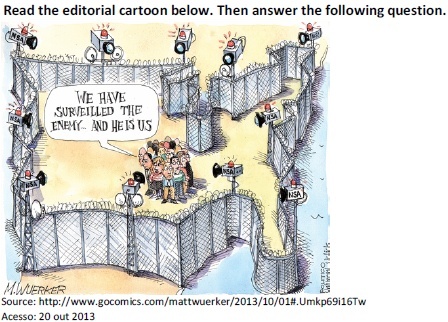
Which current episode is the editorial cartoon an allusion to?
Questão 39 113360
UFGD 2014These Protests Will Accomplish Very Little
By Carlos Pio
The world has been optimistic about Brazil for the past decade. Productivity has risen as trade has been liberalized, state-owned companies have been sold and many industries deregulated. Hyperinflation has been controlled and the exchange rate has been floated. Social policies, called conditional cash transfers, have targeted the poor. And commodity exports to China soared. The economy grew stronger and many became richer.
But the country has one of the highest levels of social inequality in the world. Many of the rich live in bubbles of prosperity, like Brasilia and beachfront avenues in major cities. The poor are almost invisible, forgotten in rural areas or marginalized in urban slums.
Unfortunately Brazil will remain socially unequal, attached to failed ideologies -- economically stagnate but still democratic.
And the policies that led to Brazil’s growth have been undermined since the 2003 inauguration of President Luiz Inácio Lula da Silva, who, along with all the left-wing parties, opposed those policies while out of power. On the positive side, Lula increased the scope of "bolsa família" (the umbrella name for all cash-transfer benefits) until it reached 12 million families. But he slowly discontinued the programs that had produced economic gains — a process that accelerated under President Dilma Rousseff, who took office in 2011.
Private investors were scared off by zigzag regulatory changes. Government finances were stressed by the rising cost of developmental projects like the 2014 World Cup and the 2016 Summer Olympics, as well as by generous wage concessions for public employees. After growing 7.5 percent in 2010, Brazil's gross domestic product growth has stalled as the Chinese economy has slowed. Simultaneously, inflation and interest rates are rising.
The first protest was aimed at a bus fare increase decreed by the mayor of São Paulo, who is aligned with Lula and Rousseff. But responsibility for crowd control fell under the governor of São Paulo state, who is a leading force in the opposition to President Rousseff. Soon the protestors were crowded out by waves of upper-middle-class and wealthy citizens touched by strong images depicting police violence. The protestors called for solidarity marches in other cities.
But spontaneous crowds -- everywhere, not just in Brazil -- lack a consistent agenda and a leadership that can enact reform. The protesters will not win much and will soon recede. And unfortunately Brazil will remain socially unequal, attached to failed ideologies -- economically stagnate but still democratic.
Disponível em: http://www.nytimes.com/roomfordebate/2013/06/19/will-the-protests-in-brazil-lead-to-change/the-protests-in-brazil-will-accomplish-verylittle. Acesso: 19 out. 2013
What is the meaning of the words underlined in the following sentence?
“ Many of the rich live in bubbles of prosperity, like Brasilia and beachfront avenues in major cities. The poor are almost invisible, forgotten in rural areas or marginalized in urban slums”.
Questão 37 113358
UFGD 2014The legacy of conflict-related violence endures long after a peace agreement is signed. In too many cases, violence and insecurity continue or even increase for women, facilitated by large-scale impunity, the absence of effective justice systems and an unreformed security sector. Re-establishing the rule of law is the foundation for women’s security, protection of rights, and, ultimately, an equitable peace.
On 18 October 2013, the UN Security Council will convene an Open Debate on women and peace and security with a focus on “Women, Rule of Law and Transitional Justice”.
Disponível em: http://www.unwomen.org/en/news/in-focus/open-debate-on-women-peace-and-security-2013#sthash.G1AWzfhC.dpuf
According to the text, which is the correct option:
Questão 48 111514
UEMA PAES 2014Marcia says that all of her friends have a cell phone, but Marcia’s mom doesn’t want to buy her one. Marcia’s mom doesn’t want Marcia to play video games either. What is more, the Internet scares her. Marcia’s mom says, “If Marcia has a cell phone, how do we know whom she is talking to? Video games are bad for you. The Internet is dangerous and uncontrolled. It’s like having a gun in the house. We should just ban her from using the computer, and I’m not buying her a cell phone until she is eighteen. This is the only way we can be sure that Marcia is safe.”
Marcia’s dad disagrees with Marcia’s mom. Although he agrees that there are some dangers to it, he likes the Internet, and finds it to be very useful. Marcia’s dad says, “The trouble is, we just can’t stop Marcia from using the Internet, as this would put her at a disadvantage. What is more, I like video games. I think that, when played in moderation, they are fun. Obviously, it is not good to play them without restraint or self-control. Finally, I think Marcia needs a cell phone. We can’t take these things away.”
Fonte: Disponível em: <englisgforevereveryone.org.> Acesso em: 03 ago. (adapted).
No fragmento: "If a person’s ability to use the Internet becomes important in the future, Marcia will be at a loss.", a expressão que substitui a palavra destacada é
Questão 47 111512
UEMA PAES 2014Marcia says that all of her friends have a cell phone, but Marcia’s mom doesn’t want to buy her one. Marcia’s mom doesn’t want Marcia to play video games either. What is more, the Internet scares her. Marcia’s mom says, “If Marcia has a cell phone, how do we know whom she is talking to? Video games are bad for you. The Internet is dangerous and uncontrolled. It’s like having a gun in the house. We should just ban her from using the computer, and I’m not buying her a cell phone until she is eighteen. This is the only way we can be sure that Marcia is safe.”
Marcia’s dad disagrees with Marcia’s mom. Although he agrees that there are some dangers to it, he likes the Internet, and finds it to be very useful. Marcia’s dad says, “The trouble is, we just can’t stop Marcia from using the Internet, as this would put her at a disadvantage. What is more, I like video games. I think that, when played in moderation, they are fun. Obviously, it is not good to play them without restraint or self-control. Finally, I think Marcia needs a cell phone. We can’t take these things away.”
Fonte: Disponível em: <englisgforevereveryone.org.> Acesso em: 03 ago. (adapted).
When Marcia’s mom says “[…] how do we know whom she is talking to?” She can be described as
06