


![[Marketing] Questao Topo - deslogado](https://storage.estuda.com.br/banners/0_6b7ebee90b03af1c560c73bb8bcce34a_banner_deslogado_70_dias.png)
Questões de Inglês
19.971 Questões
Questão 49 128975
Unisinos Verão 2014Brazil’s Rousseff woos investors for infrastructure plan
By Luciana Lopez and Alonso Soto
NEW YORK/BRASILIA, Sept 25 | Wed Sep 25, 2013 3:46pm EDT
(Reuters) – Brazilian President Dilma Rousseff and her economic team courted Wall Street on Wednesday for investment in a massive plan to upgrade roads, airports and other infrastructure that has gotten off to a rocky start.
Investments to improve dilapidated roads, ports,
railways and airports are crucial for Rousseff’s
strategy to recover confidence in Brazil and bolster
an economy that has struggled to grow over the last
three years.
Her government is worried by the initial lack of
interest in concessions being offered to private
companies, which appear reluctant to commit to
the projects due to fears of excessive government
intervention.
Rousseff assured investors at a Goldman Sachs
event that her country has never broken a contract
and never will do so.
“I believe Brazil can offer opportunities that very
few countries in the world can,” she told an audience
of bankers and business people. “Legal risk does not
exist in Brazil.”
Brazil is scrambling to lift anemic investment levels
that have kept its economy stagnant, but concerns
that the government is meddling in contracts has
dented investors’ appetite for logistics tenders that
started last week.
A deserted highway tender, a last-minute
postponement in a high-speed train concession and
disappointing participation in the upcoming auction
for the huge Libra offshore oil prospect have cast
doubt on Brazil’s ability to draw investors.
(Fonte: http://www.reuters.com/article/2013/09/25/brazil-economyinvestors-idUSL2N0HL0YD20130925. Acesso em 3 out. 2013.)
A infraestrutura mencionada no texto envolve
Questão 47 128972
Unisinos Verão 2014Brazil’s Rousseff woos investors for infrastructure plan
By Luciana Lopez and Alonso Soto
NEW YORK/BRASILIA, Sept 25 | Wed Sep 25, 2013 3:46pm EDT
(Reuters) – Brazilian President Dilma Rousseff and her economic team courted Wall Street on Wednesday for investment in a massive plan to upgrade roads, airports and other infrastructure that has gotten off to a rocky start.
Investments to improve dilapidated roads, ports,
railways and airports are crucial for Rousseff’s
strategy to recover confidence in Brazil and bolster
an economy that has struggled to grow over the last
three years.
Her government is worried by the initial lack of
interest in concessions being offered to private
companies, which appear reluctant to commit to
the projects due to fears of excessive government
intervention.
Rousseff assured investors at a Goldman Sachs
event that her country has never broken a contract
and never will do so.
“I believe Brazil can offer opportunities that very
few countries in the world can,” she told an audience
of bankers and business people. “Legal risk does not
exist in Brazil.”
Brazil is scrambling to lift anemic investment levels
that have kept its economy stagnant, but concerns
that the government is meddling in contracts has
dented investors’ appetite for logistics tenders that
started last week.
A deserted highway tender, a last-minute
postponement in a high-speed train concession and
disappointing participation in the upcoming auction
for the huge Libra offshore oil prospect have cast
doubt on Brazil’s ability to draw investors.
(Fonte: http://www.reuters.com/article/2013/09/25/brazil-economyinvestors-idUSL2N0HL0YD20130925. Acesso em 3 out. 2013.)
“Woos” (título) e “meddle in” (linha 20) significam, respectivamente,
Questão 62 128267
ULBRA Medicina 2014A demographic revolution is taking place in the world. We are witnessing the perks of improved healthcare
and living standards as longevity rises across the globe. The number of people over the age of 60 is expected to
increase to 2 billion by 2050, from about 600 million in 2000. This change will be most dramatic in countries in
the global south, where the number of older people is expected to triple during the next 40 years. However, as
often happens with demographic change, social attitudes and legal protection lag behind. Those in charge of
making policies are left scrambling to keep up with the transforming landscape.
With global aging of the population, there is an urgent need to reassess what role individual societies give to
older people to make sure that they are capable of enjoying a decent standard of living and can continue to
contribute to society as long as they wish. Shunting older people to the sidelines of our communities is not only
unjust, it makes little sense for countries to miss out on the huge opportunities that longer life brings, and the asset
that older people represent. Many older people keep on working and, in so doing, important knowledge and skills
are passed on to younger generations, and to others who act as carers to their family. In most countries, it is still
considered acceptable to deny people work, access to healthcare, education or the right to participate in government
purely because of their age.
Indeed, except for migrant workers and their families, international human rights conventions do not
recognise specifically that age discrimination should not be allowed. Human rights are, of course, universal, and,
there fore, older people\\'s rights are protected in a general sense by the Universal Declaration of Human Rights,
but the absence of an explicit mandate against age discrimination allows the issue to slip under the net and
continue as acceptable practice. Age International is thus pushing for progress towards a new UN convention on
the rights of the elderly, to clarify how rights can work better for people in later life. We have learned from the
experience of human rights conventions for children, women and people with disabilities, that giving
governments greater guidance on how to protect the rights of people in specific circumstances can have a huge
impact on their wellbeing. What it means to be "human" and to live with dignity, respect and security requires
different responses from society, depending on our age and physical circumstances. This is widely accepted for
other demographic groups, and should be the basis for our approach to older people. Older people are not a
homogenous group – differences in how we age, our economic status and social standing underline the arbitrary
nature of age discrimination. Around the world, the debate about how to adapt to a changing demographic has
been framed in terms of how working-age people will cope with the "burden" of an ageing population, rather than
recognising the value and potential older people bring to their communities when they live healthier, longer,
active lives. Experience shows us that if discrimination is made legally unacceptable, impetus is given to a
societal shift in attitude – witness, for example, the transformation of women\\'s lives in some countries where sex
discrimination laws have been passed. The need to make older people\\'s rights clearer in law is increasingly
important in many developing countries, where the impact of HIV, conflict and parents seeking work in cities
have often meant grandparents are taking on the care of their grandchildren at a time in their lives when they
most need support. Thus, the enshrinement of the rights of the elderly in a UN convention, not only would we
ensure that all individuals are granted security and dignity in old age, but that those caring for the next generation
are given the best possible environment to raise happy, healthy, productive future adults. Governments need to
approach these issues head on and make sure that global human rights legislation is fit for the future and able to
respond to the opportunities and challenges of ageing in the 21st century.
Disponível em: http://www.theguardian.com/global-development/poverty-matters/2013/jul/31/ageism-human-rights-older-people.
According to the text,
Questão 61 128262
ULBRA Medicina 2014A demographic revolution is taking place in the world. We are witnessing the perks of improved healthcare
and living standards as longevity rises across the globe. The number of people over the age of 60 is expected to
increase to 2 billion by 2050, from about 600 million in 2000. This change will be most dramatic in countries in
the global south, where the number of older people is expected to triple during the next 40 years. However, as
often happens with demographic change, social attitudes and legal protection lag behind. Those in charge of
making policies are left scrambling to keep up with the transforming landscape.
With global aging of the population, there is an urgent need to reassess what role individual societies give to
older people to make sure that they are capable of enjoying a decent standard of living and can continue to
contribute to society as long as they wish. Shunting older people to the sidelines of our communities is not only
unjust, it makes little sense for countries to miss out on the huge opportunities that longer life brings, and the asset
that older people represent. Many older people keep on working and, in so doing, important knowledge and skills
are passed on to younger generations, and to others who act as carers to their family. In most countries, it is still
considered acceptable to deny people work, access to healthcare, education or the right to participate in government
purely because of their age.
Indeed, except for migrant workers and their families, international human rights conventions do not
recognise specifically that age discrimination should not be allowed. Human rights are, of course, universal, and,
there fore, older people\\'s rights are protected in a general sense by the Universal Declaration of Human Rights,
but the absence of an explicit mandate against age discrimination allows the issue to slip under the net and
continue as acceptable practice. Age International is thus pushing for progress towards a new UN convention on
the rights of the elderly, to clarify how rights can work better for people in later life. We have learned from the
experience of human rights conventions for children, women and people with disabilities, that giving
governments greater guidance on how to protect the rights of people in specific circumstances can have a huge
impact on their wellbeing. What it means to be "human" and to live with dignity, respect and security requires
different responses from society, depending on our age and physical circumstances. This is widely accepted for
other demographic groups, and should be the basis for our approach to older people. Older people are not a
homogenous group – differences in how we age, our economic status and social standing underline the arbitrary
nature of age discrimination. Around the world, the debate about how to adapt to a changing demographic has
been framed in terms of how working-age people will cope with the "burden" of an ageing population, rather than
recognising the value and potential older people bring to their communities when they live healthier, longer,
active lives. Experience shows us that if discrimination is made legally unacceptable, impetus is given to a
societal shift in attitude – witness, for example, the transformation of women\\'s lives in some countries where sex
discrimination laws have been passed. The need to make older people\\'s rights clearer in law is increasingly
important in many developing countries, where the impact of HIV, conflict and parents seeking work in cities
have often meant grandparents are taking on the care of their grandchildren at a time in their lives when they
most need support. Thus, the enshrinement of the rights of the elderly in a UN convention, not only would we
ensure that all individuals are granted security and dignity in old age, but that those caring for the next generation
are given the best possible environment to raise happy, healthy, productive future adults. Governments need to
approach these issues head on and make sure that global human rights legislation is fit for the future and able to
respond to the opportunities and challenges of ageing in the 21st century.
Disponível em: http://www.theguardian.com/global-development/poverty-matters/2013/jul/31/ageism-human-rights-older-people.
According to the text,
Questão 60 127688
UPE 2° Dia 2014
Looking up. After failing to a low of just 50 in 1996, the West African giraffe population is growing again, aided by conservation efforts and the absence of predators able to target the world’s tallest terrestrial animal. Temporary groups forage at night, their long necks suited to reaching choice leaves. But to drink or feed on low vegetation, they are obliged to spread their front legs wide, and when fully asleep they curve their necks at
extreme angles to rest their heads on a hip or upper rear leg while sitting. Room to stretch out is in short supply due to loss and fragmentation of habitat, and their comeback is far from certain.
As we see it, we can help make the world a better place. Raising awareness of endangered species is just one of the ways we at Canon are taking action – for the good of the planet we call home. Visit canon.com/environment to learn more.
(National Geographic magazine. Volume 224, n. 3 , September, 2013. Adaptado.)
Das alternativas abaixo, apenas uma está CORRETA quanto às informações do texto. Assinale-a.
Questão 59 127686
UPE 2° Dia 2014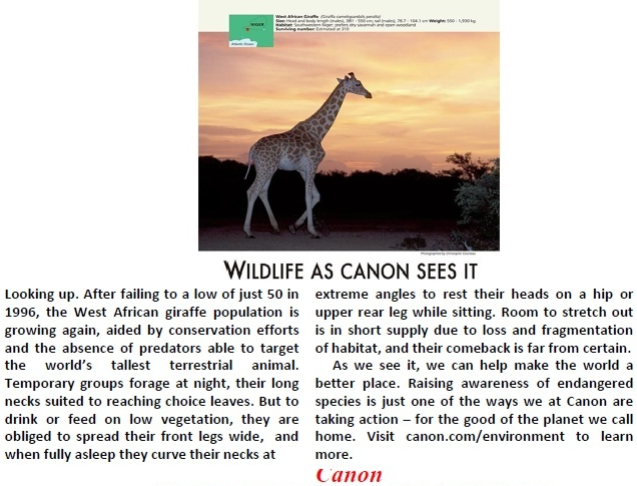
(National Geographic magazine. Volume 224, n. 3, September, 2013. Adaptado.)
Looking up. After failing to a low of just 50 in 1996, the West African giraffe population is growing again, aided by conservation efforts and the absence of predators able to target the world’s tallest terrestrial animal. Temporary groups forage at night, their long necks suited to reaching choice leaves. But to drink or feed on low vegetation, they are obliged to spread their front legs wide, and when fully asleep they curve their necks at extreme angles to rest their heads on a hip or upper rear leg while sitting. Room to stretch out is in short supply due to loss and fragmentation of habitat, and their comeback is far from certain.
As we see it, we can help make the world a better place. Raising awareness of endangered species is just one of the ways we at Canon are taking action – for the good of the planet we call home. Visit canon.com/environment to learn more.
Na linha 1, há um phrasal verb: ‘looking up’; este verbo confere um efeito interessante ao texto.
Seu significado, nesse caso, é
06