


![[Marketing] Questao Topo - deslogado](https://storage.estuda.com.br/banners/0_6b7ebee90b03af1c560c73bb8bcce34a_banner_deslogado_70_dias.png)
Questões de Inglês
19.971 Questões
Questão 2 8077174
ENEM 1° Dia (Prova Rosa) 2022As my official bio reads, was made in Cuba, assembled in Spain, and imported to the United States — meaning my mother, seven months pregnant, and the rest of my family arrived as exiles ffom Cuba to Madrid, where was born. Less than two months later, we emigrated once more and settled in New York City, then eventually in Miami, where was raised and educated. Although technically we lived in the United States, the Cuban community was culturally insular in Miami during the 1970s, bonded together by the trauma of exile. What's more, it seemed that practically everyone was Cuban: my teachers, my classmates, the mechanic, the bus driver. didn't grow up feeling different or treated as a minority. The few kids who got picked on. in my grade school were the ones with freckles and funny last names like Dawson and O'Neil.
BLANCO R Disponivel em. http "edition cnr com. Acesso em 9 dez 2017 (adaptado).
Ao relatar suas vivências, o autor destaca o(a)
Questão 43 8039597
UNIFENAS Tarde 2022/2What Are Anxiety Disorders?
Anxiety is a normal reaction to stress and can be beneficial in some situations. It can alert us to dangers and help us prepare and pay attention. Anxiety disorders differ from normal feelings of nervousness or anxiousness and involve excessive fear or anxiety. Anxiety disorders are the most common of mental disorders and affect nearly 30% of adults at some point in their lives. But anxiety disorders are treatable, and a number of effective treatments are available. Treatment helps most people lead normal productive lives.
How Common Are Anxiety Disorders?
In any given year the estimated percent of U.S. adults with various anxiety disorders are:
• specific phobia: 8% - 12%
• social anxiety disorder: 7%
• panic disorder: 2% - 3%
• agoraphobia: 1-2.9% in adolescents and adults
• generalized anxiety disorder: 2%
• separation anxiety disorder: 0.9% - 1.9%
Women are more likely than men to experience anxiety disorders. Anxiety refers to anticipation of a future concern and is more associated with muscle tension and avoidance behavior. Fear is an emotional response to an immediate threat and is more associated with a fight or flight reaction – either staying to fight or leaving to escape danger. Anxiety disorders can cause people to try to avoid situations that trigger or worsen their symptoms. Job performance, schoolwork and personal relationships can be affected. In general, for a person to be diagnosed with an anxiety disorder, the fear or anxiety must:
• Be out of proportion to the situation or age-inappropriate
• Hinder ability to function normally
There are several types of anxiety disorders, including generalized anxiety disorder, panic disorder, specific phobias, agoraphobia, social anxiety disorder and separation anxiety disorder.
Risk Factors
The causes of anxiety disorders are currently unknown but likely involve a combination of factors including genetic, environmental, psychological and developmental. Anxiety disorders can run in families, suggesting that a combination of genes and environmental stresses can produce the disorders.
Diagnosis and Treatment
The first step is to see your doctor to make sure there is no physical problem causing the symptoms. If an anxiety disorder is diagnosed, a mental health professional can work with you on finding the best treatment. Unfortunately, many people with anxiety disorders don’t seek help. They don’t realize that they have an illness for which there are effective treatments.
Although each anxiety disorder has unique characteristics, most respond well to two types of treatment: psychotherapy, or “talk therapy,” and medications. These treatments can be given alone or in combination. Cognitive behavior therapy (CBT), a type of talk therapy, can help a person learn a different way of thinking, reacting and behaving to help feel less anxious. Medications will not cure anxiety disorders but can provide significant relief from symptoms. The most commonly used medications are anti-anxiety medications (generally prescribed only for a short period of time) and antidepressants. Betablockers, used for heart conditions, are sometimes used to control physical symptoms of anxiety.
Adapted. Available at: https://www.psychiatry.org/patients-families/anxiety-disorders/what-are-anxiety-disorders Accessed on: April 14th, 2022.
“Anxiety is a normal reaction to stress and can be beneficial in some situations. It can alert us to dangers and help us prepare and pay attention.”
The pronoun It used in this sentence refers to
Questão 44 7994873
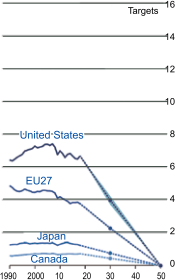
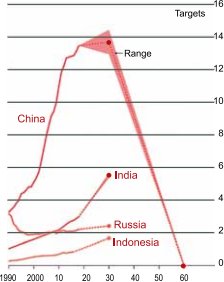
FMJ 2022Analise os gráficos e leia o texto para responder à questão.
How climate targets compare against a common baseline
Greenhouse-gas emissions, tonnes of CO2 equivalent, bn Four largest emitters in each group
Graph 1 – Developed economies
Graph 2 – Emerging markets
New climate announcements are coming thick and fast. In recent weeks dozens of countries updated the mitigation plans known as “nationally determined contributions” (NDCs) required under the Paris climate agreement of 2015. The deal obliges its signatories to increase the ambition of their NDCs every five years. The original deadline for the first round of updates was COP26, the UN climate summit in Glasgow in 2020. However, because of the covid-19 pandemic, the event’s start was delayed until October this year. So far, 58% of the 191 signatories have submitted new NDCs.
Countries’ climate targets come in many shapes and sizes. Around two-thirds of the global economy is now covered by a pledge to achieve “net-zero”1 emissions by around midcentury. The array of different benchmarks and definitions can obscure how ambitious each country actually plans to be.
One type of climate goal involves promising to cut emissions compared with a business-as-usual scenario. Pakistan promises a cut of 20% by 2030, compared with a pathway where no climate action is taken whatsoever. Yet this goal means its emissions could surge threefold by 2030.
Rebasing climate targets changes the relative ambition of rich countries, too. On the face of it, the European Union’s target of lowering emissions by 55% by 2030 is more ambitious than America’s 52% cut. But the EU’s goal is based on 1990 levels and its emissions have already fallen from that point. By contrast, America’s plan is based on 2005 levels, and its emissions have fallen by less since. Once put on the same basis, America’s goal appears more admirable.
(www.economist.com, 07.08.2021. Adaptado.)
1 “net-zero”: (of a country, city, etc.) removing as many emissions as it produces.
No primeiro parágrafo, o termo “however” estabelece, entre a frase que introduz e a que o antecede, uma relação de
Questão 41 7994700
FMJ 2022Examine a tira Calvin and Hobbes, de Bill Watterson, para responder às questão.
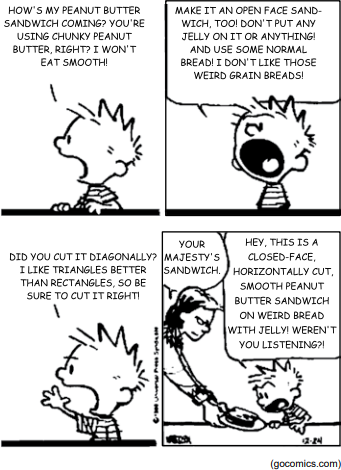
Na tira, o garoto é caracterizado como
Questão 10 7765222
FGV-SP Economia - UNIFICADO 1ª Fase - LIE BLOCO 4 2022/1Texto para a pergunta.
THE PERCEPTION OF TIME
1 A number of competing ideas explain why, as we age, our perception of time accelerates. One theory notes that our metabolism slows as we get
older, matching the slowing of our heartbeats and our breathing. Just as with a stopwatch [cronômetro] that is set to run fast, children’s versions of these
“biological clocks” tick more quickly. In a fixed period of time children experience more beats of these biological pacemakers [marca-passos] (breaths or
heartbeats, for example), making them feel as if a longer time has elapsed.
2 A competing theory suggests that our perception of time’s passage depends on the amount of new perceptual information we are subjected to from
our environment. The more novel stimuli, the longer our brains take to process the information. The corresponding period of time seems, at least in
retrospect, to last longer. This argument can explain the movie-like perception of events playing out in slow motion in the moments immediately
preceding an accident. It might be that rather than time actually slowing during the event, our recollection of the event is decelerated in hindsight
[compreensão tardia], as our brain records more detailed memories based on the flood of data it receives. Experiments on subjects experiencing the
unfamiliar sensation of free fall [queda livre] have demonstrated this.
3 This theory ties in nicely with the acceleration of perceived time. As we age, we tend to become more familiar with our environments and with life
experiences. Our daily commutes [deslocamentos de ida e volta entre a casa e o lugar de trabalho], which might initially have appeared long and
challenging, full of new sights and opportunities for wrong turns, now flash by as we navigate familiar routes on autopilot.
4 It is different for children. Their worlds are often surprising places filled with unfamiliar experiences. Youngsters are constantly reconfiguring their
models of the world around them, which takes mental effort and seems to make the sand run more slowly through their hourglasses [ampulhetas] than
for routine-bound [amarrados à rotina] adults. The greater our acquaintance with the routines of everyday life, the quicker we perceive time to pass, and
generally, as we age, this familiarity increases. This theory suggests that, to make our time last longer, we should fill our lives with new and varied
experiences, eschewing [evitando] the time-sapping [consumidora de tempo] routine of the mundane.
5 Neither idea explains the almost perfectly regular rate at which our perception of time seems to accelerate. The fact that the length of a fixed period
of time appears to reduce continually as we age suggests an “exponential scale” to time. We employ exponential scales instead of traditional linear
scales when measuring quantities that vary over a huge range of different values.
Adapted from Natural History, February 2020.
With respect to the information in the article, in which of the following situations would time, in general, most likely pass quicker than usual for a child?
Questão 60 7661879
UVV Medicina 2022/1Question refer to the text below:
He was a big man with short curly hair, brown teeth and a flat nose. A scar crossed his right cheek from ear to chin.
Disponível em: http://teach.files.bbci.co.uk. Acesso em: 21/072021.
What does scar mean?
06