


![[Marketing] Questao Topo - deslogado](https://storage.estuda.com.br/banners/0_6b7ebee90b03af1c560c73bb8bcce34a_banner_deslogado_70_dias.png)
Questões de Inglês
19.971 Questões
Questão 31 142478
UPE 3° Fase / 1° Dia SSA 2014
After 18 years covering conflict in Rwanda, Afghanistan, and Iraq, photojournalist David Guttenfelder was unsure if he had the skills for a delicate new assignment: documenting the trapping and eating of songbirds. But he soon found himself on a familiar ground, enmeshed in story with carnage and tension. He had an awakening as well. In Ayia Napa, Cyprus, he met a man who’d illegally caged a dozen wild birds. Guttenfelder thought: “This isn’t how birds are supposed to be.” In this case the authorities came in and freed the birds. […]
He was interviewed by Daniel Stone.
DS: Taking pictures of birds isn’t your usual line of work, is it?
DG: After so much time covering war, I remember some of my friends in Syria and Libya said to me, “You’re out there covering birds?” I’ve spent a long time photographing people doing horrible things to each other, but seeing hundreds of birds suffering was a very challenging p roject. It made me realize there are other types of conflicts that need to be covered.
D S: How did people justify killing birds?
DG: In Cyprus, when I listened to activists argue with local people, the Cypriots would say that the birds are delicious. One man told me, “Imagine the best thing your mother made for y ou as a kid, then multiply it a thousand. That’s how delicious they are.”
D S: Did you eat any of the birds?
DG: I did. As I learned from war photography, you sometimes need to hang around with people who do things you don’t agree with to photograph things you want show. After spending an entire day with a family in Egypt that hunted songbirds, they invited me to eat with them. I probably ate three or four birds. It wasn’t for me.
(In: The moment. David Guttenfelder: behind the lens. National Geographic, USA, July 2013. Adaptado.)
The sentence “This isn’t how birds are supposed to be.” shows Guttenfelder’s
Questão 29 142367
UPE 3° Fase / 1° Dia SSA 2014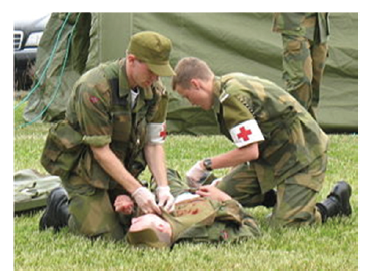
DOCTORS WITHOUT BORDERS IN A THIRD WORLD CRISIS
By Elliott Leyton and Greg Locke
When the rapes and massacre, the plagues, the famines, the floods, or droughts erupt in far off places, the world stands still but MSF does not.
While others are stymied or delayed by bureaucratic red tape, the men and women of
Medicine sans Frontiers (MSF or Doctors Without Borders) move in. They provide food and clean water. They dig latrines. They set up first aid stations and field hospitals. They are often the last to remain in situations abandoned by others as too dangerous.
The risks they take are moral and ethical as well as mortal. They are acutely aware that giving aid is controversial. Does it really do any good to save a child from murder one day when it will probably starve in the weeks ahead? Is it appropriate to bring expensive western medicine into a country that, in the long run, can’t afford it? Should relief be given to civilians who are being starved on purpose, as part of a cynical political game, by a local warlord?
Elliott Leyton and Greg Locke saw something of the implications of these questions when they travelled to Rwanda in 1996. There they found themselves plunged into a humanitarian crises of epic proportions. Hundreds of thousands of people were on the move.
Armed militias and hostiles armies lurked in the background, mass starvation, plague, and an eruption into civil and criminal violence were immediate possibilities. The two Canadians, one an internationally recognized expert on the psychology of killing, the other, and experienced international photojournalist , had the rare opportunity to observe MSF in action.
They watched and listened, to the perpetrators of violence and their victims, to survivors and those who gave them assistance, and, above all, the people of MSF who dedicate themselves to save lives because, in the words of one MSFer, “The world can afford a humanitarian idea.”
The result of Leyton and Locke’s research is and extraordinary written and visual record of small miracles performed in the midst catastrophe.
(Match Point – Teacher’s Edition – Cleide Silva and Roberto Lobo. Longman, New York, 2003. Adapted.)
In which tense are most of the verbs in paragraph four?
Questão 26 142363
UPE 3° Fase / 1° Dia SSA 2014
DOCTORS WITHOUT BORDERS IN A THIRD WORLD CRISIS
By Elliott Leyton and Greg Locke
When the rapes and massacre, the plagues, the famines, the floods, or droughts erupt in far off places, the world stands still but MSF does not.
While others are stymied or delayed by bureaucratic red tape, the men and women of
Medicine sans Frontiers (MSF or Doctors Without Borders) move in. They provide food and clean water. They dig latrines. They set up first aid stations and field hospitals. They are often the last to remain in situations abandoned by others as too dangerous.
The risks they take are moral and ethical as well as mortal. They are acutely aware that giving aid is controversial. Does it really do any good to save a child from murder one day when it will probably starve in the weeks ahead? Is it appropriate to bring expensive western medicine into a country that, in the long run, can’t afford it? Should relief be given to civilians who are being starved on purpose, as part of a cynical political game, by a local warlord?
Elliott Leyton and Greg Locke saw something of the implications of these questions when they travelled to Rwanda in 1996. There they found themselves plunged into a humanitarian crises of epic proportions. Hundreds of thousands of people were on the move.
Armed militias and hostiles armies lurked in the background, mass starvation, plague, and an eruption into civil and criminal violence were immediate possibilities. The two Canadians, one an internationally recognized expert on the psychology of killing, the other, and experienced international photojournalist , had the rare opportunity to observe MSF in action.
They watched and listened, to the perpetrators of violence and their victims, to survivors and those who gave them assistance, and, above all, the people of MSF who dedicate themselves to save lives because, in the words of one MSFer, “The world can afford a humanitarian idea.”
The result of Leyton and Locke’s research is and extraordinary written and visual record of small miracles performed in the midst catastrophe.
(Match Point – Teacher’s Edition – Cleide Silva and Roberto Lobo. Longman, New York, 2003. Adapted.)
The Doctors Without Borders
Questão 38 142063
UPE 1° Fase / 1° Dia SSA 2014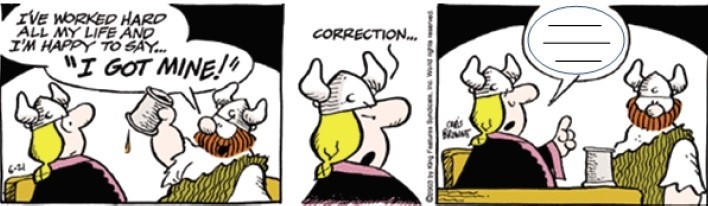
Considerando-se o contexto e as regras de uso dos adjetivos possessivos, qual seria a correção feita por Helga, a esposa de Hagar, no último balão do texto 3?
Questão 36 142057
UPE 1° Fase / 1° Dia SSA 2014ROVERS ON MARS

Curiosity is the latest and by far the largest of four NASA rovers. In 1997 Sojourner, the
smallest and simplest, proved that Mars roving was possible. Spirit and Opportunity
analyzed rocks, confirming evidence from orbiters that large amounts of water had once
been present on Mars. (Opportunity is still roving after nine years and 22 miles.)
Curiosity can drill into rocks and scoop the powder into an onboard chemical lab. It’s
looking not just for water but also for ancient environments where microbes could have
lived. “We are not searching for life itself; that would take instruments even more
advanced than Curiosity’s. Its job is to help us figure out where a future mission should
look for life”, says John Grotzinger, Caltech geologist and chief scientist for the Curiosity
mission.
(In: Field trip on Mars, by John Grotzinger. National Geographic, vol. 224 . no. 1, July 2013. Adaptado)
De acordo com o texto, analise as afirmativas a seguir:
I. Curiosity é o nome da equipe da NASA responsável pelo último veículo‐robô enviado para explorar o planeta Marte.
II. Sojourner, uma sonda menor e mais simples que as atuais, provou que era possível explorar o planeta Marte.
III. Curiosity tem, entre seus objetivos, pesquisar se já houve ambiente capaz de abrigar vida microbiana em Marte.
IV. Opportunity ainda continua explorando Marte, mesmo após ter comprovado que já houve grande quantidade de água nesse planeta.
V. Spirit e Opportunity foram enviadas a Marte para pesquisar a existência de água e analisar rochas, mas tal missão não obteve êxito.
Estão CORRETAS apenas
Questão 35 142054
UPE 1° Fase / 1° Dia SSA 2014THE KIDS ARE ALL RIGHT

In TV shows and movies, teenagers are often angry and unhappy. But according to a recent survey, most of today’s young people are affectionate, reasonable, and happy. In other words, teenagers are not so bad after all.
The survey says that most teenagers get along well with their parents. Though teens go to their friends for advice on music and clothes, they go to their parents when they have a problem. They ask their parents for advice on college and careers. Most teenagers think that their parents understand and love them. Many even think that their parents are cool!
Of course, teenagers keep secrets from their parents, but these are usually just teen items such as diaries, CDs, and magazines.
And who do teenagers choose for their heroes? Many teens choose a family member, not a singer or an actor. Most teens say they like spending time with both parents and friends.
In short, today’s teenagers are very nice kids. As the band The Who used to sing, the kids are all right.
Teacher’s Edition – Brian Abbs, Chris Barker, Ingrid Freebairn – Longman, New York, 2003. Adapted from Postcards 1
“The kids are all right” means they
06