


![[Marketing] Questao Topo - deslogado](https://storage.estuda.com.br/banners/0_6b7ebee90b03af1c560c73bb8bcce34a_banner_deslogado_70_dias.png)
Questões de Inglês
19.971 Questões
Questão 34 148431
EPCAR 2014TEXT I
WHAT IS OFFSHORE ENGLISH?
Offshore English is a term used by many people for international English (I). It is the English spoken and written by non-native speakers in international communication (II). Many in business are starting to worry that native speakers are actually at a disadvantage in international communication. A good example of this situation was when a company tried to sell flight simulators to South Korea, where a French companywon the contract because the buyers found it easier to understand the English that the French people spoke than the English spoken by the British company. Many native English speakers feel little necessity to learn foreign languages, so they often don’t understand the difficulties and problems learners have. They also don’t see (1) the need to modify their language for a foreign audience, so they use (2) idioms, synonyms, colloquialisms, phrasal verbs, etc, and don’t think (3) of the impact this has (4) on a foreign businessperson. The English studied by non-native speakers tends to use a more simple vocabulary, and considering the similarities in courses in many parts of the world, emphasized by a small number of course books (Headway Series) and the domination of a few examinations, for example TOEFL, etc. This means that non-native speakers from different countries and cultures sometimes understand each other more easily than the native speaker. Few native speakers outside the world of ESL (English as a Second language) teaching have much idea of what non-native learners assimilate, and think that as their English is native speaker level, they speak it better than their non-native counterparts. Because of this, companies are offering courses in Offshore English to native speakers to train them to speak the type of English that will make it easier for nonnative speakers to understand. So they will gain more contracts.
Adapted from http://www.usingenglish.com/articles/what-offshore-english.html Acessado em 14/03/2013
Glossary:
Foreign: estrangeiro
Businessperson: homem/ mulher de negócios
Counterpart: seu semelhante
To win: ganhar, vencer
Disadvantage: desvantagem
Outside: do lado de fora
Level: nível
We can say that Headway (line 22) is a
Questão 33 148430
EPCAR 2014TEXT I
WHAT IS OFFSHORE ENGLISH?
Offshore English is a term used by many people for international English (I). It is the English spoken and written by non-native speakers in international communication (II). Many in business are starting to worry that native speakers are actually at a disadvantage in international communication. A good example of this situation was when a company tried to sell flight simulators to South Korea, where a French companywon the contract because the buyers found it easier to understand the English that the French people spoke than the English spoken by the British company. Many native English speakers feel little necessity to learn foreign languages, so they often don’t understand the difficulties and problems learners have. They also don’t see (1) the need to modify their language for a foreign audience, so they use (2) idioms, synonyms, colloquialisms, phrasal verbs, etc, and don’t think (3) of the impact this has (4) on a foreign businessperson. The English studied by non-native speakers tends to use a more simple vocabulary, and considering the similarities in courses in many parts of the world, emphasized by a small number of course books (Headway Series) and the domination of a few examinations, for example TOEFL, etc. This means that non-native speakers from different countries and cultures sometimes understand each other more easily than the native speaker. Few native speakers outside the world of ESL (English as a Second language) teaching have much idea of what non-native learners assimilate, and think that as their English is native speaker level, they speak it better than their non-native counterparts. Because of this, companies are offering courses in Offshore English to native speakers to train them to speak the type of English that will make it easier for nonnative speakers to understand. So they will gain more contracts.
Adapted from http://www.usingenglish.com/articles/what-offshore-english.html Acessado em 14/03/2013
Glossary:
Foreign: estrangeiro
Businessperson: homem/ mulher de negócios
Counterpart: seu semelhante
To win: ganhar, vencer
Disadvantage: desvantagem
Outside: do lado de fora
Level: nível
According to the text,
Questão 23 147609
UNEB 2014/1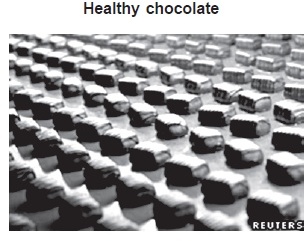
Scientists from the University of Warwick in the UK have revealed a new method to cut the amount of fat in chocolate in half while keeping all the taste. Here’s the problem with chocolate — what makes
5 it velvety and smooth in the mouth is exactly what ends up elsewhere — fat. Low-fat versions disappoint because it’s difficult to replace the tiny globules of fat with anything else that disperses within the chocolate and maintains its texture.
10 The trick, it seems, is to use agar — a widely available jelling agent. Thoroughly blended bits of it, the researchers say, act as tiny sponges that soak up any liquid — fruit juice, plain water, even alcohol. Stefan Bon, who led the research, said that the
15 method opens up whole new markets for chocolate, and that additives such as fruit juice could further increase chocolate’s health credentials. He says: “It would both lower fat content and sugar content, so for people that just have a craving and just want to down a bar of 200g,
20 you take half the amount of fat in, so it’s great.” But for the less health-conscious, students in the group have made a chocolate bar containing four shots of vodka.
HEALTHY chocolate. Disponível em: . Acesso em: 12 out. 2013.
Fill in the parentheses with T (True) or F (False). The text has answers to the following questions:
( ) What makes chocolate smooth and soft?
( ) Where did Stefan Bon work before going to Warwick?
( ) How can chocolate be made healthier?
( ) Why does agar help to keep the chocolate texture?
According to the text, the correct sequence, from top to bottom, is
Questão 19 147604
UNEB 2014/1
A recent multicenter study found that the slimmest people also ate the most carbohydrates, and the chubbiest ate the least. The research concluded that your odds of getting and staying slim are best when
5 carbs make up to 64% of your total daily caloric intake, or 361 grams. That’s the equivalent of several stuffedpotatoes, a food we bet you’ve been afraid to eat for decades.Most low-carb diets limit you to fewer than 30% of
10 total calories from carbs and sometimes contain as few as 30 grams of carbohydrates a day.
Disponível em: <http://www.health.com/gallery>. Acesso em: 12 out. 2013.
The word “odds” (l. 4) can be suitably replaced by
Questão 16 147596
UNEB 2014/1Brazil Science Without Borders
The Brazilian government’s new Science Without Borders Program will provide scholarships to undergraduate students from Brazil for one year of study at colleges and universities in the United States.
5 Scholarships will be given primarily to students in the Science, Technology, Engineering and Mathematics (STEM) fields. Students in the program will return to Brazil to complete their degrees. Undergraduate students from Brazil may apply for
10 the Science Without Borders Program scholarship
beginning August 31, 2011. This program, administered by IIE, is part of the Brazilian government’s larger initiative to grant 100,000 scholarships for the best students from Brazil to study
15 abroad at the world’s best universities.
BRAZIL Science Without Borders. Disponível em: <http://educationusacienciassemfronteiras. org/scier>. Acesso em: 12 out. 2013.
Fill in the parentheses with T (True) or F (False). About the Brazil Science Without Borders Program, it’s correct to say:
( ) In order to get a scholarship, students are required to take a hard placement test.
( ) Science is among the program’s top priorities.
( ) An advantage of this program is that students may graduate from college in the United States.
( ) One hundred thousand scholarships will be given to Brazilian students by this program.
According to the text, the correct sequence, from top to bottom, is
Questão 12 146339
UEA - Geral 2014The Amazon is the greatest river in the world, although not the longest. It has the greatest volume of water of any river, and also the ___12___ drainage basin – the area where it flows. The streams that feed it start near the Pacific, in the icy heights of the Andes Mountains in Peru. They flow eastwards, across Brazil, joining into bigger and bigger rivers. Eventually, they all unite in the gigantic Amazon, which meets the Atlantic at the equator. Its total length is 6,437 kilometres and it flows through about one-third of South America.
Passengers on an ocean liner heading for the mouth of the Amazon might actually meet the river about 320 kilometres from the coast, because the great force of the Amazon sends its waters right out into the Atlantic. Seen from the air, these waters make a long, muddy stain in the sea.
(Children’s Britannica, vol. 1, 1973. Adaptado.)
Em sentido e forma, a lacuna numerada no texto é corretamente preenchida por
06