


![[Marketing] Questao Topo - deslogado](https://storage.estuda.com.br/banners/0_6b7ebee90b03af1c560c73bb8bcce34a_banner_deslogado_70_dias.png)
Questões de Inglês
19.971 Questões
Questão 12 395201
IFSulDeMinas 2014/2World Cup 2014: Brazil still facing issues with 100 days to go
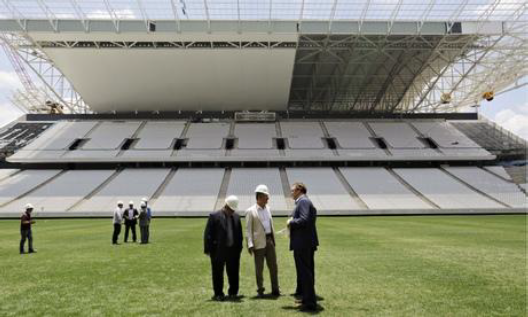
The Arena de São Paulo will not be delivered until mid-May leaving Fifa with a race against time for the required fitting. Photograph: Nelson Antoine/AP
In 100 days, Brazil will kick off the World Cup against Croatia in the gleaming new Arena
de São Paulo. Assuming, that is, the stadium is finished in time.
Amid growing excitement at the World Cup returning to the home of La Joga Bonito, there
is concern at the extent to which deadlines have been repeatedly missed before being torn up
[5] altogether. "I am not a World Cup specialist but I will say this has not been easy, for sure. I think
things will work well but it is also true that whenever you receive something late it becomes a
challenge to make it ready in time." said the Fifa secretary general, Jérôme Valcke.
Stadiums
The biggest outstanding concern remains the readiness of four of the 12 stadiums that are
[10] scattered throughout the vast country. Despite being awarded the World Cup in 2007, host cities
were not decided until two years later amid political wrangling.
A series of delays followed, as Valcke and other Fifa executives attempted to hurry things
along.
Tickets
[15] Despite initial concern about ticket prices, there has been great interest from Brazil's
burgeoning middle class and from around the world. While England fans will find it easier than in
the past to get hold of tickets, given the expense and long distances involved, Fifa has already sold
more than 2.3 million of the 3.3 million available tickets. Around 60% of the 1.5m on general sale have gone to Brazilians.
[20] The next tranche of around 160,000 tickets go on sale on 12 March. Fifa has sought to
assuage some of the concern about high prices by reserving a greater number of the cheapest
category for Brazilians, but that is unlikely to completely temper criticism.
Security
Although airing a wide range of grievances, the perceived disconnect between the $4bn
[25] (£2.4bn) spent on World Cup stadiums and underinvestment in public services became a focal point
for anger. It has not dissipated, though no one seems able to accurately predict what will happen in
June. Many Brazilians are at once looking forward to the World Cup while remaining fiercely
critical of the demands of Fifa and the priorities of the authorities.
As part of a total security spend of £500m, 150,000 members of the police and armed forces
[30] will enforce large exclusion zones around stadiums and contain any protests elsewhere.
"There is a long way to go. It's a short way to go if there are still problems," said Blatter, in
typically obtuse fashion. "But now all problems are under control and it will be, in 100 days, an
exceptionally good start for an exceptional competition. The Brazilian spirit of the game and their
ability to play football makes this World Cup very, very special."
Adapted from a post by Owen Gibson
Disponível em: < http://www.theguardian.com/football/2014/mar/04/world-cup-2014-brazil-stadiums>. Acesso em 03/04/2014.
Assinale qual das construções abaixo indica o uso do Present Perfect.
Questão 11 395191
IFSulDeMinas 2014/2World Cup 2014: Brazil still facing issues with 100 days to go
The Arena de São Paulo will not be delivered until mid-May leaving Fifa with a race against time for the required fitting. Photograph: Nelson Antoine/AP
In 100 days, Brazil will kick off the World Cup against Croatia in the gleaming new Arena
de São Paulo. Assuming, that is, the stadium is finished in time.
Amid growing excitement at the World Cup returning to the home of La Joga Bonito, there
is concern at the extent to which deadlines have been repeatedly missed before being torn up
[5] altogether. "I am not a World Cup specialist but I will say this has not been easy, for sure. I think
things will work well but it is also true that whenever you receive something late it becomes a
challenge to make it ready in time." said the Fifa secretary general, Jérôme Valcke.
Stadiums
The biggest outstanding concern remains the readiness of four of the 12 stadiums that are
[10] scattered throughout the vast country. Despite being awarded the World Cup in 2007, host cities
were not decided until two years later amid political wrangling.
A series of delays followed, as Valcke and other Fifa executives attempted to hurry things
along.
Tickets
[15] Despite initial concern about ticket prices, there has been great interest from Brazil's
burgeoning middle class and from around the world. While England fans will find it easier than in
the past to get hold of tickets, given the expense and long distances involved, Fifa has already sold
more than 2.3 million of the 3.3 million available tickets. Around 60% of the 1.5m on general sale have gone to Brazilians.
[20] The next tranche of around 160,000 tickets go on sale on 12 March. Fifa has sought to
assuage some of the concern about high prices by reserving a greater number of the cheapest
category for Brazilians, but that is unlikely to completely temper criticism.
Security
Although airing a wide range of grievances, the perceived disconnect between the $4bn
[25] (£2.4bn) spent on World Cup stadiums and underinvestment in public services became a focal point
for anger. It has not dissipated, though no one seems able to accurately predict what will happen in
June. Many Brazilians are at once looking forward to the World Cup while remaining fiercely
critical of the demands of Fifa and the priorities of the authorities.
As part of a total security spend of £500m, 150,000 members of the police and armed forces
[30] will enforce large exclusion zones around stadiums and contain any protests elsewhere.
"There is a long way to go. It's a short way to go if there are still problems," said Blatter, in
typically obtuse fashion. "But now all problems are under control and it will be, in 100 days, an
exceptionally good start for an exceptional competition. The Brazilian spirit of the game and their
ability to play football makes this World Cup very, very special."
Adapted from a post by Owen Gibson
Disponível em: < http://www.theguardian.com/football/2014/mar/04/world-cup-2014-brazil-stadiums>. Acesso em 03/04/2014.
O principal objetivo do texto é:
Questão 10 385767
IFBA 2014TEXT
Weeks of protests in Brazil: international issue
For nearly two weeks, tens of thousands of
Brazilians marched through the streets night after
night. Crowds originally protesting bus fares grew
into multitudes decrying social injustice on
[5] Tuesday, as broad avenues filled to capacity for
blocks. The movement has galvanized people
across the country who say they're fed up with
high taxes and a lack of services -- such as health
and education -- while the government spends
[10] billions on preparations for the 2014 World Cup.
In Rio de Janeiro on Thursday, protesters held
signs saying, "I'd swap 10 stadiums for one
decent hospital in this country" and "I'd give up
the World Cup for better education in my country."
[15] The protests came amid the soccer
Confederations Cup tournament, a friendly array
of matches, in which the host country, Brazil,
plays against a small group of national teams
from around the globe. The cup serves as a
[20] precursor to the World Cup.
The majority of marchers are young and welleducated.
Matheus Pires, a university student
and one of the organizers, says public
transportation should be free -- especially in
[25] expensive, sprawling cities such as São Paulo.
"You can't go to hospital; you can't see your
friends; you can't go to school; you can't go to
work," he said, describing how much the city's
residents rely on mass transit. Lowering fares, he
[30] said, would prove that the government was
listening.
But it's too soon to know whether it will bring an
end to protests or fuel further and more farreaching
demands.
[35] Rio de Janeiro (CNN) -- A massive crowd of
demonstrators swelled around an iconic church
in the heart of Rio de Janeiro on Thursday,
shouting "down with corruption" and "I can live
without the World Cup." CNN affiliate Band News
[40] reported that police used tear gas in some areas
of the city as clashes erupted.
Police initially reported tens of thousands of
protesters in Rio de Janeiro but later said the
crowds had grown to more than 300,000 people.
[45] One death was reported in São Paulo state,
where a young man was run over by a SUV at an
intersection during a demonstration, state police
said.
Outside the Candelaria Church, organizers
[50] called for protesters to march peacefully as they
listed a wide variety of demands directed at the
South American country's government. In the
nation's capital, a group of protesters on
Thursday twice forced their way into the foreign
[55] ministry building. Police repelled both incursions,
but not before protesters lit a fire inside the
building, state media reported.
Large demonstrations in Rio de Janeiro, São
Paulo and Brasília came a day after a movement
[60] that started as a protest against a 9-cent increase
in bus fares scored a major victory. Both São
Paulo and Rio de Janeiro agreed to roll back the
prices on bus and metro tickets.
But will it be too little, too late?
[65] "Fundamentally, people are on the streets
because they have very different demands, but
they don't have a forum for expressing them and
for being heard. And the bus fares were just one
of these many many different things," said
[70] Alessandra Orofino, one of the protest
organizers.
Orofino said she hoped this week's protests will
mark a turning point in Brazil, where democracy is
still relatively young. "I think that what
[75] government hasn't understood is that there will be
no single demand that will calm people down, per
se. I think fundamentally, if they don't open up, if
they don't become more transparent and truly
welcoming of participation, people will continue to
[80] demonstrate," Orofino said. "It might be for now. It
might be in the future, but this isn't going to go
away until we have a democracy that works."
Protesters say the poorest are being shortchanged
while the government spends the large
[85] bills on new stadiums and glitzy infrastructure for
the soccer competition Brazil is hosting next year
and the Olympic Games coming in 2016.
They complain that corruption is driving up the
costs.
Disponível em: http://edition.cnn.com/2013/06/20/world/americas/brazilprotests. Acesso em: 30 de agosto de 2013.
Excerpt 03: "You can't go to hospital; you can't see your friends; you can't go to school; you can't go to work…”
Observing the context, it's correct to say that Excerpt 03 from Text shows
Questão 9 385765
IFBA 2014TEXT
Weeks of protests in Brazil: international issue
For nearly two weeks, tens of thousands of
Brazilians marched through the streets night after
night. Crowds originally protesting bus fares grew
into multitudes decrying social injustice on
[5] Tuesday, as broad avenues filled to capacity for
blocks. The movement has galvanized people
across the country who say they're fed up with
high taxes and a lack of services -- such as health
and education -- while the government spends
[10] billions on preparations for the 2014 World Cup.
In Rio de Janeiro on Thursday, protesters held
signs saying, "I'd swap 10 stadiums for one
decent hospital in this country" and "I'd give up
the World Cup for better education in my country."
[15] The protests came amid the soccer
Confederations Cup tournament, a friendly array
of matches, in which the host country, Brazil,
plays against a small group of national teams
from around the globe. The cup serves as a
[20] precursor to the World Cup.
The majority of marchers are young and welleducated.
Matheus Pires, a university student
and one of the organizers, says public
transportation should be free -- especially in
[25] expensive, sprawling cities such as São Paulo.
"You can't go to hospital; you can't see your
friends; you can't go to school; you can't go to
work," he said, describing how much the city's
residents rely on mass transit. Lowering fares, he
[30] said, would prove that the government was
listening.
But it's too soon to know whether it will bring an
end to protests or fuel further and more farreaching
demands.
[35] Rio de Janeiro (CNN) -- A massive crowd of
demonstrators swelled around an iconic church
in the heart of Rio de Janeiro on Thursday,
shouting "down with corruption" and "I can live
without the World Cup." CNN affiliate Band News
[40] reported that police used tear gas in some areas
of the city as clashes erupted.
Police initially reported tens of thousands of
protesters in Rio de Janeiro but later said the
crowds had grown to more than 300,000 people.
[45] One death was reported in São Paulo state,
where a young man was run over by a SUV at an
intersection during a demonstration, state police
said.
Outside the Candelaria Church, organizers
[50] called for protesters to march peacefully as they
listed a wide variety of demands directed at the
South American country's government. In the
nation's capital, a group of protesters on
Thursday twice forced their way into the foreign
[55] ministry building. Police repelled both incursions,
but not before protesters lit a fire inside the
building, state media reported.
Large demonstrations in Rio de Janeiro, São
Paulo and Brasília came a day after a movement
[60] that started as a protest against a 9-cent increase
in bus fares scored a major victory. Both São
Paulo and Rio de Janeiro agreed to roll back the
prices on bus and metro tickets.
But will it be too little, too late?
[65] "Fundamentally, people are on the streets
because they have very different demands, but
they don't have a forum for expressing them and
for being heard. And the bus fares were just one
of these many many different things," said
[70] Alessandra Orofino, one of the protest
organizers.
Orofino said she hoped this week's protests will
mark a turning point in Brazil, where democracy is
still relatively young. "I think that what
[75] government hasn't understood is that there will be
no single demand that will calm people down, per
se. I think fundamentally, if they don't open up, if
they don't become more transparent and truly
welcoming of participation, people will continue to
[80] demonstrate," Orofino said. "It might be for now. It
might be in the future, but this isn't going to go
away until we have a democracy that works."
Protesters say the poorest are being shortchanged
while the government spends the large
[85] bills on new stadiums and glitzy infrastructure for
the soccer competition Brazil is hosting next year
and the Olympic Games coming in 2016.
They complain that corruption is driving up the
costs.
Disponível em: http://edition.cnn.com/2013/06/20/world/americas/brazilprotests. Acesso em: 30 de agosto de 2013.
Observe the excerpt from Text that follows. Mark the correct alternative about the use of “where”.
Excerpt 02: “One death was reported in São Paulo state, where a young man was run over by a SUV at an intersection during a demonstration, state police said.”
Questão 8 385760
IFBA 2014TEXT
Weeks of protests in Brazil: international issue
For nearly two weeks, tens of thousands of
Brazilians marched through the streets night after
night. Crowds originally protesting bus fares grew
into multitudes decrying social injustice on
[5] Tuesday, as broad avenues filled to capacity for
blocks. The movement has galvanized people
across the country who say they're fed up with
high taxes and a lack of services -- such as health
and education -- while the government spends
[10] billions on preparations for the 2014 World Cup.
In Rio de Janeiro on Thursday, protesters held
signs saying, "I'd swap 10 stadiums for one
decent hospital in this country" and "I'd give up
the World Cup for better education in my country."
[15] The protests came amid the soccer
Confederations Cup tournament, a friendly array
of matches, in which the host country, Brazil,
plays against a small group of national teams
from around the globe. The cup serves as a
[20] precursor to the World Cup.
The majority of marchers are young and welleducated.
Matheus Pires, a university student
and one of the organizers, says public
transportation should be free -- especially in
[25] expensive, sprawling cities such as São Paulo.
"You can't go to hospital; you can't see your
friends; you can't go to school; you can't go to
work," he said, describing how much the city's
residents rely on mass transit. Lowering fares, he
[30] said, would prove that the government was
listening.
But it's too soon to know whether it will bring an
end to protests or fuel further and more farreaching
demands.
[35] Rio de Janeiro (CNN) -- A massive crowd of
demonstrators swelled around an iconic church
in the heart of Rio de Janeiro on Thursday,
shouting "down with corruption" and "I can live
without the World Cup." CNN affiliate Band News
[40] reported that police used tear gas in some areas
of the city as clashes erupted.
Police initially reported tens of thousands of
protesters in Rio de Janeiro but later said the
crowds had grown to more than 300,000 people.
[45] One death was reported in São Paulo state,
where a young man was run over by a SUV at an
intersection during a demonstration, state police
said.
Outside the Candelaria Church, organizers
[50] called for protesters to march peacefully as they
listed a wide variety of demands directed at the
South American country's government. In the
nation's capital, a group of protesters on
Thursday twice forced their way into the foreign
[55] ministry building. Police repelled both incursions,
but not before protesters lit a fire inside the
building, state media reported.
Large demonstrations in Rio de Janeiro, São
Paulo and Brasília came a day after a movement
[60] that started as a protest against a 9-cent increase
in bus fares scored a major victory. Both São
Paulo and Rio de Janeiro agreed to roll back the
prices on bus and metro tickets.
But will it be too little, too late?
[65] "Fundamentally, people are on the streets
because they have very different demands, but
they don't have a forum for expressing them and
for being heard. And the bus fares were just one
of these many many different things," said
[70] Alessandra Orofino, one of the protest
organizers.
Orofino said she hoped this week's protests will
mark a turning point in Brazil, where democracy is
still relatively young. "I think that what
[75] government hasn't understood is that there will be
no single demand that will calm people down, per
se. I think fundamentally, if they don't open up, if
they don't become more transparent and truly
welcoming of participation, people will continue to
[80] demonstrate," Orofino said. "It might be for now. It
might be in the future, but this isn't going to go
away until we have a democracy that works."
Protesters say the poorest are being shortchanged
while the government spends the large
[85] bills on new stadiums and glitzy infrastructure for
the soccer competition Brazil is hosting next year
and the Olympic Games coming in 2016.
They complain that corruption is driving up the
costs.
Disponível em: http://edition.cnn.com/2013/06/20/world/americas/brazilprotests. Acesso em: 30 de agosto de 2013.
Observe the propositions that follow. Decide if they are correct or incorrect according to Text and mark the alternative in which there are only correct propositions.
Excerpt 01: "Protesters say the poorest are being short-changed while the government spends the large bills on new stadiums and glitzy infrastructure for the soccer competition Brazil is hosting next year and the Olympic Games coming in 2016."
I – There is an example of passive voice.
II – There is an example of comparative of adjectives.
III – The noun phrase “glitzy infrastructure for the soccer competition” is formed by a determiner, a pre modifier, a noun and a post modifier.
IV - “while” indicates simultaneous actions.
Questão 18 385252
UFAM PSC 2014/3TEXTO
Leonardo DiCaprio is to star as 28th US president Woodrow Wilson in a film that he will also produce.
[1] Warner Bros are in early negotiations to pick up the
[2] rights to Wilson, the presidential biography written
[3] by A. Scott Berg. The book was published last
[4] week to positive reviews. Wilson is known for
[5] leading the US to join the allies in World War I and
[6] his support for the Treaty of Versailles. He also
[7] created the Federal Reserve - the central banking
[8] system of the United States. Berg's biography is a
[9] heroic portrayal of Wilson, whose time in office ran
[10] from 1913 to 1921. In 1919, he was awarded the
[11] Nobel Prize for Peace for his efforts to create the
[12] League of Nations. But his critics have pointed out
[13] that he failed to support racial integration during his
[14] presidency. DiCaprio will produce the film with his
[15] company, the Appian Way, along with writer Berg
[16] and Jennifer Davisson Killoran.The actor was last
[17] seen on the big screen in Baz Luhrmann's The
[18] Great Gatsby, based on F Scott Fitzgerald's novel.
[19] He can next be seen in Martin Scorsese's Wolf of
[20] Wall Street as a risk-taking investment banker. It is
[21] the actor's fifth collaboration with the revered
[22] director.
http://www.bbc.co.uk/news/entertainment-arts-24123576
A palavra “revered” na linha 21 pode ser traduzida por:
06