


![[Marketing] Questao Topo - deslogado](https://storage.estuda.com.br/banners/0_6b7ebee90b03af1c560c73bb8bcce34a_banner_deslogado_70_dias.png)
Questões de Inglês
19.971 Questões
Questão 38 768012
UEFS Caderno 1 2014/2TEXTO:
New Trail to Machu Picchu
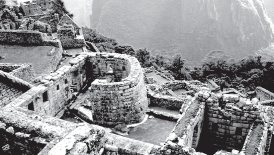
A team of Peruvian archaeologists has found a new
trail leading to the Machu Picchu complex in Cusco,
Peru — even if much of the road is still heavily covered
by thick vegetation. The discovery was announced by
[5] the director of the Archaeological Park of Machu Picchu,
Fernando Astete. The new road, almost a mile long, leads
to the Wayraqtambo area located in the rear section of
the citadel.
A team of workers are still on site cleaning the path,
[10] whose width varies between 3.9 and 4.5 feet, to clean
the road of brushes and trees. At the moment, only
intermittent retaining walls, up to 10 feet high, holding
back Machu Picchu mountain can be seen. “We don’t
know yet exactly how long or how tall the tunnel is,”
[15] Astete told Fox News Latino, explaining that much
excavation needs to be done. The tunnel was built after
20 feet of earth and rock collapsed over the road, he
added. “[The Incas] had to break up all those rocks to
construct the tunnel.”
[20] The road includes a tunnel—around 15 feet long
and as much as 12 feet high—built with the rocks typical
of Inca architecture. “It is one of the finest examples of
Inca engineering,” Astete has said.
Astete told FNL that the newly-discovered road
[25] probably predates Machu Picchu itself, which was built
at the height of the Inca Empire, around 1450, and was
unknown to the outside world before being discovered in
1911 by the American historian Hiram Bingham.
While Machu Picchu’s original purpose is still
[30] unknown, one of the most popular theories about the
site is that it was the royal retreat of the 15th-century
Inca Emperor Pachacuti. According to a National
Geographic report published in 2011, this idea maintains
that Machu Picchu was a place for Pachacuti and his
[35] royal court to relax, hunt, and entertain guests.
Machu Picchu, which covers 32,592 hectares of
mountain slopes, peaks and valleys, was declared one
of UNESCO’s World Heritage Sites in 1983.
New Trail to Machu Picchu. Disponível em: http:// latino.foxnews.com/latino/lifestyle/2014/06/06/new-trail-to-machupicchu-found-in-peru-nearly-mile-long-and-wit-tunnel/. Acesso em: 13 jun. 2014. Adaptado.
Considering language use in the text, it’s correct to say:
Questão 37 768011
UEFS Caderno 1 2014/2TEXTO:
New Trail to Machu Picchu
A team of Peruvian archaeologists has found a new
trail leading to the Machu Picchu complex in Cusco,
Peru — even if much of the road is still heavily covered
by thick vegetation. The discovery was announced by
[5] the director of the Archaeological Park of Machu Picchu,
Fernando Astete. The new road, almost a mile long, leads
to the Wayraqtambo area located in the rear section of
the citadel.
A team of workers are still on site cleaning the path,
[10] whose width varies between 3.9 and 4.5 feet, to clean
the road of brushes and trees. At the moment, only
intermittent retaining walls, up to 10 feet high, holding
back Machu Picchu mountain can be seen. “We don’t
know yet exactly how long or how tall the tunnel is,”
[15] Astete told Fox News Latino, explaining that much
excavation needs to be done. The tunnel was built after
20 feet of earth and rock collapsed over the road, he
added. “[The Incas] had to break up all those rocks to
construct the tunnel.”
[20] The road includes a tunnel—around 15 feet long
and as much as 12 feet high—built with the rocks typical
of Inca architecture. “It is one of the finest examples of
Inca engineering,” Astete has said.
Astete told FNL that the newly-discovered road
[25] probably predates Machu Picchu itself, which was built
at the height of the Inca Empire, around 1450, and was
unknown to the outside world before being discovered in
1911 by the American historian Hiram Bingham.
While Machu Picchu’s original purpose is still
[30] unknown, one of the most popular theories about the
site is that it was the royal retreat of the 15th-century
Inca Emperor Pachacuti. According to a National
Geographic report published in 2011, this idea maintains
that Machu Picchu was a place for Pachacuti and his
[35] royal court to relax, hunt, and entertain guests.
Machu Picchu, which covers 32,592 hectares of
mountain slopes, peaks and valleys, was declared one
of UNESCO’s World Heritage Sites in 1983.
New Trail to Machu Picchu. Disponível em: http:// latino.foxnews.com/latino/lifestyle/2014/06/06/new-trail-to-machupicchu-found-in-peru-nearly-mile-long-and-wit-tunnel/. Acesso em: 13 jun. 2014. Adaptado.
The word “around” (l. 20) has the same meaning as
Questão 34 767994
UEFS Caderno 1 2014/2TEXTO:
New Trail to Machu Picchu
A team of Peruvian archaeologists has found a new
trail leading to the Machu Picchu complex in Cusco,
Peru — even if much of the road is still heavily covered
by thick vegetation. The discovery was announced by
[5] the director of the Archaeological Park of Machu Picchu,
Fernando Astete. The new road, almost a mile long, leads
to the Wayraqtambo area located in the rear section of
the citadel.
A team of workers are still on site cleaning the path,
[10] whose width varies between 3.9 and 4.5 feet, to clean
the road of brushes and trees. At the moment, only
intermittent retaining walls, up to 10 feet high, holding
back Machu Picchu mountain can be seen. “We don’t
know yet exactly how long or how tall the tunnel is,”
[15] Astete told Fox News Latino, explaining that much
excavation needs to be done. The tunnel was built after
20 feet of earth and rock collapsed over the road, he
added. “[The Incas] had to break up all those rocks to
construct the tunnel.”
[20] The road includes a tunnel—around 15 feet long
and as much as 12 feet high—built with the rocks typical
of Inca architecture. “It is one of the finest examples of
Inca engineering,” Astete has said.
Astete told FNL that the newly-discovered road
[25] probably predates Machu Picchu itself, which was built
at the height of the Inca Empire, around 1450, and was
unknown to the outside world before being discovered in
1911 by the American historian Hiram Bingham.
While Machu Picchu’s original purpose is still
[30] unknown, one of the most popular theories about the
site is that it was the royal retreat of the 15th-century
Inca Emperor Pachacuti. According to a National
Geographic report published in 2011, this idea maintains
that Machu Picchu was a place for Pachacuti and his
[35] royal court to relax, hunt, and entertain guests.
Machu Picchu, which covers 32,592 hectares of
mountain slopes, peaks and valleys, was declared one
of UNESCO’s World Heritage Sites in 1983.
New Trail to Machu Picchu. Disponível em: http:// latino.foxnews.com/latino/lifestyle/2014/06/06/new-trail-to-machupicchu-found-in-peru-nearly-mile-long-and-wit-tunnel/. Acesso em: 13 jun. 2014. Adaptado.
Fill in the parentheses with T (True) or F (False).
About the new trail to Machu Picchu, it’s correct to say:
( ) It’s narrower than a five feet path.
( ) It has already been cleared of all kinds of vegetation.
( ) There is a regular high wall all around it.
( ) Its discovers are still uncertain about the exact size of its tunnel.
According to the text, the correct sequence, from top to bottom, is
Questão 32 767988
UEFS Caderno 1 2014/2TEXTO:
Heads in the cloud
It all started with the wall. In 1999 education
researcher Sugata Mitra and his colleagues thought it
would be interesting to install a computer in a wall
bordering an urban slum in New Delhi to see what the
[5] kids there might make of it. The results were stunning.
With no supervision, the children taught themselves how
to use the computer, including picking up English to look
for answers to all sorts of questions. Subsequent similar
experiments led Mitra to conclude that the most creative
[10] and productive education comes when children aren’t
threatened but inspired – especially by their peers. The
traditional approach was created by the British to train
the subjects of the empire, and, he argues, the system
continues to produce “identical people for a machine that
[15] no longer exists.” Instead, what he calls a self-organized
learning environment is all about getting kids excited
about what they can know. In a proposal that won Mitra
the TED award this year, he suggests creating an
enormous self-organized school in the cloud, where, with
[20] a little guidance but minimal interference from
“grandmothers,” kids can explore the universe at will to
answer their own questions and those that are put to them.
DICKEY, Christopher. Heads in the cloud. In: Big Think, Around the worldin six ideas. Newsweek, Mar 25, 2013. p. 8.
The phrase “With no supervision” (l. 6) can be exactly rephrased as
Questão 29 767979
UEFS Caderno 1 2014/2TEXTO:
Heads in the cloud
It all started with the wall. In 1999 education
researcher Sugata Mitra and his colleagues thought it
would be interesting to install a computer in a wall
bordering an urban slum in New Delhi to see what the
[5] kids there might make of it. The results were stunning.
With no supervision, the children taught themselves how
to use the computer, including picking up English to look
for answers to all sorts of questions. Subsequent similar
experiments led Mitra to conclude that the most creative
[10] and productive education comes when children aren’t
threatened but inspired – especially by their peers. The
traditional approach was created by the British to train
the subjects of the empire, and, he argues, the system
continues to produce “identical people for a machine that
[15] no longer exists.” Instead, what he calls a self-organized
learning environment is all about getting kids excited
about what they can know. In a proposal that won Mitra
the TED award this year, he suggests creating an
enormous self-organized school in the cloud, where, with
[20] a little guidance but minimal interference from
“grandmothers,” kids can explore the universe at will to
answer their own questions and those that are put to them.
DICKEY, Christopher. Heads in the cloud. In: Big Think, Around the worldin six ideas. Newsweek, Mar 25, 2013. p. 8.
Fill in the parentheses with T (True) or F (False).
It’s stated in the text:
( ) Sugata Mitra and his colleagues donated lots of computers to the inhabitants of a slum in New Delhi.
( ) The slum kids were highly motivated by the opportunity of having a computer in their area.
( ) The kids who lived in that slum couldn’t make the most of the opportunity because all the sites and comments were in English.
( ) The slum kids learned how to use the computer all on their own.
According to the text, the correct sequence, from top to bottom, is
Questão 27 767975
UEFS Caderno 1 2014/2TEXTO:
China’s one-child policy
China’s top legislature approved resolutions to
officially amend its controversial one-child policy. The
changes to the one-child policy will mean couples will
be allowed to have two children if one of the parents was
[5] an only child, according to the state-run Xinhua news
agency. Currently, both parents must be sole children to
be eligible for a second child.
The one-child policy, which started in the 1970s, is
believed to have prevented some 400 million births,
[10] according to Xinhua. Although the policy has been
applauded by many for slowing down China’s rapid
population growth, it has also been widely criticized for
resulting in forced abortions and hefty fines for families.
Some critics say the law hurts China’s elderly, who
[15] typically rely on their children for support in old age, and
even constrains economic growth as the working-age
population begins to decline. Since the 1990s, the birth
rate has declined, with Chinese women giving birth to an
average of 1.4 to 1.6 children.
[20] The world’s most populous nation will soon have
too few people – or, rather, too few of the right kind of
people. More than three decades of government-
mandated family planning have succeeded beyond the
architects’ most grandiose dreams. Add to that the natural
[25] inclination of richer, more educated people to limit their
family size, and China’s population growth is projected
to gradually diminish within fifteen years. That would leave
the People’s Republic with a distorted population: too
few youths, too few women and too many elderly.
[30] Off icials say the easing of the one-child policy does
not mean China is ending its family planning. “China still
has a large population. This has not changed. Many of
our economic and social problems are rooted in this
reality,” said Jiang Fan, a National People’s Congress
[35] deputy, in Chinese media. “We cannot risk the population
growing out of control.”
PARK, Madison. China’s one-child policy. Disponível em: http:// www.cnn.com/2013/12/28/world/asia/china-one-child-policy-official. Acesso em: 13 jun. 2014. Adaptado.
The only pair of opposites is in alternative
06