


![[Marketing] Questao Topo - deslogado](https://storage.estuda.com.br/banners/0_6b7ebee90b03af1c560c73bb8bcce34a_banner_deslogado_70_dias.png)
Questões de Inglês
19.971 Questões
Questão 20 790307
USS (Univassouras) 2014/1Brazil’s people are crying out for change, so let’s seize the moment
Who would have thought that the Latin American spring would blossom in Brazil? In the past 10
years, the country has created a “new middle class” by bringing 40 million people to unprecedented
levels of income and consumption, and creating 19 million jobs in the midst of one of the worst
global financial crises. Why then do millions of young people feel so politically unrepresented that
[5] they have taken to the streets in such numbers?
Brazilian commentators have proffered many partial answers, some of universal import, others
specific to Brazil. The low level of confidence in representative institutions which are seen as
corrupt and undemocratic is one; the government’s willingness to back various mega sporting
events alongside its broken promises on the social state agenda (including health, education and
[10] public transport) is another; finally, the depoliticisation of a part of the Brazilian middle and upper-
middle class youth. These are people who have reaped the benefits of capitalist growth without
experiencing its side-effects of extreme inequality, poverty and despair. They have accepted the
rightwing, anti-state ideology and have turned it into the anti-political “no party” slogans constantly
heard in the protests.
[15] It would be too reductionist, however, to interpret the multitude in the streets as part of a rightwing
or neoliberal conspiracy. The colourful multiplicity of protests is not a prelude to a rightwing coup,
something from which Brazil has repeatedly suffered. The activists of the social movements as well
as the extremist rightwing groups are only a minority. The central meaning of the protests makes
them an integral part of the cycle of occupations all over the world since 2011. Diverse grievances,
[20] antagonistic hopes and conflicting narratives ground the protests, but they are also part of the new
age of resistance. Have we seen this film before? Definitely not.
The protests in Brazil express, in a specific and rich manner, the emerging fissure between the
standard conception of politics and the new politics of resistance. This gap had been bridged in
the past by the lethargic and technocratic formal politics or by identity politics. Could it be that we
[25] are now facing the opening of a new grammar of acting politically, broadcast live? Could protest,
resistance and rebellion be considered as a gesture towards what is essential but missing in formal
politics — the determination of those who fight for justice? The capture of the streets marks the
collective capacity to act and to create new political meanings. From now on, nothing will be the
same as before. Our problems have changed and new answers are in the air. This is what matters.
BETHANIA ASSY and BRUNO CAVA theguardian.com
Questions may have different functions in a text.
The fragment which signals that the authors are formulating a hypothesis is:
Questão 20 787673
USS (Univassouras) 2014/2Universities need to tell students the rules about plagiarism

Some universities are letting students down by failing to warn
them about plagiarism and its consequences until it is too
late, says the official who deals with student complaints.
The annual report of the Office of the Independent
[5] Adjudicator (OIA) shows that complaints from students about
harsh treatment by their universities over cheating have risen
sharply in the past three years.
The OIA’s chief executive, Rob Behrens, says the problem of student academic misconduct appears
to be growing. “When I go round to universities, I realise they are already dealing with significant
[10] amounts of academic misconduct that doesn’t ever come to the OIA.”
According to Behrens, these complaints fall into three categories. “Students say to us either: ‘No
one told me what the rules were’, or ‘I accept I broke the rules, but the sanction is too severe’, or ‘The
university didn’t follow its own regulations and I didn’t get a fair hearing’.”
In one typical example, a student used notes from a website that publishes essays and was caught
[15] by his university. The work also included sentences identical to another student’s from a previous
year. The university decided this was a serious breach of its rules. Marks for the whole module
were reduced to zero, which meant the student’s degree classification also dropped. The student
believed his punishment was too severe, but the adjudicator ruled against the student.
However, the concept of plagiarism can vary across cultures. For example, imitation can be regarded
[20] as a form of flattery and respect. As Behrens told the inquiry, “Chinese colleagues comment ‘what
you call plagiarism we call good practice’, so you have to explain to people they can do X and they
can’t do Y. You can’t just assume it is known. This also applies to British students. We can no longer
have assumptions about what students know when they go to university”.
Behrens says universities should do more to communicate their rules, procedures and sanctions on
[25] plagiarism. And Liam Burns, president of the National Union of Students agrees, especially to avoid
“accidental cheating”, such as when a student has been unclear about when to cite a source. “I’d
like to see more universities use the plagiarism software for student training as well as detection. If
students can see what sets off the ‘plagiarism alarm’, that helps”.
Behrens urges continuing investment in both detection and prevention. “Good students and
universities have common cause here”, he says.
theguardian.com
According to the text, plagiarism can be discovered by a software.
Liam Burns believes that this software can also be used with purpose of:
Questão 17 787665
USS (Univassouras) 2014/2Universities need to tell students the rules about plagiarism
Some universities are letting students down by failing to warn
them about plagiarism and its consequences until it is too
late, says the official who deals with student complaints.
The annual report of the Office of the Independent
[5] Adjudicator (OIA) shows that complaints from students about
harsh treatment by their universities over cheating have risen
sharply in the past three years.
The OIA’s chief executive, Rob Behrens, says the problem of student academic misconduct appears
to be growing. “When I go round to universities, I realise they are already dealing with significant
[10] amounts of academic misconduct that doesn’t ever come to the OIA.”
According to Behrens, these complaints fall into three categories. “Students say to us either: ‘No
one told me what the rules were’, or ‘I accept I broke the rules, but the sanction is too severe’, or ‘The
university didn’t follow its own regulations and I didn’t get a fair hearing’.”
In one typical example, a student used notes from a website that publishes essays and was caught
[15] by his university. The work also included sentences identical to another student’s from a previous
year. The university decided this was a serious breach of its rules. Marks for the whole module
were reduced to zero, which meant the student’s degree classification also dropped. The student
believed his punishment was too severe, but the adjudicator ruled against the student.
However, the concept of plagiarism can vary across cultures. For example, imitation can be regarded
[20] as a form of flattery and respect. As Behrens told the inquiry, “Chinese colleagues comment ‘what
you call plagiarism we call good practice’, so you have to explain to people they can do X and they
can’t do Y. You can’t just assume it is known. This also applies to British students. We can no longer
have assumptions about what students know when they go to university”.
Behrens says universities should do more to communicate their rules, procedures and sanctions on
[25] plagiarism. And Liam Burns, president of the National Union of Students agrees, especially to avoid
“accidental cheating”, such as when a student has been unclear about when to cite a source. “I’d
like to see more universities use the plagiarism software for student training as well as detection. If
students can see what sets off the ‘plagiarism alarm’, that helps”.
Behrens urges continuing investment in both detection and prevention. “Good students and
universities have common cause here”, he says.
theguardian.com
Observe how the writer introduces Behren’s voice below:
The OIA’s chief executive, Rob Behrens, says the problem of student academic misconduct appears to be growing. (l. 8-9)
The type of reported speech used to introduced Behren’s voice is:
Questão 16 787658
USS (Univassouras) 2014/2Universities need to tell students the rules about plagiarism
Some universities are letting students down by failing to warn
them about plagiarism and its consequences until it is too
late, says the official who deals with student complaints.
The annual report of the Office of the Independent
[5] Adjudicator (OIA) shows that complaints from students about
harsh treatment by their universities over cheating have risen
sharply in the past three years.
The OIA’s chief executive, Rob Behrens, says the problem of student academic misconduct appears
to be growing. “When I go round to universities, I realise they are already dealing with significant
[10] amounts of academic misconduct that doesn’t ever come to the OIA.”
According to Behrens, these complaints fall into three categories. “Students say to us either: ‘No
one told me what the rules were’, or ‘I accept I broke the rules, but the sanction is too severe’, or ‘The
university didn’t follow its own regulations and I didn’t get a fair hearing’.”
In one typical example, a student used notes from a website that publishes essays and was caught
[15] by his university. The work also included sentences identical to another student’s from a previous
year. The university decided this was a serious breach of its rules. Marks for the whole module
were reduced to zero, which meant the student’s degree classification also dropped. The student
believed his punishment was too severe, but the adjudicator ruled against the student.
However, the concept of plagiarism can vary across cultures. For example, imitation can be regarded
[20] as a form of flattery and respect. As Behrens told the inquiry, “Chinese colleagues comment ‘what
you call plagiarism we call good practice’, so you have to explain to people they can do X and they
can’t do Y. You can’t just assume it is known. This also applies to British students. We can no longer
have assumptions about what students know when they go to university”.
Behrens says universities should do more to communicate their rules, procedures and sanctions on
[25] plagiarism. And Liam Burns, president of the National Union of Students agrees, especially to avoid
“accidental cheating”, such as when a student has been unclear about when to cite a source. “I’d
like to see more universities use the plagiarism software for student training as well as detection. If
students can see what sets off the ‘plagiarism alarm’, that helps”.
Behrens urges continuing investment in both detection and prevention. “Good students and
universities have common cause here”, he says.
theguardian.com
The illustration shows the cut-and-paste process of writing a text.
This process is directly related to the following definition of plagiarism:
Questão 40 768014
UEFS Caderno 1 2014/2TEXTO:
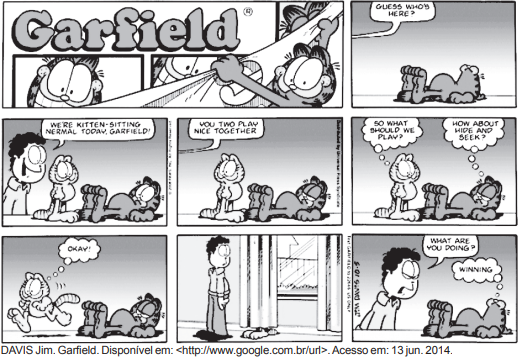
According to the last picture of the comic strip,
Questão 39 768013
UEFS Caderno 1 2014/2TEXTO:
According to this comic strip, the big cat, Garfield,
06