


![[Marketing] Questao Topo - deslogado](https://storage.estuda.com.br/banners/0_6b7ebee90b03af1c560c73bb8bcce34a_banner_deslogado_70_dias.png)
Questões de Inglês
19.971 Questões
Questão 19 8452345
UNIFESP 1 Dia 2022Leia o texto para responder à questão.
Facebook officials had internal research in March 2020 showing that Instagram — the social media platform most used by adolescents — is harmful to teen girls’ body image and well-being but swept those findings under the rug to continue conducting business as usual, according to a Sept. 14, 2021, Wall Street Journal report.
Facebook’s policy of pursuing profits regardless of documented harm has sparked comparisons to Big Tobacco, which knew in the 1950s that its products were carcinogenic but publicly denied it into the 21st century. Those of us who study social media use in teens didn’t need a suppressed internal research study to know that Instagram can harm teens.
Understanding the impact of social media on teens is important. A Pew Research Center poll shows that 89% of teens report they are online “almost constantly” or “several times a day”. Teens are more likely to log on to Instagram than any other social media site. It is a prevalent part of adolescent life. Yet studies consistently show that the more often teens use Instagram, the worse their overall well-being, self-esteem, life satisfaction, mood and body image.
But Instagram isn’t problematic simply because it is popular. There are two key features that seem to make it particularly risky. First, it allows users to follow both celebrities and peers, both of whom can present a manipulated, filtered picture of an unrealistic body along with a highly curated impression of a perfect life. Meanwhile, Facebook has been relegated to the uncool soccer moms and grandparents. For teens, this integration of celebrities and retouched versions of real-life peers presents a ripe environment for upward social comparison, or comparing yourself to someone who is “better” in some respect.
Instagram is also risky for teens because its emphasis on pictures of the body leads users to focus on how their bodies look to others. Being an object for others to view doesn’t help the “selfie generation” feel empowered and sure of themselves — it can do exactly the opposite. These are not insignificant health concerns, because body dissatisfaction during the teen years is a powerful and consistent predictor of later eating disorder symptoms.
Facebook has acknowledged internally what researchers have been documenting for years: Instagram can be harmful to teens. The big question will be how Facebook handles these damaging results. History and the courts have been less than forgiving of the head-in-the-sand approach of Big Tobacco.
(Christia Spears Brown. www.theconversation.com, 16.09.2021. Adaptado.)
According to the third paragraph, studies about the impact of social media on the teen generation are justified considering that
Questão 7 8452217
UNIFESP 1 Dia 2022Examine o meme criado a partir de uma cena famosa do filme O sétimo selo, do cineasta sueco Ingmar Bergman.

Para obter seu efeito de humor, o meme explora os recursos expressivos:
Questão 16 8400881
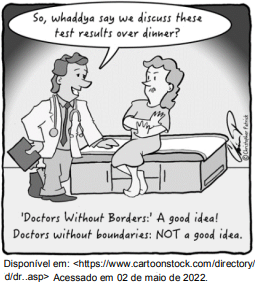
FPS Demais Cursos 2022/2A charge abaixo intenta mostrar como
Questão 15 8400880
FPS Demais Cursos 2022/2A manchete da capa da revista Newsweek faz alusão a:

Questão 43 8398050
UNIP 2022Para responder à questão.
TEXTO I
New HIV jabs taken two months apart hailed as huge step forward
Safe injectable antiretroviral drugs, approved by health bodies, ‘could lift burden of daily oral therapy’
Thousands of people living with HIV in Britain are to be freed from the burden of taking daily pills, after health chiefs gave the green light for a revolutionary treatment by injection every two months.
Draft guidance from the National Institute for Health and Care Excellence (Nice) recommends offering the antiretroviral drugs cabotegravir and rilpivirine in England and Wales after trials proved they work as effectively as daily tablets.
The Scottish Medicines Consortium has also approved the injections for adults living with HIV in Scotland.
Although HIV, which attacks the immune system, is still incurable, researchers found that patients who had the new treatment could reach a point where the virus particles in their blood (the viral load) were so low those particles could not be detected or transmitted between people.
(…)
The treatment is the first long-acting, injectable treatment for adults with HIV. It is also the first recommendation Nice has made about the use of HIV treatments since they came under its remit two years ago.
Cabotegravir with rilpivirine is now being recommended as an option for adults with HIV infection when antiretroviral medicines they are already taking have kept the virus at a low level, and where there is no evidence to suspect viral resistance and no previous failure of other antiHIV medicines.
About 100,000 people have HIV in Britain. It is estimated that initially at least 13,000 people will be eligible for the new jab in England alone.
At present treatment for HIV involves life-long antiretroviral regimens taken as tablets every day. Clinical trial results show cabotegravir with rilpivirine is as effective as oral drugs at keeping the viral load low. The antiretrovirals are administered as two separate injections every two months. (…)
A treatment only required six times a year will make taking medicine easier for some people, and is more discreet for those who feel unable to be open about their HIV status. Experts say removing the need to take pills every single day may also lessen the emotional toll of living with HIV, and improve the numbers of people who adhere to their treatment regime.
(…)
Source:https://www.theguardian.com/society/2021/nov/18/new-hivjabs-taken-two-months-apart-hailed-as-huge-step-forward. Access: 11/22/2021.
De acordo com as ideias veiculadas pelo texto, informe se é verdadeiro (V) ou falso (F) o que se afirma a seguir e assinale a alternativa com a sequência correta.
( ) O novo antirretroviral do qual o texto fala será administrado em todos os pacientes que têm HIV no Reino Unido.
( ) O novo tratamento para pacientes que têm HIV será feito a cada dois meses, portanto seis vezes por ano.
( ) O tratamento convencional para pacientes que têm HIV é feito com pílulas que são administradas todos os dias.
( ) É esperado que o novo tratamento para pacientes com HIV possa atenuar o impacto emocional nos pacientes que vivem com o vírus.
Questão 17 8395370
UFAM PSC 3º Etapa 2022A questão se referem ao texto a seguir:
Aeroponics: feeding tomorrow's world?
If our world is to survive for much longer, we have no choice but to reduce the use of natural resources and cut out wastage. Compared to traditional agriculture, aeroponics does both. The world's population is expected to continue growing until the end of the twenty-first century; that at least was the consensus of experts until 2019. Maybe in the new post-Covid reality, the rate of growth will slow; but even so, unless Covid-19 or some other new virus causes millions more deaths than initially predicted, the world's population will continue to grow, putting everincreasing pressure on the natural environment, on resources, on living space, and most critically on food and water. Aeroponics will be part of the solution. According to United Nations reports published in 2011, half of the fruit and vegetables produced in the world go to waste – they never get consumed by the humans for whom they are grown. Wastage occurs throughout the production and distribution cycle, during production, during transformation, during transport, and even – notably in developed economies after purchase by the final customer. Fifty percent of all fruit and vegetables going to waste, that is an enormous amount of wastage, and not just in economic terms. This wastage has a huge impact in terms of natural resources, particularly space and water, which in turn have huge implications for the global environment. Cutting out all waste in the production and distribution of food is an impossible goal. Even people living in small eco-sustainable communities generate waste. Even in organic crop production, pests and disease cause wastage; and even if harvested and distributed locally, part of a crop will always be wasted. But there is a large difference between wasting fifty percent of all fruit and vegetables produced worldwide, and the unreachable goal of achieving no waste at all. Between 50% and zero, there is plenty of scope for significantly reducing the volume of food waste worldwide simply through the use of new more efficient production methods. Studies have shown that packaging and distribution systems account for about 25% of total wastage of fresh fruit and vegetables, leaving plenty of opportunity for improvement. In an ideal world, and as in the past, much of the food consumed in cities would be produced locally, not shipped thousands of miles as happens today. In 1998, the US Department of Agriculture released a study into fruit and vegetables arriving at the Chicago Terminal Market, the main point of distribution for the American Middle West. The report showed that basic vegetables including lettuce, broccoli, peas or cauliflowers all traveled over 2000 miles (over 3000 km) before reaching the market... and before being shipped on to supermarkets across the region. Yet Chicago is in the heart of a massive agricultural area. Granted it can get pretty cold in winter, but with modern agricultural techniques, the Midwest could be self-sufficient for many types of fruit and vegetables, cutting out the massive environmental cost of shipping tons of vegetables halfway across a continent. Since 2011, Chicago's O'Hare airport has been home to an aeroponic garden, where people can see how vegetables can be grown in an environment that is not only without soil but even without any permanent medium in which to grow. In this experimental garden, plants are grown, as the name suggests, ... in the air, their roots hanging down in nothing. Hydroponics, growing plants in troughs of nutrient-rich water, has been developing since the 1970's. Aeroponics takes things one step further, by removing the water and replacing it with air. Not just air, obviously; while plants are grown with roots hanging in the air, these roots are regularly sprayed with a nutrient-rich solution that gives them just what they need for optimum growth. It's very high-tech, it's not cheap, and it's a long way from currently popular organic farming techniques. Yet in many ways, aeroponics is actually more environment-friendly than even the most strictly managed traditional organic farming methods. And it's down to one factor: waste. Traditional farming is wasteful; modern intensive agriculture relies on large inputs of external resources, notably heat, water and nutrients. The vast amounts of water used by agriculture are already causing serious problems in many parts of the world; beneath California's San Joaquim Valley, the world's most productive agricultural area, water tables have been dropping for almost a century, and scientists estimate that the land... not the water table below it... has sunk by over 8 meters in some parts. NASA calculate that Southern California had a "water deficit" of 4.2 gigatons per year from 2002 to 2015.Aeroponic agriculture reduces water waste to zero. The only water used is what is actually taken up by the roots of plants when they are sprayed. Any water not used can be collected and reused. The same goes for nutrients; in traditional agriculture, plants only extract a small proportion of nutrients from the ground, and good ground will have many nutrients in it that will not be used at all by the crops grown on it. In an age of diminishing natural resources, traditional agriculture uses millions of tons of chemical fertilizer each year, much of which goes to waste. In Brittany, France, many streams, and beaches have been seriously polluted by nutrient-rich water running off fields, causing "algal bloom" along the seashore and covering some beaches in green slime. With aeroponic agriculture, no nutrients are lost, so there is no risk of unintended pollution. One big advantage of traditional agriculture is that it almost always uses natural heat and light, even if under glass or plastic. Aeroponic agriculture, by contrast, may require artificial heat and light, especially if practiced indoors. But with the development of smallscale locally sited renewable energy production, and highly energy-efficient buildings and lighting systems, large-scale indoor aeroponic vegetable growing units are liable to be a feature of tomorrow's cities. If all the lettuces consumed in Chicago in winter could be grown locally, in carbon-neutral zero-waste aeroponic "farms", instead of being brought in by truck from California, that would lead to a huge reduction in the use of water, minerals, landspace and transportation costs. Reproduced on a global scale, reduced use of natural resources will be vital for ensuring a sustainable future for generations to come, even when the global population goes above 10 billion.
Fonte: https://linguapress.com/advanced/aeroponics.htm. Acessado em 27 de março de 2022.
A palavra “it”, destacada em negrito no texto, referese:
06