


![[Marketing] Questao Topo - deslogado](https://storage.estuda.com.br/banners/0_6b7ebee90b03af1c560c73bb8bcce34a_banner_deslogado_70_dias.png)
Questões de Inglês
19.971 Questões
Questão 8 6414975
EFOMM 2014Mark the correct alternative to complete the sentence.
Max _________________ ill for three weeks. He’s still in hospital.
Questão 1 6414710
EFOMM 2014TEXT
Royal Navy hands fishing boat to Yemen
authorities in counter-piracy operation
An elite team of Royal Marines stormed
the fishing vessel on Friday, seizing it back from a
gang of suspected Somali pirates. The pirates are
believed to have stolen the fishing vessel in order
[5] to use it as a platform for launching hijack
attempts on cargo ships and tankers in the Gulf of
Aden.
The return of the fishing vessel – known
as a dhow – is part of the NATO (North Atlantic
[10] Treaty Organization) crackdown on piracy in the
seas around Somalia. Captain Gerry Northwood,
who is heading the counter-piracy operation on
board RFA Fort Victoria, said that he was pleased
to return the dhow to her Yemeni owner. “This
[15] was a good example of Royal Navy and the
Yemeni Navy working together for the common
good of the local maritime community”, he said.
“I was pleased that we were able to return the
dhow to its rightful owner. It is important that
[20] through our cooperation with the Yemeni Navy,
we reassure the local maritime community that we
are able to protect their interests. They are as
much the victims of Somali piracy as the larger
international ships navigating through the area".
[25] The dhow was handed over to the Yemeni Navy.
A spokesman said “Thank you for the dhow and
thank you for everything”.
Piracy in the Indian Ocean currently costs
the world economy billions of pounds a year.
[30] Merchant vessels are being forced into large
detours around dangerous areas and insurance
costs have risen.
(Adapted from www.telegraph.co.uk/news/worldnews/piracy/ Jan 17,2012)
According to TEX, it is correct to say that:
Questão 80 6317735
UNIFESO 2014/1 A few months ago two out of three Colombians
approved of the Santos government – a rockͲstar
standing by the bruising political standards of the Andes.
The country´s economy was soaring, overtaking
[5] Argentina as the fifth largest in Latin America. Foreign
investors lined up as prospectors found oil, gas and coal
practically everywhere they dug. Crime, once a national
scourge, was plunging. The only thing missing was
peace. And so, late last year, the savvy 62ͲyearͲold
[10] economist turned president declared, “the stars are
aligned”, and set out to secure a peace deal that would
end the insurgency by the Revolutionary Armed Forces
of Colombia (FARC), which has lasted more than half a
century.
[15] But, after 12 tough rounds of negotiations in Havana,
even the significantly weakened FARC may be proving
too difficult for Santos to handle. Certainly, hope of a
peace deal by November, as had been hopefully
predicted by the Santos regime, looks increasingly
[20] unlikely.
As negotiations have dragged on, the national mood
has dragged down. The most recent polls show that two
thirds of the country now disapproves of the peace
effort and 60 percent of those surveyed said that they
[25] don´t want to see him reelected next year.
Perhaps his harshest critic was Álvaro Úribe, his
predecessor and once mentor, who had waged an allͲ
out war against the FARC while in office. Ironically, it was
Úribe´s unrelenting pursuit of the FARC that paved the
[30] way for the current peace plan. With dimming prospects
for peace and a looming election, the irony may be lost
on the ColombiansͲand on Santos himself.
(from a Perilous Peace Plan, by Mac Margolis, in NEWSWEEK, August 26, 2013)
From the passage as a whole we infer that
Questão 75 6317725
UNIFESO 2014/1 A few months ago two out of three Colombians
approved of the Santos government – a rockͲstar
standing by the bruising political standards of the Andes.
The country´s economy was soaring, overtaking
[5] Argentina as the fifth largest in Latin America. Foreign
investors lined up as prospectors found oil, gas and coal
practically everywhere they dug. Crime, once a national
scourge, was plunging. The only thing missing was
peace. And so, late last year, the savvy 62ͲyearͲold
[10] economist turned president declared, “the stars are
aligned”, and set out to secure a peace deal that would
end the insurgency by the Revolutionary Armed Forces
of Colombia (FARC), which has lasted more than half a
century.
[15] But, after 12 tough rounds of negotiations in Havana,
even the significantly weakened FARC may be proving
too difficult for Santos to handle. Certainly, hope of a
peace deal by November, as had been hopefully
predicted by the Santos regime, looks increasingly
[20] unlikely.
As negotiations have dragged on, the national mood
has dragged down. The most recent polls show that two
thirds of the country now disapproves of the peace
effort and 60 percent of those surveyed said that they
[25] don´t want to see him reelected next year.
Perhaps his harshest critic was Álvaro Úribe, his
predecessor and once mentor, who had waged an allͲ
out war against the FARC while in office. Ironically, it was
Úribe´s unrelenting pursuit of the FARC that paved the
[30] way for the current peace plan. With dimming prospects
for peace and a looming election, the irony may be lost
on the ColombiansͲand on Santos himself.
(from a Perilous Peace Plan, by Mac Margolis, in NEWSWEEK, August 26, 2013)
According to paragraphs 2 and 3,
Questão 73 6317721
UNIFESO 2014/1 A few months ago two out of three Colombians
approved of the Santos government – a rockͲstar
standing by the bruising political standards of the Andes.
The country´s economy was soaring, overtaking
[5] Argentina as the fifth largest in Latin America. Foreign
investors lined up as prospectors found oil, gas and coal
practically everywhere they dug. Crime, once a national
scourge, was plunging. The only thing missing was
peace. And so, late last year, the savvy 62ͲyearͲold
[10] economist turned president declared, “the stars are
aligned”, and set out to secure a peace deal that would
end the insurgency by the Revolutionary Armed Forces
of Colombia (FARC), which has lasted more than half a
century.
[15] But, after 12 tough rounds of negotiations in Havana,
even the significantly weakened FARC may be proving
too difficult for Santos to handle. Certainly, hope of a
peace deal by November, as had been hopefully
predicted by the Santos regime, looks increasingly
[20] unlikely.
As negotiations have dragged on, the national mood
has dragged down. The most recent polls show that two
thirds of the country now disapproves of the peace
effort and 60 percent of those surveyed said that they
[25] don´t want to see him reelected next year.
Perhaps his harshest critic was Álvaro Úribe, his
predecessor and once mentor, who had waged an allͲ
out war against the FARC while in office. Ironically, it was
Úribe´s unrelenting pursuit of the FARC that paved the
[30] way for the current peace plan. With dimming prospects
for peace and a looming election, the irony may be lost
on the ColombiansͲand on Santos himself.
(from a Perilous Peace Plan, by Mac Margolis, in NEWSWEEK, August 26, 2013)
According to paragraph 1,
Questão 48 6317526
EEAR 2014Read the cartoon and answer question.
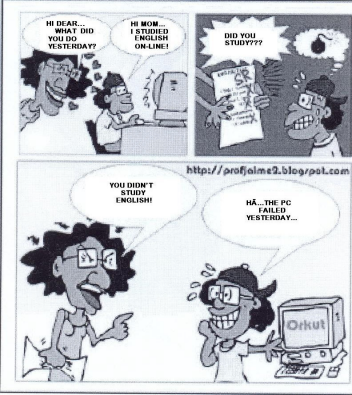
Reading the cartoon leads to the conclusion that, except:
06