


![[Marketing] Questao Topo - deslogado](https://storage.estuda.com.br/banners/0_6b7ebee90b03af1c560c73bb8bcce34a_banner_deslogado_70_dias.png)
Questões de Inglês
19.971 Questões
Questão 38 93327
USF Geral 2015Caffeine: The Silent Killer of Success
By Travis Bradberry, Ph.D.
September 08, 2014
Most people start drinking caffeine because it makes them feel more alert and improves their mood. Many studies suggest that caffeine actually improves cognitive task performance (memory, attention span, etc.) in the short-term. Unfortunately, these studies fail to consider the participants’ caffeine habits. New research from Johns Hopkins Medical School shows that performance increases due to caffeine intake is the result of caffeine drinkers experiencing a shortterm reversal of caffeine withdrawal.
By controlling for caffeine use in study participants, John Hopkins researchers found that caffeine-related performance improvement is nonexistent without caffeine withdrawal. In essence, coming off caffeine reduces your cognitive performance and has a negative impact on your mood. The only way to get back to normal is to drink caffeine, and when you do drink it, you feel like it’s taking you to new heights. In reality, the caffeine is just taking your performance back to normal for a short period.
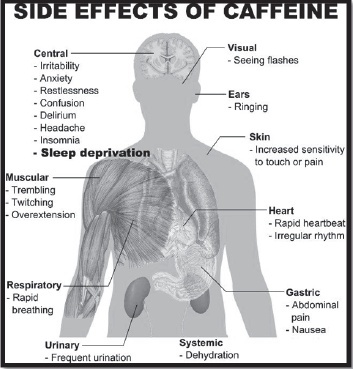
The Bad: Adrenaline: Drinking caffeine triggers the release of adrenaline. Adrenaline is the source of the “fight or flight” response, a survival mechanism that forces you to stand up and fight or run for the hills when faced with a threat. The fight-or-flight mechanism sidesteps rational thinking in favor of a faster response. This is great when a bear is chasing you, but not so great when you’re responding to a curt email. When caffeine puts your brain and body into this hyper-aroused state, your emotions overrun your behavior. Irritability and anxiety are the most commonly seen emotional effects of caffeine, but caffeine enables all of your emotions to take charge. The negative effects of a caffeinegenerated adrenaline surge are not just behavioral. Researchers at Carnegie Mellon University found that large doses of caffeine raise blood pressure, stimulate the heart, and produce rapid shallow breathing.
The Ugly: Sleep: Caffeine has a six-hour half-life, which means it takes a full twenty-four hours to work its way out of your system. Have a cup of coffee at eight a.m., and you’ll still have 25% of the caffeine in your body at eight p.m. Anything you drink after noon will still be at 50% strength at bedtime. Any caffeine in your bloodstream—with the negative effects increasing with the dose—makes it harder to fall asleep. When caffeine disrupts your sleep, you wake up the next day with an emotional handicap. You’re naturally going to be inclined to grab a cup of coffee or an energy drink to try to make yourself feel better.
Withdrawal: Like any stimulant, caffeine is physiologically and psychologically addictive. If you do choose to lower your caffeine intake, you should do so slowly under the guidance of a qualified medical professional. The researchers at Johns Hopkins found that caffeine withdrawal causes headache, fatigue, sleepiness, and difficulty concentrating. Some people report feeling flu-like symptoms, depression, and anxiety after reducing intake by as little as one cup a day. Slowly tapering your caffeine dosage each day can greatly reduce these withdrawal symptoms.
Disponível em: <https://www.linkedin.com/pulse/article/20140908162020-50578967-caffeine-the-silent-killer-of-success> Acesso em:
10/09/2014, às 14h45min (fins pedagógicos – Adaptado).
“If you do choose to lower your caffeine intake, you should do so slowly under the guidance…”
In the sentence from the text, the underlined words express respectively _______________ and ________________
Questão 29 93020
UNESP 2015/1Pediatric group advises parents to read to kids
June 26, 2014
By Amy Graff

Reading Go Dog Go to your 6 month old might seem like wasted time because she’s more likely to eat the book than help you turn the pages, but a statement released by the American Academy of Pediatrics (AAP) this week says reading in the early years is essential. Reading out loud gets parents talking to their babies and the sound of an adult’s voice stimulates that tiny yet rapidly growing brain. In the statement, the academy advises pediatricians to tell parents to read books to their children from birth.
Reading regularly with young children stimulates optimal patterns of brain development and strengthens parent-child relationships at a critical time in child development, which, in turn, builds language, literacy, and social-emotional skills that last a lifetime. Research shows that a child’s brain develops faster between 0 and 3 than at any other time in life, making the early years a critical time for babies to hear rich oral language. The more words children hear directed at them by parents and caregivers, the more they learn.
While many babies are read Goodnight Moon and The Very Hungry Caterpillar every night before bed, others never get a chance to “pat the bunny.” Studies reveal that children from low-income, less-educated families have significantly fewer books than their more affluent peers. By age 4, children in poverty hear 30 million fewer words than those in higher-income households. These dramatic gaps result in significant learning disadvantages that persist into adulthood. The AAP hopes the new guidelines will encourage all parents to start reading from day one.
Research shows that when pediatricians talk with parents about reading, moms and dads are more likely to fill their home with books and read. Also, to help get more parents reading, the AAP is partnering with organizations such as Scholastic and Too Small to Fail to help get reading materials to new families who need books the most.
This is the first time the AAP has made a recommendation on children’s literary education and it seems the timing might be just right as more and more parents are leaning on screens and electronic gadget to occupy their babies. “The reality of today’s world is that we’re competing with portable digital media,” Dr. Alanna Levine, a pediatrician in Orangeburg, N.Y., told The New York Times. “So you really want to arm parents with tools and rationale behind it about why it’s important to stick to the basics of things like books.”
(http://blog.seattlepi.com. Adaptado.)
No trecho do terceiro parágrafo “By age 4, children in poverty hear 30 million fewer words than those in higher-income households.”, o termo em destaque se refere às crianças
Questão 27 93018
UNESP 2015/1Pediatric group advises parents to read to kids
June 26, 2014
By Amy Graff
Reading Go Dog Go to your 6 month old might seem like wasted time because she’s more likely to eat the book than help you turn the pages, but a statement released by the American Academy of Pediatrics (AAP) this week says reading in the early years is essential. Reading out loud gets parents talking to their babies and the sound of an adult’s voice stimulates that tiny yet rapidly growing brain. In the statement, the academy advises pediatricians to tell parents to read books to their children from birth.
Reading regularly with young children stimulates optimal patterns of brain development and strengthens parent-child relationships at a critical time in child development, which, in turn, builds language, literacy, and social-emotional skills that last a lifetime. Research shows that a child’s brain develops faster between 0 and 3 than at any other time in life, making the early years a critical time for babies to hear rich oral language. The more words children hear directed at them by parents and caregivers, the more they learn.
While many babies are read Goodnight Moon and The Very Hungry Caterpillar every night before bed, others never get a chance to “pat the bunny.” Studies reveal that children from low-income, less-educated families have significantly fewer books than their more affluent peers. By age 4, children in poverty hear 30 million fewer words than those in higher-income households. These dramatic gaps result in significant learning disadvantages that persist into adulthood. The AAP hopes the new guidelines will encourage all parents to start reading from day one.
Research shows that when pediatricians talk with parents about reading, moms and dads are more likely to fill their home with books and read. Also, to help get more parents reading, the AAP is partnering with organizations such as Scholastic and Too Small to Fail to help get reading materials to new families who need books the most.
This is the first time the AAP has made a recommendation on children’s literary education and it seems the timing might be just right as more and more parents are leaning on screens and electronic gadget to occupy their babies. “The reality of today’s world is that we’re competing with portable digital media,” Dr. Alanna Levine, a pediatrician in Orangeburg, N.Y., told The New York Times. “So you really want to arm parents with tools and rationale behind it about why it’s important to stick to the basics of things like books.”
(http://blog.seattlepi.com. Adaptado.)
No trecho do primeiro parágrafo “that tiny yet rapidly growing brain”, o termo em destaque indica
Questão 26 93017
UNESP 2015/1Pediatric group advises parents to read to kids
June 26, 2014
By Amy Graff
Reading Go Dog Go to your 6 month old might seem like wasted time because she’s more likely to eat the book than help you turn the pages, but a statement released by the American Academy of Pediatrics (AAP) this week says reading in the early years is essential. Reading out loud gets parents talking to their babies and the sound of an adult’s voice stimulates that tiny yet rapidly growing brain. In the statement, the academy advises pediatricians to tell parents to read books to their children from birth.
Reading regularly with young children stimulates optimal patterns of brain development and strengthens parent-child relationships at a critical time in child development, which, in turn, builds language, literacy, and social-emotional skills that last a lifetime. Research shows that a child’s brain develops faster between 0 and 3 than at any other time in life, making the early years a critical time for babies to hear rich oral language. The more words children hear directed at them by parents and caregivers, the more they learn.
While many babies are read Goodnight Moon and The Very Hungry Caterpillar every night before bed, others never get a chance to “pat the bunny.” Studies reveal that children from low-income, less-educated families have significantly fewer books than their more affluent peers. By age 4, children in poverty hear 30 million fewer words than those in higher-income households. These dramatic gaps result in significant learning disadvantages that persist into adulthood. The AAP hopes the new guidelines will encourage all parents to start reading from day one.
Research shows that when pediatricians talk with parents about reading, moms and dads are more likely to fill their home with books and read. Also, to help get more parents reading, the AAP is partnering with organizations such as Scholastic and Too Small to Fail to help get reading materials to new families who need books the most.
This is the first time the AAP has made a recommendation on children’s literary education and it seems the timing might be just right as more and more parents are leaning on screens and electronic gadget to occupy their babies. “The reality of today’s world is that we’re competing with portable digital media,” Dr. Alanna Levine, a pediatrician in Orangeburg, N.Y., told The New York Times. “So you really want to arm parents with tools and rationale behind it about why it’s important to stick to the basics of things like books.”
(http://blog.seattlepi.com. Adaptado.)
According to the information presented in the third paragraph,
Questão 25 93016
UNESP 2015/1Pediatric group advises parents to read to kids
June 26, 2014
By Amy Graff
Reading Go Dog Go to your 6 month old might seem like wasted time because she’s more likely to eat the book than help you turn the pages, but a statement released by the American Academy of Pediatrics (AAP) this week says reading in the early years is essential. Reading out loud gets parents talking to their babies and the sound of an adult’s voice stimulates that tiny yet rapidly growing brain. In the statement, the academy advises pediatricians to tell parents to read books to their children from birth.
Reading regularly with young children stimulates optimal patterns of brain development and strengthens parent-child relationships at a critical time in child development, which, in turn, builds language, literacy, and social-emotional skills that last a lifetime. Research shows that a child’s brain develops faster between 0 and 3 than at any other time in life, making the early years a critical time for babies to hear rich oral language. The more words children hear directed at them by parents and caregivers, the more they learn.
While many babies are read Goodnight Moon and The Very Hungry Caterpillar every night before bed, others never get a chance to “pat the bunny.” Studies reveal that children from low-income, less-educated families have significantly fewer books than their more affluent peers. By age 4, children in poverty hear 30 million fewer words than those in higher-income households. These dramatic gaps result in significant learning disadvantages that persist into adulthood. The AAP hopes the new guidelines will encourage all parents to start reading from day one.
Research shows that when pediatricians talk with parents about reading, moms and dads are more likely to fill their home with books and read. Also, to help get more parents reading, the AAP is partnering with organizations such as Scholastic and Too Small to Fail to help get reading materials to new families who need books the most.
This is the first time the AAP has made a recommendation on children’s literary education and it seems the timing might be just right as more and more parents are leaning on screens and electronic gadget to occupy their babies. “The reality of today’s world is that we’re competing with portable digital media,” Dr. Alanna Levine, a pediatrician in Orangeburg, N.Y., told The New York Times. “So you really want to arm parents with tools and rationale behind it about why it’s important to stick to the basics of things like books.”
(http://blog.seattlepi.com. Adaptado.)
Segundo o texto, uma das vantagens de ler para os filhos é que:
Questão 24 93015
UNESP 2015/1Pediatric group advises parents to read to kids
June 26, 2014
By Amy Graff
Reading Go Dog Go to your 6 month old might seem like wasted time because she’s more likely to eat the book than help you turn the pages, but a statement released by the American Academy of Pediatrics (AAP) this week says reading in the early years is essential. Reading out loud gets parents talking to their babies and the sound of an adult’s voice stimulates that tiny yet rapidly growing brain. In the statement, the academy advises pediatricians to tell parents to read books to their children from birth.
Reading regularly with young children stimulates optimal patterns of brain development and strengthens parent-child relationships at a critical time in child development, which, in turn, builds language, literacy, and social-emotional skills that last a lifetime. Research shows that a child’s brain develops faster between 0 and 3 than at any other time in life, making the early years a critical time for babies to hear rich oral language. The more words children hear directed at them by parents and caregivers, the more they learn.
While many babies are read Goodnight Moon and The Very Hungry Caterpillar every night before bed, others never get a chance to “pat the bunny.” Studies reveal that children from low-income, less-educated families have significantly fewer books than their more affluent peers. By age 4, children in poverty hear 30 million fewer words than those in higher-income households. These dramatic gaps result in significant learning disadvantages that persist into adulthood. The AAP hopes the new guidelines will encourage all parents to start reading from day one.
Research shows that when pediatricians talk with parents about reading, moms and dads are more likely to fill their home with books and read. Also, to help get more parents reading, the AAP is partnering with organizations such as Scholastic and Too Small to Fail to help get reading materials to new families who need books the most.
This is the first time the AAP has made a recommendation on children’s literary education and it seems the timing might be just right as more and more parents are leaning on screens and electronic gadget to occupy their babies. “The reality of today’s world is that we’re competing with portable digital media,” Dr. Alanna Levine, a pediatrician in Orangeburg, N.Y., told The New York Times. “So you really want to arm parents with tools and rationale behind it about why it’s important to stick to the basics of things like books.”
(http://blog.seattlepi.com. Adaptado.)
Conforme o texto, os pais devem ler para seus filhos
06