


![[Marketing] Questao Topo - deslogado](https://storage.estuda.com.br/banners/0_6b7ebee90b03af1c560c73bb8bcce34a_banner_deslogado_70_dias.png)
Questões de Inglês
19.971 Questões
Questão 38 93463
UNICAMP Conhecimentos Gerais 2015
Qual das técnicas descritas no infográfico acima foi utilizada por Gregor Mendel (1822-1884) em seus experimentos?
Questão 37 93462
UNICAMP Conhecimentos Gerais 2015Earthquakes
Some 80 percent of all the planet's earthquakes occur along the rim of the Pacific Ocean, called the "Ring of Fire" because of the preponderance of volcanic activity there. Most earthquakes occur at fault zones, where tectonic plates – giant rock slabs that make up the Earth's upper layer – collide or slide against each other. These impacts are usually gradual and unnoticeable on the surface; however, immense stress can build up between plates. When this stress is released quickly, it sends massive vibrations, called seismic waves, often hundreds of miles through the rock and up to the surface.
(Adaptado de http://environment.nationalgeographic.com/environment/natural-disasters/earthquake-profile/. Acessado em 22/06/2014.)
De acordo com o texto,
Questão 36 93461
UNICAMP Conhecimentos Gerais 2015
O cartaz acima critica, de forma irônica,
Questão 35 93460
UNICAMP Conhecimentos Gerais 2015Feline Intelligence
Dog and cat lovers seem to relish unending debates over which animal is "smarter." Dog owners often cap their arguments with the fact that dogs have the ability to perform tricks, while cat people counter with the claim that their pets are too intelligent to perform on command. In truth, such methods of pet comparison are useless animal-world versions of mixing apples and oranges. Dogs are motivated by a strong need to follow and please their masters in order to receive praise. The solitary cat answers to no one; nevertheless, if trainability may not be the feline's forte, cleverness and adaptability certainly are.
(Adaptado de http://www.animalplanet.com/pets/cat-intelligence.htm. Acessado em 14/06/2014.)
Segundo o texto,
Questão 34 93459
UNICAMP Conhecimentos Gerais 2015Tyrannosaurus rex
Tyrannosaurus rex was one of the largest meateating dinosaurs that ever lived. Fossil evidence shows that T. rex was about 12 meters long and about 4.6 to 6 meters tall. Its robust thighs and long, powerful tail helped it move quickly.
T. rex's serrated, conical teeth were used to pierce and grip flesh, which it then ripped away with its strong neck muscles. Its two-fingered forearms could probably seize prey, but they were too short to reach its mouth.
(Adaptado de http://animals.nationalgeographic.com/animals/ prehistoric/tyrannosaurus-rex/. Acessado em 15/06/2014.)
Segundo o texto,
Questão 40 93329
USF Geral 2015Caffeine: The Silent Killer of Success
By Travis Bradberry, Ph.D.
September 08, 2014
Most people start drinking caffeine because it makes them feel more alert and improves their mood. Many studies suggest that caffeine actually improves cognitive task performance (memory, attention span, etc.) in the short-term. Unfortunately, these studies fail to consider the participants’ caffeine habits. New research from Johns Hopkins Medical School shows that performance increases due to caffeine intake is the result of caffeine drinkers experiencing a shortterm reversal of caffeine withdrawal.
By controlling for caffeine use in study participants, John Hopkins researchers found that caffeine-related performance improvement is nonexistent without caffeine withdrawal. In essence, coming off caffeine reduces your cognitive performance and has a negative impact on your mood. The only way to get back to normal is to drink caffeine, and when you do drink it, you feel like it’s taking you to new heights. In reality, the caffeine is just taking your performance back to normal for a short period.
The Bad: Adrenaline: Drinking caffeine triggers the release of adrenaline. Adrenaline is the source of the “fight or flight” response, a survival mechanism that forces you to stand up and fight or run for the hills when faced with a threat. The fight-or-flight mechanism sidesteps rational thinking in favor of a faster response. This is great when a bear is chasing you, but not so great when you’re responding to a curt email. When caffeine puts your brain and body into this hyper-aroused state, your emotions overrun your behavior. Irritability and anxiety are the most commonly seen emotional effects of caffeine, but caffeine enables all of your emotions to take charge. The negative effects of a caffeinegenerated adrenaline surge are not just behavioral. Researchers at Carnegie Mellon University found that large doses of caffeine raise blood pressure, stimulate the heart, and produce rapid shallow breathing.
The Ugly: Sleep: Caffeine has a six-hour half-life, which means it takes a full twenty-four hours to work its way out of your system. Have a cup of coffee at eight a.m., and you’ll still have 25% of the caffeine in your body at eight p.m. Anything you drink after noon will still be at 50% strength at bedtime. Any caffeine in your bloodstream—with the negative effects increasing with the dose—makes it harder to fall asleep. When caffeine disrupts your sleep, you wake up the next day with an emotional handicap. You’re naturally going to be inclined to grab a cup of coffee or an energy drink to try to make yourself feel better.
Withdrawal: Like any stimulant, caffeine is physiologically and psychologically addictive. If you do choose to lower your caffeine intake, you should do so slowly under the guidance of a qualified medical professional. The researchers at Johns Hopkins found that caffeine withdrawal causes headache, fatigue, sleepiness, and difficulty concentrating. Some people report feeling flu-like symptoms, depression, and anxiety after reducing intake by as little as one cup a day. Slowly tapering your caffeine dosage each day can greatly reduce these withdrawal symptoms.
Disponível em: <https://www.linkedin.com/pulse/article/20140908162020-50578967-caffeine-the-silent-killer-of-success> Acesso em:
10/09/2014, às 14h45min (fins pedagógicos – Adaptado).
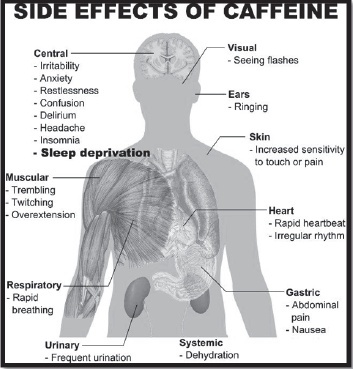
Read the following statements and indicate the ones where the underlined prepositions are used correctly.
I. The studies were over the side effects of caffeine.
II. There seem to be some issues against drinking a dose of caffeine after 12 p.m.
III. Studies have pointed to interesting findings about the side effects of caffeine.
06