


![[Marketing] Questao Topo - deslogado](https://storage.estuda.com.br/banners/0_6b7ebee90b03af1c560c73bb8bcce34a_banner_deslogado_70_dias.png)
Questões de Inglês
19.971 Questões
Questão 49 8786976
EsPCEx 2º Dia 2022Leia o texto a seguir e responda à questão.
Cornelius Ryan, the Irish D-Day Reporter Who Re-Invented Journalism
The father of modern literary journalism is Cornelius Ryan, whose massive “I was there” coverage of D-Day and its aftermath led to two incredible books and movies, The Longest Day and A Bridge Too Far. He was an unlikely war correspondent.
Ryan was on a boat that ditched on Normandy Beach on June 6, 1944. He followed the Allied invasion attached to General Patton’s army. Years later he put together perhaps the best book about war ever written. It was exquisite writing and research, and as Michael Shapiro wrote in the Columbia Journalism Review in 2010, “it broke completely new ground”.
Shapiro wrote, “The book (The Longest Day) was a triumph, earning rave reviews and sales that, within a few years, would stretch into the tens of millions in eighteen different languages. I opened the book on the eve of a long weekend. I was hooked after a single page. Something was taking place in the telling of this story that transcended journalism.”
The book was written when Ryan placed an ad in several newspapers in 1957 which went, “June 6th, 1944: Were You There?” One thousand, one hundred, and fifty people wrote back. And of that group, he interviewed 172 alone or with his assistants. Out of that came a book that puts you at the heart of the greatest invasion of all time. You are there as the invasion forces first gain the beaches and the Germans, taken by surprise, fight back furiously.
Ryan died at just 54 from prostate cancer. On his gravestone in Connecticut is his name and one word: “Reporter.” No one has earned that title more. He deserves to be remembered. Adapted from
https://www.irishcentral.com/roots/history/cornelius-ryan-irish-dday-reporter.
How many people wrote back when Ryan placed an ad in the newspapers in 1957 (paragraph 4)?
Questão 48 8786922
EsPCEx 2º Dia 2022Leia o texto a seguir e responda à questão.
Cornelius Ryan, the Irish D-Day Reporter Who Re-Invented Journalism
The father of modern literary journalism is Cornelius Ryan, whose massive “I was there” coverage of D-Day and its aftermath led to two incredible books and movies, The Longest Day and A Bridge Too Far. He was an unlikely war correspondent.
Ryan was on a boat that ditched on Normandy Beach on June 6, 1944. He followed the Allied invasion attached to General Patton’s army. Years later he put together perhaps the best book about war ever written. It was exquisite writing and research, and as Michael Shapiro wrote in the Columbia Journalism Review in 2010, “it broke completely new ground”.
Shapiro wrote, “The book (The Longest Day) was a triumph, earning rave reviews and sales that, within a few years, would stretch into the tens of millions in eighteen different languages. I opened the book on the eve of a long weekend. I was hooked after a single page. Something was taking place in the telling of this story that transcended journalism.”
The book was written when Ryan placed an ad in several newspapers in 1957 which went, “June 6th, 1944: Were You There?” One thousand, one hundred, and fifty people wrote back. And of that group, he interviewed 172 alone or with his assistants. Out of that came a book that puts you at the heart of the greatest invasion of all time. You are there as the invasion forces first gain the beaches and the Germans, taken by surprise, fight back furiously.
Ryan died at just 54 from prostate cancer. On his gravestone in Connecticut is his name and one word: “Reporter.” No one has earned that title more. He deserves to be remembered. Adapted from
https://www.irishcentral.com/roots/history/cornelius-ryan-irish-dday-reporter.
In the sentence “...whose massive ‘I was there’ coverage of D-Day…” (paragraph 1), the word whose refers to
Questão 46 8786864
EsPCEx 2º Dia 2022(Título omitido propositadamente)
Often when mentoring, in a one-to-one session, it will be clear that the mentee’s worst critic is the one they see very regularly – daily, in fact. Often when they are tired and stressed. Often when they are at a low point. It’s the one they look (1)________ the mirror.
I mean most of the time, the worst critic lives inside people’s head. It might be the criticism that you heard at school or college. It might be the voice of so-called friends. It might be a parent or guardian, sibling or perfect cousin. You can’t always shut those voices up. No matter how much you want to. You can, however, recognise that they are internal voices and cultivate a strategy to counteract them.
If you can have an internal critic, you can also have an internal cheerleader. One technique is to give yourself advice that you would give your best friend in that situation. If you’re worrying about not being good (2)________ something, what would you say to your best friend in that state? You’d probably tell them that it would be alright, they’ll sail through it, that you believe (3)________ them. If you can do it for your best friend, you can do it for yourself.
Adapted from https://www.campaignlive.co.uk/article.
Choose the alternative that correctly substitutes counteract in the sentence “You can, however, recognise that they are internal voices and cultivate a strategy to counterat them.” (paragraph 2).
Questão 5 8563500
ENEM PPL 1° Dia 2022Letter to the Editor
Michael Gerson’s Oct. 19 Tuesday Opinion column, “The state laboratory of idiocracy strikes again” did not highlight the disservice done to the Black community or any other minority group affected by White history. I wonder about how this will manipulate the perceptions of minorities in the eyes of students. The misguided stereotypes and assumptions perpetuated by these curriculum restrictions will likely prevent Black Americans from expressing themselves safely.
It’s plausible to assume that continued miseducation over generations could create a sense of false comfort for Black Americans. Without proper access to history, minorities might begin to forget the oppression they have faced and the injustices they are currently dealing with. Lacking this vital historical education only serves to continue the longstanding issue of misinformation in modern generations.
The problems are only the start of the issues that could begin to plague the American education system. Riley Kilcarr, Springfield.
Disponível em: www.washingtonpost.com. Acesso em: 29 out. 2021.
O autor dessa carta se reporta ao editor de um jornal para
Questão 4 8563485
ENEM PPL 1° Dia 2022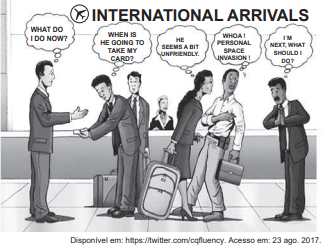
Os recursos verbais e não verbais do cartum fazem referência a situações comuns em aeroportos, motivadas pelo fato de que os(as)
Questão 3 8563467
ENEM PPL 1° Dia 2022We walked on, the stranger walking with us. Taylor Franklin Bankole. Our last names an instant bond between us. We’re both descended from men who assumed African surnames back during the 1960s. His father and my grandfather had had their names legally changed, and both had chosen Yoruba replacement names.
“Most people chose Swahili names in the ’60s”, Bankole told me. He wanted to be called Bankole. “My father had to do something different. All his life he had to be different”.
“I don’t know my grandfather’s reasons”, I said. “His last name was Broome before he changed it, and that was no loss’. But why he chose Olamina…? Even my father didn’t know. He made the change before my father was born, so my father was always Olamina, and so were we.
BUTLER, O. E. Parable of the Sower. New York: Hachette, 2019 (adaptado).
Nesse trecho do romance Parable of the Sower, os nomes “Bankole” e “Olamina” representam o(a)
06