


![[Marketing] Questao Topo - deslogado](https://storage.estuda.com.br/banners/0_6b7ebee90b03af1c560c73bb8bcce34a_banner_deslogado_70_dias.png)
Questões de Inglês
19.971 Questões
Questão 21 99855
EBMSP Medicina 2015/1
It’s not news to most of us that our environment can
have an impact on our mood. A cloudy day. Working in a
cubicle farm. Growing up in poverty.
But can it also impact our health? There’s a growing
[5] body of research that suggests the beneficial effects of
picking and hanging the “right” artwork in hospitals, to
help healing and improve patients’ mood:
Upali Nanda, who has a doctorate in architecture with
a specialization in health-care systems and design, says
[10] scientific studies show that art can aid in the recovery of
patients, shorten hospital stays and help manage pain.
But she says it has to be the right art – vivid paintings of
landscapes, friendly faces and familiar objects can lower
blood pressure and heart rate, while abstract pictures can
[15] have the opposite effect.
Nanda and two university professors did a study at
Houston’s St. Luke’s Episcopal Hospital using two types
of art. In the first group were images that had been proved
to calm patients, including green landscapes, water
[20] scenes, cultural artifacts and emotionally expressive
pictures of people. The second group contained abstract
pieces. When asked which they preferred, most patients
chose images from the first group.
Not surprising, since that opinion reflects most
[25] people’s opinion about those two groups of artwork in the
real world. Ambiguous artwork, such as many abstract
paintings, provokes anxiety in many people, while familiar
scenes of people and the outdoors are more serene
and something most people can identify with. The article
[30] theorizes that people feel more at ease with paintings
of trees, flowers and fields, allowing them to project their
own feelings of uneasiness or anxiety onto them.
Can you imagine how simple and inexpensive
making hospitals look, well, hospitable is, compared
[35] to all the fancy imaging equipment and latest
micro-surgery tools? And yet, these components can be
just as important to a patient’s recovery as taking the right
pills at the right time. Sterile white hallways might make
for a clean environment, but it does nothing for the needs
[40] of being human in such places. After all, hospitals aren’t
technology clean-rooms — they are where we treat
people. And people are emotional and social creatures
who value the familiar.
Of course artwork isn’t going to heal anybody’s
[45] wounds, but it can help speed the healing process
after-the-fact.
GROHOL, J. (2009). Pode Art melhorar sua saúde? Psych Central. Disponível em: <http://psychcentral.com/blog/archives/2009/09/01/can_art_melhorar_seu_health/>. Acesso em:10 out. 2014.
Considering language use in the text, it’s correct to say:
Questão 20 99854
EBMSP Medicina 2015/1
It’s not news to most of us that our environment can
have an impact on our mood. A cloudy day. Working in a
cubicle farm. Growing up in poverty.
But can it also impact our health? There’s a growing
[5] body of research that suggests the beneficial effects of
picking and hanging the “right” artwork in hospitals, to
help healing and improve patients’ mood:
Upali Nanda, who has a doctorate in architecture with
a specialization in health-care systems and design, says
[10] scientific studies show that art can aid in the recovery of
patients, shorten hospital stays and help manage pain.
But she says it has to be the right art – vivid paintings of
landscapes, friendly faces and familiar objects can lower
blood pressure and heart rate, while abstract pictures can
[15] have the opposite effect.
Nanda and two university professors did a study at
Houston’s St. Luke’s Episcopal Hospital using two types
of art. In the first group were images that had been proved
to calm patients, including green landscapes, water
[20] scenes, cultural artifacts and emotionally expressive
pictures of people. The second group contained abstract
pieces. When asked which they preferred, most patients
chose images from the first group.
Not surprising, since that opinion reflects most
[25] people’s opinion about those two groups of artwork in the
real world. Ambiguous artwork, such as many abstract
paintings, provokes anxiety in many people, while familiar
scenes of people and the outdoors are more serene
and something most people can identify with. The article
[30] theorizes that people feel more at ease with paintings
of trees, flowers and fields, allowing them to project their
own feelings of uneasiness or anxiety onto them.
Can you imagine how simple and inexpensive
making hospitals look, well, hospitable is, compared
[35] to all the fancy imaging equipment and latest
micro-surgery tools? And yet, these components can be
just as important to a patient’s recovery as taking the right
pills at the right time. Sterile white hallways might make
for a clean environment, but it does nothing for the needs
[40] of being human in such places. After all, hospitals aren’t
technology clean-rooms — they are where we treat
people. And people are emotional and social creatures
who value the familiar.
Of course artwork isn’t going to heal anybody’s
[45] wounds, but it can help speed the healing process
after-the-fact.
GROHOL, J. (2009). Pode Art melhorar sua saúde? Psych Central. Disponível em: <http://psychcentral.com/blog/archives/2009/09/01/can_art_melhorar_seu_health/>. Acesso em:10 out. 2014.
The only alternative in which the word or expression from the text has not been correctly defined is
Questão 18 99852
EBMSP Medicina 2015/1
It’s not news to most of us that our environment can
have an impact on our mood. A cloudy day. Working in a
cubicle farm. Growing up in poverty.
But can it also impact our health? There’s a growing
[5] body of research that suggests the beneficial effects of
picking and hanging the “right” artwork in hospitals, to
help healing and improve patients’ mood:
Upali Nanda, who has a doctorate in architecture with
a specialization in health-care systems and design, says
[10] scientific studies show that art can aid in the recovery of
patients, shorten hospital stays and help manage pain.
But she says it has to be the right art – vivid paintings of
landscapes, friendly faces and familiar objects can lower
blood pressure and heart rate, while abstract pictures can
[15] have the opposite effect.
Nanda and two university professors did a study at
Houston’s St. Luke’s Episcopal Hospital using two types
of art. In the first group were images that had been proved
to calm patients, including green landscapes, water
[20] scenes, cultural artifacts and emotionally expressive
pictures of people. The second group contained abstract
pieces. When asked which they preferred, most patients
chose images from the first group.
Not surprising, since that opinion reflects most
[25] people’s opinion about those two groups of artwork in the
real world. Ambiguous artwork, such as many abstract
paintings, provokes anxiety in many people, while familiar
scenes of people and the outdoors are more serene
and something most people can identify with. The article
[30] theorizes that people feel more at ease with paintings
of trees, flowers and fields, allowing them to project their
own feelings of uneasiness or anxiety onto them.
Can you imagine how simple and inexpensive
making hospitals look, well, hospitable is, compared
[35] to all the fancy imaging equipment and latest
micro-surgery tools? And yet, these components can be
just as important to a patient’s recovery as taking the right
pills at the right time. Sterile white hallways might make
for a clean environment, but it does nothing for the needs
[40] of being human in such places. After all, hospitals aren’t
technology clean-rooms — they are where we treat
people. And people are emotional and social creatures
who value the familiar.
Of course artwork isn’t going to heal anybody’s
[45] wounds, but it can help speed the healing process
after-the-fact.
GROHOL, J. (2009). Pode Art melhorar sua saúde? Psych Central. Disponível em: <http://psychcentral.com/blog/archives/2009/09/01/can_art_melhorar_seu_health/>. Acesso em:10 out. 2014.
Scientific study has shown that the right art can
Questão 17 99851
EBMSP Medicina 2015/1
It’s not news to most of us that our environment can
have an impact on our mood. A cloudy day. Working in a
cubicle farm. Growing up in poverty.
But can it also impact our health? There’s a growing
[5] body of research that suggests the beneficial effects of
picking and hanging the “right” artwork in hospitals, to
help healing and improve patients’ mood:
Upali Nanda, who has a doctorate in architecture with
a specialization in health-care systems and design, says
[10] scientific studies show that art can aid in the recovery of
patients, shorten hospital stays and help manage pain.
But she says it has to be the right art – vivid paintings of
landscapes, friendly faces and familiar objects can lower
blood pressure and heart rate, while abstract pictures can
[15] have the opposite effect.
Nanda and two university professors did a study at
Houston’s St. Luke’s Episcopal Hospital using two types
of art. In the first group were images that had been proved
to calm patients, including green landscapes, water
[20] scenes, cultural artifacts and emotionally expressive
pictures of people. The second group contained abstract
pieces. When asked which they preferred, most patients
chose images from the first group.
Not surprising, since that opinion reflects most
[25] people’s opinion about those two groups of artwork in the
real world. Ambiguous artwork, such as many abstract
paintings, provokes anxiety in many people, while familiar
scenes of people and the outdoors are more serene
and something most people can identify with. The article
[30] theorizes that people feel more at ease with paintings
of trees, flowers and fields, allowing them to project their
own feelings of uneasiness or anxiety onto them.
Can you imagine how simple and inexpensive
making hospitals look, well, hospitable is, compared
[35] to all the fancy imaging equipment and latest
micro-surgery tools? And yet, these components can be
just as important to a patient’s recovery as taking the right
pills at the right time. Sterile white hallways might make
for a clean environment, but it does nothing for the needs
[40] of being human in such places. After all, hospitals aren’t
technology clean-rooms — they are where we treat
people. And people are emotional and social creatures
who value the familiar.
Of course artwork isn’t going to heal anybody’s
[45] wounds, but it can help speed the healing process
after-the-fact.
GROHOL, J. (2009). Pode Art melhorar sua saúde? Psych Central. Disponível em: <http://psychcentral.com/blog/archives/2009/09/01/can_art_melhorar_seu_health/>. Acesso em:10 out. 2014.
According to the text, fill in the parentheses with T (True) or F (False).
( ) People’s feelings may be significantly influenced by their surroundings.
( ) Such artwork as paintings of landscapes have been recognized as a powerful tool for speeding up a patient’s healing process.
( ) It has been noticed that patients in hospitals can benefit from any kind of artwork.
( ) Unpleasant and gloomy hospital hallways can cause physical distress and affect patients’ health.
The correct sequence, from top to bottom, is
Questão 31 99812
EBMSP Medicina 2015/2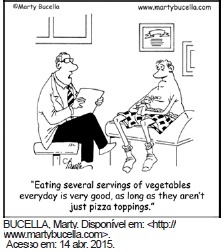
From what the doctor is saying, it is correct to say that the patient in this cartoon
Questão 18 99799
EBMSP Medicina 2015/2[1] How tall you are is strongly related to the genes you
inherit, and previous studies suggested that as much as
80% of the variance in height among people is due to their
DNA. And in the largest genetic study of height-related
[5] genes to date, scientists have identified 423 genetic
regions connected to height – which could explain as
much as 60% of that genetic component.
Dr. Joel Hirschhorn, leader of the GIANT consortium
at Harvard Medical School says that for a trait like height,
[10] which isn’t determined by a single gene but likely the
combined effects of multiple genes involved in multiple
different processes from bone growth to cell growth, the
new findings are like finding biggest nuggets of gold in
a riverbed. The latest analysis, published in the journal
[15] Nature Genetics, describes the gene variants most
commonly shared among people that likely contribute to
height.
They emerged from a sweep of the genomes of
more than 250,000 people of various heights, and from
[20] correlating their stature with their genetics. Many of the
known and familiar factors related to height, including
those dealing with skeletal growth and collagen that
are mutated in people with medically short stature, for
example, appeared in the study, confirming their role in
[25] determining how tall people get.
But there were also some surprises ‒ genetic regions
that previously had never been thought to be related
to height, including a gene known to be involved in cell
growth but not in skeletal functions. “It’s a mix ranging
[30] from completely known things, to those that make sense
to things that are completely surprising and things we don’t
even know what to think about them,” says Hirschhorn.
What the group has identified are gene regions of
interest, and a new round of studies will have to delve
[35] deeper into those areas to isolate specific genes that
are actually responsible for determining height. But it’s a
critical first step, and could lead to potential new ways of
treating medical conditions of short stature or gigantism
that can have negative health effects on the heart and
[40] joints.
PARK, Alice. New genes found that determine your height. Disponível em: <http://www.time.com/3462490/nev-gines-found-that-determine-your-height>. Acesso em: 14 abr. 2015. Adaptado.
Fill in the parentheses with T (True) or F (False).
Considering language use in the text, it’s correct to say:
( ) The pronoun “their” (l. 3) refers to "people" (l. 3).
( ) The word “that (l. 16) is functioning as a conjunction.
( ) The word “actually” (l. 36) is the same as “currently”.
( ) The modal “could” (l. 37) expresses possibility.
The correct sequence, from top to bottom, is
06