


![[Marketing] Questao Topo - deslogado](https://storage.estuda.com.br/banners/0_6b7ebee90b03af1c560c73bb8bcce34a_banner_deslogado_70_dias.png)
Questões de Inglês
19.971 Questões
Questão 53 103119
FAMEVAÇO Tipo A 2015/1Texto 1
Doctors, Patients Embrace Technology in Medicine
By Brenda Goodman, MA
WebMD Health News
Reviewed by Arefa Cassoobhoy, MD, MPH
Sept. 22, 2014 -- Technology is quickly changing many parts of medicine, giving people more power to take charge of their health care. Many patients and doctors are embracing these changes, a new Medscape/WebMD survey finds.
The findings are part of the WebMD/Medscape Digital Technology Survey, which included more than 1,100 patients and 1,400 health professionals, including 827 doctors. Questions focused on issues related to the evolution of medical care -- including using smartphones to assist in the diagnostic process, clearness about what a procedure costs, the right to review medical records, radiation risks from imaging tests, and genetic testing.
Eric Topol, MD, editor-in-chief of Medscape and the chief academic officer of Scripps Health, says the report is unique. There hasn’t been a large survey that’s asked the same questions of doctors and patients. “Technology is really democratizing all aspects of the doctor’s visit,” Topol says. Today, people can use smartphones to track their blood sugar. And soon, apps and accessories may be available that check cholesterol or track the heart’s electrical activity. Instead of the doctor’s office or lab being a place to begin gathering information about their health, people could soon be showing up for checkups with the info already in hand.
In the survey:
• A majority of both groups -- 84% of patients and 69% of doctors -- said they embrace technology to enhance and aid the diagnostic process.
• Both groups -- 64% of patients and 63% of doctors -- agreed that the smartphone can be a useful diagnostic tool in regard to blood tests.
About 40% of patients liked the idea of using technology to identify health concerns without a trip to the doctor, while only 17% of doctors endorsed that method.
Available at : http://www.webmd.com/news/20140922/doctors-patients-embrace-technology-medicine. Acess on October 22nd, 2014.
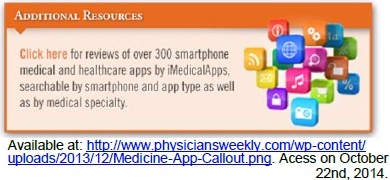
According to the text above, if the user clicks where it’s indicated he can
Questão 51 103117
FAMEVAÇO Tipo A 2015/1Texto 1
Doctors, Patients Embrace Technology in Medicine
By Brenda Goodman, MA
WebMD Health News
Reviewed by Arefa Cassoobhoy, MD, MPH
Sept. 22, 2014 -- Technology is quickly changing many parts of medicine, giving people more power to take charge of their health care. Many patients and doctors are embracing these changes, a new Medscape/WebMD survey finds.
The findings are part of the WebMD/Medscape Digital Technology Survey, which included more than 1,100 patients and 1,400 health professionals, including 827 doctors. Questions focused on issues related to the evolution of medical care -- including using smartphones to assist in the diagnostic process, clearness about what a procedure costs, the right to review medical records, radiation risks from imaging tests, and genetic testing.
Eric Topol, MD, editor-in-chief of Medscape and the chief academic officer of Scripps Health, says the report is unique. There hasn’t been a large survey that’s asked the same questions of doctors and patients. “Technology is really democratizing all aspects of the doctor’s visit,” Topol says. Today, people can use smartphones to track their blood sugar. And soon, apps and accessories may be available that check cholesterol or track the heart’s electrical activity. Instead of the doctor’s office or lab being a place to begin gathering information about their health, people could soon be showing up for checkups with the info already in hand.
In the survey:
• A majority of both groups -- 84% of patients and 69% of doctors -- said they embrace technology to enhance and aid the diagnostic process.
• Both groups -- 64% of patients and 63% of doctors -- agreed that the smartphone can be a useful diagnostic tool in regard to blood tests.
About 40% of patients liked the idea of using technology to identify health concerns without a trip to the doctor, while only 17% of doctors endorsed that method.
Available at : http://www.webmd.com/news/20140922/doctors-patients-embrace-technology-medicine. Acess on October 22nd, 2014.
The possessive adjective THEIR, in the sentence “Instead of the doctor’s office or lab being a place to begin gathering information about their health” refers to:
Questão 50 103116
FAMEVAÇO Tipo A 2015/1Texto 1
Doctors, Patients Embrace Technology in Medicine
By Brenda Goodman, MA
WebMD Health News
Reviewed by Arefa Cassoobhoy, MD, MPH
Sept. 22, 2014 -- Technology is quickly changing many parts of medicine, giving people more power to take charge of their health care. Many patients and doctors are embracing these changes, a new Medscape/WebMD survey finds.
The findings are part of the WebMD/Medscape Digital Technology Survey, which included more than 1,100 patients and 1,400 health professionals, including 827 doctors. Questions focused on issues related to the evolution of medical care -- including using smartphones to assist in the diagnostic process, clearness about what a procedure costs, the right to review medical records, radiation risks from imaging tests, and genetic testing.
Eric Topol, MD, editor-in-chief of Medscape and the chief academic officer of Scripps Health, says the report is unique. There hasn’t been a large survey that’s asked the same questions of doctors and patients. “Technology is really democratizing all aspects of the doctor’s visit,” Topol says. Today, people can use smartphones to track their blood sugar. And soon, apps and accessories may be available that check cholesterol or track the heart’s electrical activity. Instead of the doctor’s office or lab being a place to begin gathering information about their health, people could soon be showing up for checkups with the info already in hand.
In the survey:
• A majority of both groups -- 84% of patients and 69% of doctors -- said they embrace technology to enhance and aid the diagnostic process.
• Both groups -- 64% of patients and 63% of doctors -- agreed that the smartphone can be a useful diagnostic tool in regard to blood tests.
About 40% of patients liked the idea of using technology to identify health concerns without a trip to the doctor, while only 17% of doctors endorsed that method.
Available at : http://www.webmd.com/news/20140922/doctors-patients-embrace-technology-medicine. Acess on October 22nd, 2014.
Consider the extract
“Technology is really democratizing all aspects of the doctor’s visit,” Topol says.
The INDIRECT form of the sentence is:
Questão 49 103115
FAMEVAÇO Tipo A 2015/1Texto 1
Doctors, Patients Embrace Technology in Medicine
By Brenda Goodman, MA
WebMD Health News
Reviewed by Arefa Cassoobhoy, MD, MPH
Sept. 22, 2014 -- Technology is quickly changing many parts of medicine, giving people more power to take charge of their health care. Many patients and doctors are embracing these changes, a new Medscape/WebMD survey finds.
The findings are part of the WebMD/Medscape Digital Technology Survey, which included more than 1,100 patients and 1,400 health professionals, including 827 doctors. Questions focused on issues related to the evolution of medical care -- including using smartphones to assist in the diagnostic process, clearness about what a procedure costs, the right to review medical records, radiation risks from imaging tests, and genetic testing.
Eric Topol, MD, editor-in-chief of Medscape and the chief academic officer of Scripps Health, says the report is unique. There hasn’t been a large survey that’s asked the same questions of doctors and patients. “Technology is really democratizing all aspects of the doctor’s visit,” Topol says. Today, people can use smartphones to track their blood sugar. And soon, apps and accessories may be available that check cholesterol or track the heart’s electrical activity. Instead of the doctor’s office or lab being a place to begin gathering information about their health, people could soon be showing up for checkups with the info already in hand.
In the survey:
• A majority of both groups -- 84% of patients and 69% of doctors -- said they embrace technology to enhance and aid the diagnostic process.
• Both groups -- 64% of patients and 63% of doctors -- agreed that the smartphone can be a useful diagnostic tool in regard to blood tests.
About 40% of patients liked the idea of using technology to identify health concerns without a trip to the doctor, while only 17% of doctors endorsed that method.
Available at : http://www.webmd.com/news/20140922/doctors-patients-embrace-technology-medicine. Acess on October 22nd, 2014.
From the text we can say that
Questão 52 102734
FAMEVAÇO Tipo A 2015/2TEXT 2
Breast-Feeding May Cut Breast Cancer Recurrence Risk
By NICHOLAS BAKALAR
A new report suggests that breast-feeding, which has been associated with a reduced breast cancer risk, may have another benefit. In mothers who later develop breast cancer, breast-feeding may reduce the risk of cancer recurrence.
The study, in the July issue of The Journal of the National Cancer Institute, followed 1,636 breast cancer survivors. Researchers examined medical records and gathered data on whether mothers had ever breast-fed their children. They found 383 recurrences and 290 breast cancer deaths during an average nine years of follow-up after completion of treatment.
After controlling for age, smoking, education, race, type of therapy and other factors, they found that compared with women who had never breast-fed, any breast-feeding was associated with a 30 percent reduced risk of recurrence, and breast-feeding for more than six months was associated with a 37 percent reduced risk. There were similar risk reductions for breast cancer deaths.
“Breast-feeding is a good thing for the baby, and there are additional benefits for the mom that this study suggests,” said the lead author, Marilyn L. Kwan, a research scientist at Kaiser Permanente in Oakland, Calif. “This contributes to information already available in making a personal decision about whether or not to breast-feed.”
The risk reductions were particularly apparent in estrogen-receptor positive cancers, the most common type, but were not significant for women with HER2 positive tumors. Breast-feeding leads to certain molecular changes in breast cells, which may help explain the effect.
Source: http://well.blogs.nytimes.com/2015/05/13/breast-feeding-may-cut-breast-cancer-recurrence-risk/?ref=health&_r=0 Access on May 15th, 2015
Consider the extract
“After controlling for age, smoking, education, race, type of therapy and other factors, they found that compared with women who had never breast-fed”.
The pronoun they could be substituted for:
Questão 51 102733
FAMEVAÇO Tipo A 2015/2TEXT 2
Breast-Feeding May Cut Breast Cancer Recurrence Risk
By NICHOLAS BAKALAR
A new report suggests that breast-feeding, which has been associated with a reduced breast cancer risk, may have another benefit. In mothers who later develop breast cancer, breast-feeding may reduce the risk of cancer recurrence.
The study, in the July issue of The Journal of the National Cancer Institute, followed 1,636 breast cancer survivors. Researchers examined medical records and gathered data on whether mothers had ever breast-fed their children. They found 383 recurrences and 290 breast cancer deaths during an average nine years of follow-up after completion of treatment.
After controlling for age, smoking, education, race, type of therapy and other factors, they found that compared with women who had never breast-fed, any breast-feeding was associated with a 30 percent reduced risk of recurrence, and breast-feeding for more than six months was associated with a 37 percent reduced risk. There were similar risk reductions for breast cancer deaths.
“Breast-feeding is a good thing for the baby, and there are additional benefits for the mom that this study suggests,” said the lead author, Marilyn L. Kwan, a research scientist at Kaiser Permanente in Oakland, Calif. “This contributes to information already available in making a personal decision about whether or not to breast-feed.”
The risk reductions were particularly apparent in estrogen-receptor positive cancers, the most common type, but were not significant for women with HER2 positive tumors. Breast-feeding leads to certain molecular changes in breast cells, which may help explain the effect.
Source: http://well.blogs.nytimes.com/2015/05/13/breast-feeding-may-cut-breast-cancer-recurrence-risk/?ref=health&_r=0 Access on May 15th, 2015
The text suggests that:
06