


![[Marketing] Questao Topo - deslogado](https://storage.estuda.com.br/banners/0_6b7ebee90b03af1c560c73bb8bcce34a_banner_deslogado_70_dias.png)
Questões de Inglês
19.971 Questões
Questão 12 106844
UNIVAG 2015/1Woman grows a nose on her spine after stem cell experiment
By Sarah Fecht
07.18.2014
Eight years ago, doctors took nasal tissue samples and grafted them onto the spines of 20 quadriplegics. The idea was that stem cells within the nasal tissue might turn into neurons that could help repair the damaged spinal cord, and the experiment actually worked for a few of the patients, who regained a little bit of sensation. But it didn’t go well for one woman in particular, who not only didn’t experience any abatement in her paralysis, but recently started feeling pain at the site of the implant. When doctors took a closer look, they realized she was growing the beginnings of a nose on her spine, New Scientist reports.
The surgeons removed a 3-centimeter-long growth, which was found to be mainly nasal tissue, as well as bits of bone and tiny nerve branches that had not connected with the spinal nerves. The growth wasn’t cancerous, but it was secreting a “thick copious mucus-like material”, which is probably why it was pressing painfully on her spine, says Brian Dlouhy at the University of Iowa Hospitals and Clinics in Iowa City, the neurosurgeon who removed the growth.
This is hardly the first case of adverse side effects from a stem cell transplant. The New Scientist article points to several cases where people developed tumors after participating in clinical trials – including one 50-year-old man who, after receiving an experimental treatment for Parkinson’s disease, developed a brain tumor with hairs and cartilage embedded within it.
The nasal tissue experiment took place at a mainstream hospital in Portugal, and there are thousands of legitimate stem cell trials taking place all over the world, but so far only a few stem cell therapies have been approved by the FDA (Food and Drug Administration). Stem cells have the potential to treat everything from baldness and diabetes to cardiovascular disease and Parkinson’s. But stem cells, some of which can differentiate into almost any cell in the body, also have the potential to cause harm.
That hasn’t stopped private companies from peddling unproven stem cell therapies that haven’t been properly tested for safety, may not be effective, and can have dangerous consequences. Attempts to shut down the scientifically invalid (and possibly fraudulent) companies have met with resistance from patients.(www.popsci.com. Adaptado.)
De acordo com o terceiro e o quarto parágrafos,
Questão 11 106843
UNIVAG 2015/1Woman grows a nose on her spine after stem cell experiment
By Sarah Fecht
07.18.2014
Eight years ago, doctors took nasal tissue samples and grafted them onto the spines of 20 quadriplegics. The idea was that stem cells within the nasal tissue might turn into neurons that could help repair the damaged spinal cord, and the experiment actually worked for a few of the patients, who regained a little bit of sensation. But it didn’t go well for one woman in particular, who not only didn’t experience any abatement in her paralysis, but recently started feeling pain at the site of the implant. When doctors took a closer look, they realized she was growing the beginnings of a nose on her spine, New Scientist reports.
The surgeons removed a 3-centimeter-long growth, which was found to be mainly nasal tissue, as well as bits of bone and tiny nerve branches that had not connected with the spinal nerves. The growth wasn’t cancerous, but it was secreting a “thick copious mucus-like material”, which is probably why it was pressing painfully on her spine, says Brian Dlouhy at the University of Iowa Hospitals and Clinics in Iowa City, the neurosurgeon who removed the growth.
This is hardly the first case of adverse side effects from a stem cell transplant. The New Scientist article points to several cases where people developed tumors after participating in clinical trials – including one 50-year-old man who, after receiving an experimental treatment for Parkinson’s disease, developed a brain tumor with hairs and cartilage embedded within it.
The nasal tissue experiment took place at a mainstream hospital in Portugal, and there are thousands of legitimate stem cell trials taking place all over the world, but so far only a few stem cell therapies have been approved by the FDA (Food and Drug Administration). Stem cells have the potential to treat everything from baldness and diabetes to cardiovascular disease and Parkinson’s. But stem cells, some of which can differentiate into almost any cell in the body, also have the potential to cause harm.
That hasn’t stopped private companies from peddling unproven stem cell therapies that haven’t been properly tested for safety, may not be effective, and can have dangerous consequences. Attempts to shut down the scientifically invalid (and possibly fraudulent) companies have met with resistance from patients.(www.popsci.com. Adaptado.)
De acordo com o texto, há oito anos, médicos enxertaram amostras de tecido nasal na coluna vertebral de vinte tetraplégicos. Sobre esse experimento, é correto afirmar que:
Questão 16 106788
UNIVAG 2015/2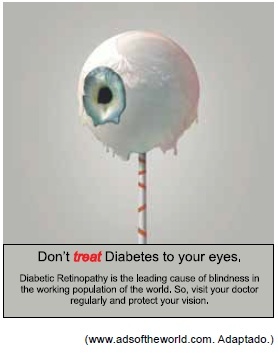
O anúncio faz parte de uma campanha contra a diabetes.
De acordo com a análise do anúncio, é correto afirmar que
Questão 15 106787
UNIVAG 2015/2
De acordo com o infográfico, é correto afirmar que, para controlar a diabetes,
Questão 14 106786
UNIVAG 2015/2How many steps does it take to avoid a heart attack?
Researchers find out.
Walking can lower your risk of having a heart attack, as any doctor will tell you. Now scientists have found out exactly how many steps it takes to keep your ticker healthy.
Even people who are at risk for diabetes can cut their risk for heart-related events like a heart attack or stroke by 8%.
In new research published in the journal Lancet, scientists report that among people with early signs of pre-diabetes, taking an extra 2,000 steps a day – the equivalent of 20 minutes of moderate-paced walking – helped them lower their chances of heart problems.
The research team looked at data from 9,306 adults from 40 countries participating in a trial called NAVIGATOR. All of the volunteers were assigned to a program to lose weight and exercise 150 minutes a week. They were given pedometers that they wore for a week at the beginning of the study, and again a year later.
Using statistical modeling, the researchers studied the association between the number of steps the participants took on average and their relative risk for heart events in that year, accounting for potentially confounding factors that could influence heart disease rates such as diet and the participants’ previous history of heart issues.
Two thousand steps seemed to be the magic number. Even before the study began, for every 2,000 steps a day one participant tended to walk on average compared to another, he enjoyed a 10% lower rate of heart problems by the end of the year. During the study year, there was an additional 8% lower risk of heart disease for every 2,000 steps walked a day.
That should be encouraging news to those who have added exercise to their daily routine. You don’t have to take your doctor’s word for it — now there’s pretty convincing data on exactly how much walking it takes to avoid heart disease.(www.time.com. Adaptado.)
De acordo com o último parágrafo,
Questão 13 106785
UNIVAG 2015/2How many steps does it take to avoid a heart attack? Researchers find out.
Walking can lower your risk of having a heart attack, as any doctor will tell you. Now scientists have found out exactly how many steps it takes to keep your ticker healthy.
Even people who are at risk for diabetes can cut their risk for heart-related events like a heart attack or stroke by 8%.
In new research published in the journal Lancet, scientists report that among people with early signs of pre-diabetes, taking an extra 2,000 steps a day – the equivalent of 20 minutes of moderate-paced walking – helped them lower their chances of heart problems.
The research team looked at data from 9,306 adults from
40 countries participating in a trial called NAVIGATOR. All of the volunteers were assigned to a program to lose weight and exercise 150 minutes a week. They were given pedometers that they wore for a week at the beginning of the study, and again a year later.
Using statistical modeling, the researchers studied the association between the number of steps the participants took on average and their relative risk for heart events in that year, accounting for potentially confounding factors that could influence heart disease rates such as diet and the participants’ previous history of heart issues.
Two thousand steps seemed to be the magic number. Even before the study began, for every 2,000 steps a day one participant tended to walk on average compared to another, he enjoyed a 10% lower rate of heart problems by the end of the year. During the study year, there was an additional 8% lower risk of heart disease for every 2,000 steps walked a day.
That should be encouraging news to those who have added exercise to their daily routine. You don’t have to take your doctor’s word for it — now there’s pretty convincing data on exactly how much walking it takes to avoid heart disease.
(www.time.com. Adaptado.)
No trecho do terceiro parágrafo “helped them lower their chances of heart problems”, o pronome em destaque faz referência a
06