


![[Marketing] Questao Topo - deslogado](https://storage.estuda.com.br/banners/0_6b7ebee90b03af1c560c73bb8bcce34a_banner_deslogado_70_dias.png)
Questões de Inglês
19.971 Questões
Questão 26 142005
UPE 3° Fase / 1° Dia SSA 2015
The Vestibular (from Portuguese: vestíbulo, "entrance hall") is a competitive examination and is the primary and widespread entrance system used by Brazilian universities to select their students. The Vestibular usually takes place from November to January, right before the start of school year in February or March, although certain universities hold it every semester. The exams often span several days, usually three, with different disciplines being tested each day. Origin
The Vestibular was implanted primarily as a way to prevent nepotism or some other form of unfair or beneficial selection of candidates. It was considered by law the only authorized selection method until 1996, when the new Education Law was passed.
Criticism
While the Vestibular is generally considered to be a fair and unbiased system to select students, there are controversies.
There is some criticism to the alleged standardization of the high school curriculum for the whole country to match the Vestibular agenda. As most types of academic evaluation, the vestibular suffers from the same limitations as a regular test; that is, factors such as stress come into play. It also seems to favor candidates that come from a wealthier background, who had access to better and deeper education in private schools, as opposed to the comparatively poor public high school educational system, although many university boards claim that it doesn\'t matter which background the candidates have, since their Vestibular aims to select the best students based solely on their knowledge. To ease this problem, some universities such as the Federal University of Minas Gerais, provide a 10– 15% bonus for students who received their middle and high education in public schools. There is also the alternative of taking classes at cram schools called cursinhos. Those are revisions of Vestibular subjects, given through periods of 9 months (the regular year-long one), 6 months (the semi-intensive one), and 3 months (known as intensive). These "cursinhos" are given usually for the most prestigious schools and can be done after concluding high school or as a complement of the last year of it.
(Disponível em: http://en.wikipedia.org/wiki/Vestibular)
According to the text,
I. vestibular also doesn’t make people to get stressed.
II. all the students have the same background.
III. it doesn’t matter if students come from public or private schools.
IV. students that come from public schools have a bonus.
V. “cursinhos” can be done after concluding high school.
The CORRECT alternative is
Questão 25 142003
UPE 3° Fase / 1° Dia SSA 2015
The Vestibular (from Portuguese: vestíbulo, "entrance hall") is a competitive examination and is the primary and widespread entrance system used by Brazilian universities to select their students. The Vestibular usually takes place from November to January, right before the start of school year in February or March, although certain universities hold it every semester. The exams often span several days, usually three, with different disciplines being tested each day. Origin
The Vestibular was implanted primarily as a way to prevent nepotism or some other form of unfair or beneficial selection of candidates. It was considered by law the only authorized selection method until 1996, when the new Education Law was passed.
Criticism
While the Vestibular is generally considered to be a fair and unbiased system to select students, there are controversies.
There is some criticism to the alleged standardization of the high school curriculum for the whole country to match the Vestibular agenda. As most types of academic evaluation, the vestibular suffers from the same limitations as a regular test; that is, factors such as stress come into play. It also seems to favor candidates that come from a wealthier background, who had access to better and deeper education in private schools, as opposed to the comparatively poor public high school educational system, although many university boards claim that it doesn\'t matter which background the candidates have, since their Vestibular aims to select the best students based solely on their knowledge. To ease this problem, some universities such as the Federal University of Minas Gerais, provide a 10– 15% bonus for students who received their middle and high education in public schools. There is also the alternative of taking classes at cram schools called cursinhos. Those are revisions of Vestibular subjects, given through periods of 9 months (the regular year-long one), 6 months (the semi-intensive one), and 3 months (known as intensive). These "cursinhos" are given usually for the most prestigious schools and can be done after concluding high school or as a complement of the last year of it.
(Disponível em: http://en.wikipedia.org/wiki/Vestibular)
According to the text, the vestibular
I. is a system to select students to enter the university.
II. has its origin in Brazil.
III. just takes place in February or March.
IV. was implanted as a fair way of entering the university.
V. doesn’t show any limitations to select students for the university.
The CORRECT alternative is
Questão 38 141740
UPE 1° Fase / 1° Dia SSA 2015
Levi’s jeans launched a new advertising campaign in Europe. Like most ads, these used music.
And what did the advertising agency choose? Handel’s “Sarabande in D minor”.
Most bands and groups are really happy to record music for ads. People associate their name with specific products — cellphones, jeans, and so on. This helps them to become famous. It also makes it easier to sell their other things – CDs and tickets for their concerts. Of course, they prefer to provide music for “cool” products. And there can be ethical problems. Will a vegetarian group provide music for a hamburger ad?
Words or emotions?
In the past, most ads used “jingles” — special words and music written about the product. But now these soundtracks are more like movie music. They express a mood, which reinforces the visual message. Often, people remember the music, and want to know who performed it — and wrote it. Then the sales of other music by the same composer usually increase dramatically. Movie music – the new classics?
The sales of movie music can be enormous. Soundtracks like “Gladiator”, “Apocalypse Now” and “Titanic” are really popular. And their success can be worldwide, too, just like the movies. “Gladiator” sold more than a million copies.
For more composers, writing movie soundtracks compensates for the difficulty of making money from their “serious” work. But what’s the difference? Pop music, dance music, classical… Perhaps it’s just music.
HOLDEN, Susan. Macmillan Portfolio / Susan Holden. São Paulo: Macmillan, 2004. Adaptado.
Complete the definitions with the words or expressions from the box.
• Launch • Campaign • Mood • Ad • Soundtrack
• ………… - the way you feel (happy, sad, etc.).
• ………… - to start a new activity or product.
• ………… - a series of ads for a product.
• ………… - the music played during a movie or a TV program.
• ………… - public communication about causes, goods and services, ideas, places, etc. through means such as print, radio, television, and internet.
The CORRECT sequence of words that complete the gaps is
Questão 37 141738
UPE 1° Fase / 1° Dia SSA 2015
Levi’s jeans launched a new advertising campaign in Europe. Like most ads, these used music.
And what did the advertising agency choose? Handel’s “Sarabande in D minor”.
Most bands and groups are really happy to record music for ads. People associate their name with specific products — cellphones, jeans, and so on. This helps them to become famous. It also makes it easier to sell their other things – CDs and tickets for their concerts. Of course, they prefer to provide music for “cool” products. And there can be ethical problems. Will a vegetarian group provide music for a hamburger ad?
Words or emotions?
In the past, most ads used “jingles” — special words and music written about the product. But now these soundtracks are more like movie music. They express a mood, which reinforces the visual message. Often, people remember the music, and want to know who performed it — and wrote it. Then the sales of other music by the same composer usually increase dramatically. Movie music – the new classics?
The sales of movie music can be enormous. Soundtracks like “Gladiator”, “Apocalypse Now” and “Titanic” are really popular. And their success can be worldwide, too, just like the movies. “Gladiator” sold more than a million copies.
For more composers, writing movie soundtracks compensates for the difficulty of making money from their “serious” work. But what’s the difference? Pop music, dance music, classical… Perhaps it’s just music.
HOLDEN, Susan. Macmillan Portfolio / Susan Holden. São Paulo: Macmillan, 2004. Adaptado.
Com a pergunta “Will a vegetarian group provide music for a hamburger ad?”, no final do 1º parágrafo, a autora do texto
Questão 35 141736
UPE 1° Fase / 1° Dia SSA 2015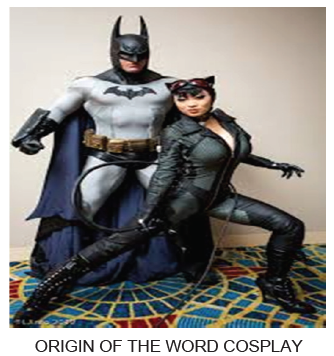
Cosplay, or costume play, is a popular trend where people dressing up mimicking fictional characters from anime, manga (comics), video games and movies etc.
Japan is generally credited as the origin of cosplay, but there are no actual facts of when the cosplay culture started. The credit for coining the word ‘cosplay’ seems more apparent though… although there are a few versions on how it was created, the credit goes to Nobuyuki Takahashi when he first used the word in some Japanese magazines in 1983/1984.
“Akibanana” has some scanned image of the My Anime magazine released in June 1983, which is said to be where the word first appeared, written in Japanese – コスプレ (kosupure)…
Disponível em: http://yeinjee.com/origin-of-the-word-cosplay
The past tense for “there are” (second paragraph) is
Questão 34 141735
UPE 1° Fase / 1° Dia SSA 2015
Cosplay, or costume play, is a popular trend where people dressing up mimicking fictional characters from anime, manga (comics), video games and movies etc.
Japan is generally credited as the origin of cosplay, but there are no actual facts of when the cosplay culture started. The credit for coining the word ‘cosplay’ seems more apparent though… although there are a few versions on how it was created, the credit goes to Nobuyuki Takahashi when he first used the word in some Japanese magazines in 1983/1984.
“Akibanana” has some scanned image of the My Anime magazine released in June 1983, which is said to be where the word first appeared, written in Japanese – コスプレ (kosupure)…
Disponível em: http://yeinjee.com/origin-of-the-word-cosplay
“Magazine”, in the last paragraph, in Portuguese means
06