


![[Marketing] Questao Topo - deslogado](https://storage.estuda.com.br/banners/0_6b7ebee90b03af1c560c73bb8bcce34a_banner_deslogado_70_dias.png)
Questões de Inglês
19.971 Questões
Questão 34 756311
UEFS Caderno 1 2015/1TEXTO:
The Greenland shark
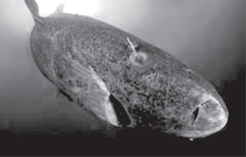
They can be as big as great white sharks, but that’s
about as far as the comparison goes. Their maximum
speed is a lethargic 1.7 miles per hour, many are almost
blind, and they are happy to eat rotting carcasses. They
[5] may be common throughout the ocean, but you’ve
probably never heard of them. Meet the Greenland
shark. Looking like nothing so much as a chunk of
weather-beaten rock, Greenland sharks (Somniosus
microcephalus) can grow up to 7.3 metres (24 feet) long,
[10] making them one of the largest of all fish, and the biggest
in the Arctic. But they prefer to live in deep, cold water,
so humans rarely see them.
Studies in the Arctic have revealed a few snippets
of information about Greenland sharks, and more data
[15] is now starting to come in from elsewhere. It turns out
that Greenland sharks are bizarre, and may be crucially
important for the ocean ecosystem.
Greenland sharks only come close to the surface
in places where the shallow water is frigid enough for
[20] them — primarily in the Arctic. They are most easily
seen around Greenland and Iceland. As a result, they
were long thought of as purely polar animals, as were
the closely-related Pacific sleeper shark and southern
sleeper shark.
[25] But they have been reported on the coasts of
Canada, Portugal, France, Scotland and Scandinavia.
Some researchers think they live in many other areas
too but just haven’t been spotted in them yet. “They may
be everywhere that’s cold enough and deep enough,”
[30] says Aaron MacNeil of the Australian Institute of Marine
Science, in Townsville, Queensland.
The obvious way to see a Greenland shark in the
wild is to dive into the deep sea. For instance, in 2001 a
remotely operated vehicle in the Gulf of Mexico captured
[35] footage of either a Greenland shark or a sleeper shark in
over 2,600 meters (8,530ft) of water. Two years later, a
pilot and a scientist from the Harbor Branch
Oceanographic Institution in Fort Pierce, Florida, became
the first people to come face to face with a Greenland
[40] shark in the deep sea. The shark, which was five meters
(16ft) long, bumped into their submersible vessel 1,000
meters (3,280ft) down in the Gulf of Maine. But hardly
anyone dives that deep. So these rare encounters can’t
tell us how widespread and important the Greenland
[45] sharks are.
The Greenland shark. Disponível em: www.bbc.com/earth/20141028- the-mystery-shark-of-the-arctic. Acesso em: 12 out. 2014.
Fill in the parentheses with T (True) or F (False).
Considering the Greenland sharks, it’s correct to say
( ) Scientists have always considered them of minor significance to the ocean ecosystem.
( ) Some researchers think they might be found anywhere as long as the water is ice-cold and not shallow.
( ) Their natural and preferred habitat seems to be the Arctic region.
( ) Some fishermen argue that, although they are said to be rare, they’ve already been spotted all over the world.
The correct sequence, from top to bottom, is
Questão 31 756297
UEFS Caderno 1 2015/1TEXTO:
A climate of agreement
In the not-too-distant past, the tobacco industry
funded scientists who raised the shadow of a doubt that
the shadows on people’s lungs were cancers caused by
smoking. There were other causes, they said. And many
[5] people who wanted to believe them did so, kept smoking,
and died. Today those who don’t want to believe that
climate change is caused by human activities keep
saying there’s no consensus among scientists. Well,
that’s just not true. It’s been proven again and again that
[10] a great majority of scientists have concluded there is a
casual connection between human activity and global
warming. Now the journal Environmental Research
Letters has published a careful new study of thousands
of peer-reviewed papers showing that when scientists
[15] take a position on the issue, a full 97 percent blame
human causes. This is important because press reports
that cite doubters representing “the other side of the
question,” without saying how minuscule the proportion,
have convinced the public there’s an even split. There
[20] are many issues on which scientists really do disagree,
like the specific link, or lack of it, between global warming
and killer tornados. But about the general cause of the
warming itself, there’s barely any dissent at all.
DICKEY, Christopher. A climate of agreement.In Around the world in five ideas, Newsweek, Jun 3, 2013, p.9
The verb form “did” (l. 5) has been used to avoid saying
Questão 30 756295
UEFS Caderno 1 2015/1TEXTO:
A climate of agreement
In the not-too-distant past, the tobacco industry
funded scientists who raised the shadow of a doubt that
the shadows on people’s lungs were cancers caused by
smoking. There were other causes, they said. And many
[5] people who wanted to believe them did so, kept smoking,
and died. Today those who don’t want to believe that
climate change is caused by human activities keep
saying there’s no consensus among scientists. Well,
that’s just not true. It’s been proven again and again that
[10] a great majority of scientists have concluded there is a
casual connection between human activity and global
warming. Now the journal Environmental Research
Letters has published a careful new study of thousands
of peer-reviewed papers showing that when scientists
[15] take a position on the issue, a full 97 percent blame
human causes. This is important because press reports
that cite doubters representing “the other side of the
question,” without saying how minuscule the proportion,
have convinced the public there’s an even split. There
[20] are many issues on which scientists really do disagree,
like the specific link, or lack of it, between global warming
and killer tornados. But about the general cause of the
warming itself, there’s barely any dissent at all.
DICKEY, Christopher. A climate of agreement.In Around the world in five ideas, Newsweek, Jun 3, 2013, p.9
The percentage of scientists who say there is no significant link between human activity and climate change is
Questão 28 756290
UEFS Caderno 1 2015/1TEXTO:
A climate of agreement
In the not-too-distant past, the tobacco industry
funded scientists who raised the shadow of a doubt that
the shadows on people’s lungs were cancers caused by
smoking. There were other causes, they said. And many
[5] people who wanted to believe them did so, kept smoking,
and died. Today those who don’t want to believe that
climate change is caused by human activities keep
saying there’s no consensus among scientists. Well,
that’s just not true. It’s been proven again and again that
[10] a great majority of scientists have concluded there is a
casual connection between human activity and global
warming. Now the journal Environmental Research
Letters has published a careful new study of thousands
of peer-reviewed papers showing that when scientists
[15] take a position on the issue, a full 97 percent blame
human causes. This is important because press reports
that cite doubters representing “the other side of the
question,” without saying how minuscule the proportion,
have convinced the public there’s an even split. There
[20] are many issues on which scientists really do disagree,
like the specific link, or lack of it, between global warming
and killer tornados. But about the general cause of the
warming itself, there’s barely any dissent at all.
DICKEY, Christopher. A climate of agreement.In Around the world in five ideas, Newsweek, Jun 3, 2013, p.9
According to the text, the tobacco industry used to
Questão 27 756288
UEFS Caderno 1 2015/1
SIFFERLIN, Alexandra. Gacsifferiin - TIME - Jul 17, 2014.
Considering language use in the text, it’s correct to say:
Questão 26 756285
UEFS Caderno 1 2015/1
SIFFERLIN, Alexandra. Gacsifferiin - TIME - Jul 17, 2014.
The phrase “the high yield” (l. 21) is the same as
06