


![[Marketing] Questao Topo - deslogado](https://storage.estuda.com.br/banners/0_6b7ebee90b03af1c560c73bb8bcce34a_banner_deslogado_70_dias.png)
Questões de Inglês
19.971 Questões
Questão 2 1222497
FGV-SP Economia - Tarde 2015Read the text and answer question
Argentina defaults – Eighth time unlucky
Cristina Fernández argues that her country’s latest default is different. She is missing the point.
Aug 2nd 2014 ARGENTINA’S
first bond, issued in 1824, was supposed to have had a lifespan of 46 years. Less than four years later, the government defaulted. Resolving the ensuing stand-off with creditors took 29 years. Since then seven more defaults have followed, the most recent this week, when Argentina failed to make a payment on bonds issued as partial compensation to victims of the previous default, in 2001.
Most investors think they can see a pattern in all this, but Argentina’s president, Cristina Fernández de Kirchner, insists the latest default is not like the others. Her government, she points out, had transferred the full $539m it owed to the banks that administer the bonds. It is America’s courts (the bonds were issued under American law) that blocked the payment, at the behest of the tiny minority of owners of bonds from 2001 who did not accept the restructuring Argentina offered them in 2005 and again in 2010. These “hold-outs”, balking at the 65% haircut the restructuring entailed, not only persuaded a judge that they should be paid in full but also got him to freeze payments on the restructured bonds until Argentina coughs up.
Argentina claims that paying the hold-outs was impossible. It is not just that they are “vultures” as Argentine officials often put it, who bought the bonds for cents on the dollar after the previous default and are now holding those who accepted the restructuring (accounting for 93% of the debt) to ransom. The main problem is that a clause in the restructured bonds prohibits Argentina from offering the hold-outs better terms without paying everyone else the same. Since it cannot afford to do that, it says it had no choice but to default.
Yet it is not certain that the clause requiring equal treatment of all bondholders would have applied, given that Argentina would not have been paying the hold-outs voluntarily, but on the courts’ orders. Moreover, some owners of the restructured bonds had agreed to waive their rights; had Argentina made a concerted effort to persuade the remainder to do the same, it might have succeeded. Lawyers and bankers have suggested various ways around the clause in question, which expires at the end of the year. But Argentina’s government was slow to consider these options or negotiate with the hold-outs, hiding instead behind indignant nationalism.
Ms Fernández is right that the consequences of America’s court rulings have been perverse, unleashing a big financial dispute in an attempt to solve a relatively small one. But hers is not the first government to be hit with an awkward verdict. Instead of railing against it, she should have tried to minimise the harm it did. Defaulting has helped no one: none of the bondholders will now be paid, Argentina looks like a pariah again, and its economy will remain starved of loans and investment.
Happily, much of the damage can still be undone. It is not too late to strike a deal with the hold-outs or back an ostensibly private effort to buy out their claims. A quick fix would make it easier for Argentina to borrow again internationally. That, in turn, would speed development of big oil and gas deposits, the income from which could help ease its money troubles.
More important, it would help to change perceptions of Argentina as a financial rogue state. Over the past year or so Ms Fernández seems to have been trying to rehabilitate Argentina’s image and resuscitate its faltering economy. She settled financial disputes with government creditors and with Repsol, a Spanish oil firm whose Argentine assets she had expropriated in 2012. This week’s events have overshadowed all that. For its own sake, and everyone else’s, Argentina should hold its nose and do a deal with the hold-outs.
(http://www.economist.com/news/leaders/21610263. Adapted)
According to the first paragraph,
Questão 20 1148992
Unichristus 2015/1Texto para a questão.
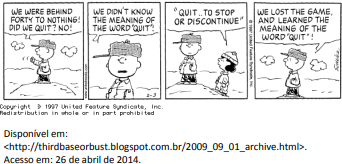
Obs.: Charlie is the boy.
About the comic strip, it is possible to assert that:
Questão 18 1148943
Unichristus 2015/1Texto para a questão.
PALESTINIANS SIGNAL WILLINGNESS TO CONTINUE PEACE TALKS
By Ruth Eglash
JERUSALEM – Palestinian President Mahmoud Abbas said Saturday that he is willing to continue negotiations with Israel, speaking two days after Israel broke off the latest round of peace talks following the conclusion of a deal between Abbas’s moderate Fatah faction and the militant Islamist group Hamas to form a unity government.
Israeli officials, however, contend that including Hamas in a Palestinian government would make peace negotiations impossible. Israel holds Hamas responsible for almost daily rocket fire into Israeli territory from the Gaza Strip that it rules, and both Israel and the United States have labeled the group a terrorist organization. Hamas refuses to recognize Israel’s legitimacy or talk directly to Israeli officials.
Disponível em: http://www.washingtonpost. com/world/middle_east/palestin ianssignal-willingness-to-cont inue-peace-talks>. Acesso em 26 abr. 2014
According to the text:
Questão 17 1148915
Unichristus 2015/1Texto para a questão.
HAS 'ONCE UPON A TIME' GONE TOO FAR WITH THE CHARACTERS?
By: Molly Freeman – Mar 21, 2014
With the spring premiere of Once Upon a Time, the ABC fairytale series has turned a page in its storybook and wound up in Oz. The show has been known to pull characters not only from fairytales – both the traditional versions and the Disney incarnations – but fantasy and sci-fi literature as well – Alice’s Adventures in Wonderland, Peter Pan and Frankenstein. Now, Once Upon a Time has introduced characters from The Wizard of Oz, but will it help a show that seems to be bogged down in fairytale lore?
Disponível em: http://www.hollywood.com/n ews/tv/56826584/has-onceupon-a -time-gone-too-far-with-the-ch aracters> Acesso em: 26 abr. 2014
It can be inferred from the text:
Questão 20 1141154
Unichristus 1° Fase 2015/2Picture yourself in a boat on a river
With tangerine trees and marmalade skies
Somebody calls you, you answer quite slowly
A girl with kaleidoscope eyes
Cellophane flowers of yellow and green
Towering over your head
Look for the girl with the sun in her eyes
And she's gone
[...]
Picture yourself on a train in a station
With plasticine porters with looking glass ties
Suddenly someone is there at the turnstile
The girl with kaleidoscope eyes.
[...]
Lucy in the sky,
The Beatles
Disponível em: http://letras.mus.br/the-beatles/195/. Acesso em: 8 de fev. de 2015.
Esse trecho da música da banda “The Beatles” utiliza referências pictóricas para a construção de um meio fantasioso e imaginário criado pelo interlocutor artístico.
Diante disso, qual expressão melhor demonstra essa intenção do autor da música?
Questão 17 1141126
Unichristus 1° Fase 2015/2Texto para a questão.
JOBS NUMBERS RELEASED
The Bureau of Labor Statistics will release its January jobs report on Friday morning. The report will show whether 2014's steady employment improvement has continued into the new year; the more jobs there are, the better off the economy is. According to Wall Street, the economy likely created 230,000 jobs last month, close to the 246,000 monthly average of 2014. Economists expect the unemployment rate to remain unchanged at 5.6%. The strength of the job market will influence policies from the Federal Reserve, which is expected to hike interest rates this year.
Disponível em: http://www.usatoday.com/story/news/2015/02/06/5-thingsto-know-friday/22647903/. Acesso em: 7 de fev. de 2015.
From the text above about jobs in the U.S., we can infer that:
06