


![[Marketing] Questao Topo - deslogado](https://storage.estuda.com.br/banners/0_6b7ebee90b03af1c560c73bb8bcce34a_banner_deslogado_70_dias.png)
Questões de Inglês
19.971 Questões
Questão 45 1307730
EsPCEx 2° Dia 2015Leia o texto a seguir, extraído do livro He knows too much, e responda à questão.
Chapter 1 - Madras 1986
“He knows too much. I must ask you to do nothing.”
“But this time I caught him in the act. I have proof, witnesses, everything. There is no possible doubt.”
“I said he knows too much! The company can’t afford to have any problems. Our position is very sensitive in this country. We can’t afford to take risks. I am telling you once again – you will do nothing. And if there is any trouble, I’m afraid I shall have to hold you personally responsible. So be sensible for once in your life.”
“I see. So you are telling me to close my eyes to corruption and behave as if nothing has happened. Is that right?”
“I didn’t put it quite like that. But, if you insist, yes. What Vish does or doesn’t do is a minor matter compared with the company’s global strategy. Just try to get things in perspective. After all, you won’t be stuck in Madras for ever – I’ll make sure that you are not. So just go with the flow for a bit longer. When you’re in your next post this will all seem a very long way away, I can assure you. But meantime, no trouble. I hope I’ve made myself clear. Oh, and, by the way, I advise you to forget that we have had this conversation. Goodbye.”
Dick Sterling put the phone down. His hands were trembling. He was furious with himself for failing to persuade his boss in Delhi, Keith Lennox, to support him, and was disgusted at the mixture of veiled threats and vague promises Lennox had made.
Adapted from MALEY, Alan. He knows too much. Cambridge University Press, 1999. p.6
In the sentences “Our position is very sensitive in this country.” and “So be sensible for once in your life.” (paragraph 3), sensitive and sensible mean respectively
Questão 58 1258936
FIP-Moc Saúde 2015/2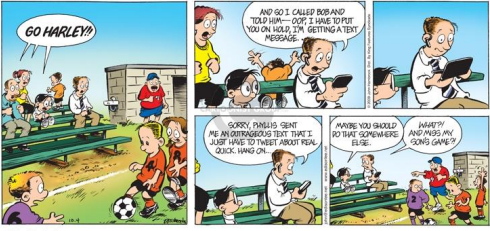
From the comic strip above, we feel that…
Questão 57 1258927
FIP-Moc Saúde 2015/2How to Beat Bad Ankles
ANKLE INJURIES CAN IMPAIR ONE'S BALANCE LONG AFTER THEY HEAL
People who’ve sprained an ankle are likely to sprain it again, writes Gretchen Reynolds for the New York Times, but there may be a "supremely low-tech" fix: balance training. An ankle sprain interferes with the neural receptors in the ligaments that transmit balance information to the brain. Even when the sprain is healed, balance can still remain impaired—increasing the chance of a future injury.
"If you don’t mind your spouse sniggering," writes Reynolds, you can beat bad ankles at home. It’s not complicated: When your ankle has healed well enough to bear weight, simply try standing on one foot for one minute. If that’s too easy, try crossing your arms closing your eyes, or brushing your teeth while on one foot. One study noted dramatic balance improvement in a month.
Source: Newser.com
The underlined words in the sentence: “Ankle injuries can impair one’s balance long after they heal.”, can correctly be replaced by:
Questão 56 1258917
FIP-Moc Saúde 2015/2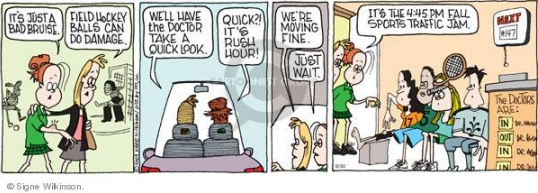
The traffic was slow due to the...
Questão 54 1258899
FIP-Moc Saúde 2015/2Chronic Traumatic Encephalopathy
Concussions are brain injuries hat occur when a person receives a blow to the head, face, or neck. Although most people who suffer a concussion experience initial bouts of dizziness, nausea, and drowsiness, these symptoms often disappear after a few days. The long-term effects of concussions, however, are less understood and far more severe. Recent studies suggest that people who suffer multiple concussions are at a significant risk for developing chronic traumatic encephalopathy (CTE), a degenerative brain disorder that causes a variety of dangerous mental and emotional problems to arise weeks, months,or even years after the initial injury. These psychological problems can include depression, anxiety, memory loss, inability to concentrate, and aggression. In extreme cases, people suffering from CTE have even committed suicide or homicide. The majority of people who develop these issues are athletes who participate in popular high-impact sports, especially football. Although both new sports regulations and improvements in helmet technology can help protect players, the sports media and fans alike bear some of the responsibility for reducing the incidence of these devastating injuries.
Perhaps the most important factor in reducing the number of traumatic brain injuries, however, lies not with the players, coaches, or the administrators, but with the media and fans. Sports media producers have become used to showcasing the most aggressive tackles and the most intense plays. BFL broadcasts often replay especially violent collisions, while the commentators marvel at the physical prowess of the players involved. Some sports programs even feature weekly countdowns of the hardest hits. When the media exalts such hazardous behavior,professionals are rewarded for injuring each other on the field,and amateurs become more likely to try to imitate their favorite NFL athletes. Announcers, commentators, television producers, and sportswriters should engage in a collective effort to cease glorifying brutal plays. In turn,fans should stop expecting their favorite players to put their lives on the line for the purposes of entertainment. Players must stop being encouraged to trade their careers, health, happiness, and their lives for the sake of a game.
Source: Copyright Read Theory LLC
The following sentence: “Although most people who suffer a concussion experience initial bouts of dizziness, nausea, and drowsiness, these symptoms often disappear after a few days.”, has the same meaning as:
Questão 15 1222648
FGV-SP Economia - Tarde 2015Read the text and answer question
Argentina defaults – Eighth time unlucky
Cristina Fernández argues that her country’s latest default is different. She is missing the point.
Aug 2nd 2014 ARGENTINA’S
first bond, issued in 1824, was supposed to have had a lifespan of 46 years. Less than four years later, the government defaulted. Resolving the ensuing stand-off with creditors took 29 years. Since then seven more defaults have followed, the most recent this week, when Argentina failed to make a payment on bonds issued as partial compensation to victims of the previous default, in 2001.
Most investors think they can see a pattern in all this, but Argentina’s president, Cristina Fernández de Kirchner, insists the latest default is not like the others. Her government, she points out, had transferred the full $539m it owed to the banks that administer the bonds. It is America’s courts (the bonds were issued under American law) that blocked the payment, at the behest of the tiny minority of owners of bonds from 2001 who did not accept the restructuring Argentina offered them in 2005 and again in 2010. These “hold-outs”, balking at the 65% haircut the restructuring entailed, not only persuaded a judge that they should be paid in full but also got him to freeze payments on the restructured bonds until Argentina coughs up.
Argentina claims that paying the hold-outs was impossible. It is not just that they are “vultures” as Argentine officials often put it, who bought the bonds for cents on the dollar after the previous default and are now holding those who accepted the restructuring (accounting for 93% of the debt) to ransom. The main problem is that a clause in the restructured bonds prohibits Argentina from offering the hold-outs better terms without paying everyone else the same. Since it cannot afford to do that, it says it had no choice but to default.
Yet it is not certain that the clause requiring equal treatment of all bondholders would have applied, given that Argentina would not have been paying the hold-outs voluntarily, but on the courts’ orders. Moreover, some owners of the restructured bonds had agreed to waive their rights; had Argentina made a concerted effort to persuade the remainder to do the same, it might have succeeded. Lawyers and bankers have suggested various ways around the clause in question, which expires at the end of the year. But Argentina’s government was slow to consider these options or negotiate with the hold-outs, hiding instead behind indignant nationalism.
Ms Fernández is right that the consequences of America’s court rulings have been perverse, unleashing a big financial dispute in an attempt to solve a relatively small one. But hers is not the first government to be hit with an awkward verdict. Instead of railing against it, she should have tried to minimise the harm it did. Defaulting has helped no one: none of the bondholders will now be paid, Argentina looks like a pariah again, and its economy will remain starved of loans and investment.
Happily, much of the damage can still be undone. It is not too late to strike a deal with the hold-outs or back an ostensibly private effort to buy out their claims. A quick fix would make it easier for Argentina to borrow again internationally. That, in turn, would speed development of big oil and gas deposits, the income from which could help ease its money troubles.
More important, it would help to change perceptions of Argentina as a financial rogue state. Over the past year or so Ms Fernández seems to have been trying to rehabilitate Argentina’s image and resuscitate its faltering economy. She settled financial disputes with government creditors and with Repsol, a Spanish oil firm whose Argentine assets she had expropriated in 2012. This week’s events have overshadowed all that. For its own sake, and everyone else’s, Argentina should hold its nose and do a deal with the hold-outs.
(http://www.economist.com/news/leaders/21610263. Adapted)
In the last sentence of the text, the use of the phrase Argentina should hold its nose implies that Argentina should
06