


![[Marketing] Questao Topo - deslogado](https://storage.estuda.com.br/banners/0_6b7ebee90b03af1c560c73bb8bcce34a_banner_deslogado_70_dias.png)
Questões de Inglês
19.971 Questões
Questão 45 1542084
PUC-PR Inverno - Demais Cursos 2015Read the text and answer question:
The Internet giant, Amazon, has put a warning on some of the 'Tom and Jerry' cartoons it offers to its customers. Visitors who want to buy or download the series 'Tom and Jerry: The Complete Second Volume' get a warning that the cartoons contain scenes that are racist. The warning says: "Tom and Jerry shorts may show some ethnic and racial prejudices that were once commonplace in American society." It added that the scenes were wrong when the cartoons were made 70 years ago, and are still wrong today. People say the character of the black maid in the cartoon series is racist. Some of the cartoons were edited in the 1960s because of worries about racism.
Tom and Jerry were created in 1940 by cartoonists William Hanna and Joseph Barbera. The cartoons won the Oscar for the best Animated Short Film seven times. The shows have become one of the most popular cartoons in animation history. Many people posted on Twitter to say it was "madness" for Amazon to put a warning on the cartoons
Disponível em: http://www.breakingnewsenglish.com/1410/141004-tom-and-jerry.html#ixzz3FVuisi75. Acesso em: set. 2014.
Based on the reading select the CORRECT alternatives:
I. In the sixties the cartoons were revised due to racism issues.
II. Visitors can only download the series “Tom and Jerry” from Amazon.
III. Tom and Jerry were created over 20 years before some cartoons were edited due to worries about racism.
IV. People on twitter supported Amazon’s warning.
Questão 42 1541271
PUC-PR Inverno - Demais Cursos 2015Read the comic strip and check the correct meaning of the following expression:
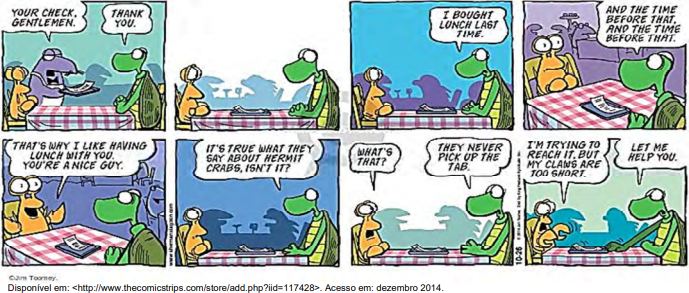
In the comic strip above the phrasal verb pick up the tab means:
Questão 56 1313544
EsPCEx 2° Dia 2015Leia o texto a seguir e responda à questão.
We’re so well educated – but we’re useless
Record numbers of students have entered higher education in the past 10 years, but despite being the most educated generation in history, it seems that we’ve grown increasingly ignorant when it comes to basic life skills.
Looking back on my first weeks living in student halls, I consider myself lucky to still be alive. I have survived a couple of serious boiling egg incidents and numerous cases of food-poisoning, probably from dirty kitchen counters. Although some of my clothes have fallen victim to ironing experimentation, I think I have now finally acquired all the domestic skills I missed out in my modern education.
Educationist Sir Ken Robinson says that our current education system dislocates people from their natural talents and deprives us of what used to be passed from generation to generation – a working knowledge of basic life skills. Today’s graduates may have earned themselves distinctions in history, law or economics, but when it comes to simple things like putting up a shelf to hold all their academic books, or fixing a hole in their on-trend clothes, they have to call for help from a professional handyman or tailor.
Besides what we need to know for our own jobs, we must have practical skills. We don’t grow our own crops, build our own houses, or make our own clothes anymore; we simply buy these things. Unable to create anything ourselves, what we have mastered instead is consumption.
Sociologist Saskia Sassen argues that the modern liberal state has created a middle class that isn’t able to “make” anymore. I suggest that we start with the immediate reintroduction of some of the most vital aspects of “domestic science” education. Instead of only maths, language and history, we should create an interactive learning environment in schools where craftsmanship and problem-solving are valued as highly as the ability to absorb and regurgitate information. We need to develop children into people that not only think for themselves, but are also able to act for themselves.
Adapted from http://www.guardian.co.uk/education/ mortarboard/2013/feb/25/well-educated-but-useless
In the sentence “Besides what we need to know for our own jobs, we must have practical skills.” (paragraph 4), the word besides can be replaced by
Questão 55 1313541
EsPCEx 2° Dia 2015Leia o texto a seguir e responda à questão.
We’re so well educated – but we’re useless
Record numbers of students have entered higher education in the past 10 years, but despite being the most educated generation in history, it seems that we’ve grown increasingly ignorant when it comes to basic life skills.
Looking back on my first weeks living in student halls, I consider myself lucky to still be alive. I have survived a couple of serious boiling egg incidents and numerous cases of food-poisoning, probably from dirty kitchen counters. Although some of my clothes have fallen victim to ironing experimentation, I think I have now finally acquired all the domestic skills I missed out in my modern education.
Educationist Sir Ken Robinson says that our current education system dislocates people from their natural talents and deprives us of what used to be passed from generation to generation – a working knowledge of basic life skills. Today’s graduates may have earned themselves distinctions in history, law or economics, but when it comes to simple things like putting up a shelf to hold all their academic books, or fixing a hole in their on-trend clothes, they have to call for help from a professional handyman or tailor.
Besides what we need to know for our own jobs, we must have practical skills. We don’t grow our own crops, build our own houses, or make our own clothes anymore; we simply buy these things. Unable to create anything ourselves, what we have mastered instead is consumption.
Sociologist Saskia Sassen argues that the modern liberal state has created a middle class that isn’t able to “make” anymore. I suggest that we start with the immediate reintroduction of some of the most vital aspects of “domestic science” education. Instead of only maths, language and history, we should create an interactive learning environment in schools where craftsmanship and problem-solving are valued as highly as the ability to absorb and regurgitate information. We need to develop children into people that not only think for themselves, but are also able to act for themselves.
Adapted from http://www.guardian.co.uk/education/ mortarboard/2013/feb/25/well-educated-but-useless
In the sentence “I think I have now finally acquired all the domestic skills I missed out in my modern education.” (paragraph 2), the words missed out mean
Questão 54 1313530
EsPCEx 2° Dia 2015Leia o texto a seguir e responda à questão.
We’re so well educated – but we’re useless
Record numbers of students have entered higher education in the past 10 years, but despite being the most educated generation in history, it seems that we’ve grown increasingly ignorant when it comes to basic life skills.
Looking back on my first weeks living in student halls, I consider myself lucky to still be alive. I have survived a couple of serious boiling egg incidents and numerous cases of food-poisoning, probably from dirty kitchen counters. Although some of my clothes have fallen victim to ironing experimentation, I think I have now finally acquired all the domestic skills I missed out in my modern education.
Educationist Sir Ken Robinson says that our current education system dislocates people from their natural talents and deprives us of what used to be passed from generation to generation – a working knowledge of basic life skills. Today’s graduates may have earned themselves distinctions in history, law or economics, but when it comes to simple things like putting up a shelf to hold all their academic books, or fixing a hole in their on-trend clothes, they have to call for help from a professional handyman or tailor.
Besides what we need to know for our own jobs, we must have practical skills. We don’t grow our own crops, build our own houses, or make our own clothes anymore; we simply buy these things. Unable to create anything ourselves, what we have mastered instead is consumption.
Sociologist Saskia Sassen argues that the modern liberal state has created a middle class that isn’t able to “make” anymore. I suggest that we start with the immediate reintroduction of some of the most vital aspects of “domestic science” education. Instead of only maths, language and history, we should create an interactive learning environment in schools where craftsmanship and problem-solving are valued as highly as the ability to absorb and regurgitate information. We need to develop children into people that not only think for themselves, but are also able to act for themselves.
Adapted from http://www.guardian.co.uk/education/ mortarboard/2013/feb/25/well-educated-but-useless
What is the main topic of the text?
Questão 52 1313501
EsPCEx 2° Dia 2015Leia o texto a seguir e responda à questão.
Children experience basic training and mock deployment
The 460th Force Support Squadron (FSS) hosted the 6th Annual Operation Future Forces (OFF) Sept. 13, 2014, at Camp Rattlesnake. OFF allows children ages 8-18 to experience what military members endure from basic training to technical school to a mock deployment, ending with a homecoming party.
“The youth mock deployment was developed to alleviate many of the stresses commonly experienced by young family members when one or both parents are deployed,” said Thomas Cox, 460th FSS youth program chief. “Everything from basic training, tech schools, camp activities and accomplishing their mission as a team made the event a one of a kind opportunity for military kids.”
A few of the boys had their heads shaved before heading off to “Basic Military Training.” The training consisted of doing push-ups and sit-ups, jumping through hula-hoops and running through an inflatable castle. They were also taught how to stand at attention, salute and do an about-face.
After basic training, each child attended “technical school” and was taught a specific Air Force Specialty Code to help them in their mock deployment. Some children were taught lifesaving self-aid and buddy care skills while others learned about the importance of radio communications while on a deployment.
The tech-school graduates were then issued water pistols before heading out. During their deployment, the children encountered hostile and non-hostile citizens, a water-balloon fight and injured allies who needed help along the way.
At the end of a long day, loved ones waited outside the youth center on base with homemade signs welcoming the “troops” back home.
“This event was great,” said Senior Airman Jasmine Madison, 460th FSS Force Support Force Management technician. “It’s a way for kids to get a hands-on understanding of what their parents do when they are separated from them during deployments.”
Adapted from http://www.buckley.af.mil/news/story.asp?id=123424927
In the sentence “During their deployment, the children encountered hostile and non-hostile citizens, a water-balloon fight and injured allies who needed help along the way.” (paragraph 5), the words their and who respectively refer to
06