


![[Marketing] Questao Topo - deslogado](https://storage.estuda.com.br/banners/0_6b7ebee90b03af1c560c73bb8bcce34a_banner_deslogado_70_dias.png)
Questões de Inglês
19.971 Questões
Questão 10 14071467
UnB - PAS 2022/3
The cartoon above criticizes
Questão 29 14055351
UnB Conhecimento Gerais 2022/1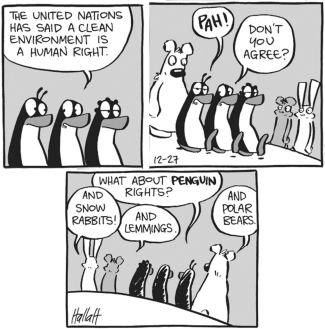
Alex Hallatt. Arctic circle comics. Internet: arcticcirclecartoons.com (adapted).
Based on cartoon above, it can be deduced that
Questão 10 14037652
UnB - PAS 2022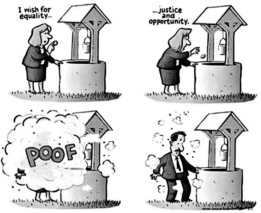
Internet: www.mesosyn.com.
Read the cartoon considering today’s society. The message conveyed by the cartoon is that
Questão 12 14033496
UEA - Geral Conhecimentos Gerais 2022Leia o texto para responder às questão.
Michigan State University’s Quick Check
1. Check the website name and domain: Fake sites often have a “.co” in the domain.
2. Spelling & Grammar: Are there multiple errors or does the site look professionally edited?
3. Author Attribution: Is an author listed? Are there links to their profile and credentials? Anonymous articles generally should be avoided.
4. Emotional Manipulation: Do you feel emotions by simply reading the headline?
5. Statement of Ethics: Most reputable news sites have a Statement of Ethics.
6. Corrections: Again, reputable sites have a Corrections section or policy.
7. Named Sources, Studies etc.: Does the article name a source or study for its information?
8. Identify Editorials vs News: Reputable news sources clearly identify editorials, which as we know are just someone’s opinion.
9. Check A Reporter’s Body of Work: Does the reporter have a large body of work? Do they generally cover the same topic(s), or do the topics seem to be random or inconsistent?
10. Verify Information Using Multiple Sources: This is a good habit for all research. Make sure you can find more than one reputable source reporting the same information.
(www.libguides.valenciacollege.edu, 04.08.2022. Adaptado.)
In the excerpt from the third item “Anonymous articles generally should be avoided”, the underlined term is used to
Questão 10 14033475
UEA - Geral Conhecimentos Gerais 2022No trecho “the human progress that enables us to easily buy a burger”, o termo sublinhado equivale, em português, a
Questão 65 12909357
UECE 2ª Fase 1° Dia 2022/2T E X T
The Story Paradox
Scott McLemee reviews Jonathan Gottschall’s The Story Paradox: How Our Love of Storytelling Builds Societies and Tears Them Down.
Rarely does anyone read a work of
social criticism for the plot. But in the case
of Jonathan Gottschall’s The Story Paradox:
How Our Love of Storytelling Builds
[5] Societies and Tears Them Down (Basic
Books), we have a sort of whodunit: Who is
ultimately responsible for the new world
disorder? The storytellers, as it happens—
although that turns out to be a very broad
[10] category of suspects.
Gottschall, a research fellow in
English at Washington & Jefferson College in
Pennsylvania, is also author of The
Storytelling Animal: How Stories Make us
[15] Human (Mariner Books, 2012), aspects of
which are reprised in the new book. The
basic argument runs like so: Humans are by
no means the strongest of the primates, or
the most nimble or hardy, and our
[20] altogether improbable rise as a species
owes almost everything to having evolved a
capacity to accumulate and transfer
information over time. And in that regard,
storytelling may have been catalytic. Being
[25] able to transmit the message “one of the
ancestors ate those berries and died” counts
as a definite evolutionary advantage, one
that must have developed long before the
cognitive power required to formulate so
[30] complex a concept as “poison.”
An enormous portion of humanity’s
mental bandwidth is devoted to producing,
consuming and processing narratives of all
kinds: long and short, serious and trivial,
[35] complex and simple. Whole professions and
industries specialize in factual or
imaginative narratives and the many shades
in between. As an alternative to the self-
bestowed title of Homo sapiens (“wise
[40] person”), Gottschall proposes our species
might better be called Homo fictus (“story
person”). The suggested change in
nomenclature will likely go unheeded, but
the point seems valid: humans are both the
[45] creators and the products of narrative
communication.
The Story Paradox expands upon
this notion by emphasizing that narrative’s
tool-like aspects are not limited to its
[50] usefulness in transmitting experience.
Through the skills of the teller or the power
of the tale itself, narrative engrosses not
just the individual listener (or reader) but
groups—even whole populations—creating a
[55] sort of coordinated social attention that
influences human thought and behavior.
Gottschall returns to his point about the
presumable long-term evolutionary
advantages: “Human groups with strong
[60] fantasies that bound them together into
well-functioning collectives would have
outcompeted human groups that lacked
them,” he writes. “And we, the
grandchildren of these ancient storytellers,
[65] have inherited the earth.”
Here the full significance of the
book’s title comes into view. While
storytelling is an occasion for shared
engrossment, the most compelling
[70] narratives—whether real or fictional—
involve conflict. (Everyone knows that “they
lived happily ever after” means the story is
over.) “That people gravitate most naturally
to tales of social conflict,” writes Gottschall,
[75] “is supported not just by the relative
prevalence of these stories but also by
research showing that even little children
are far more attracted to stories of social
conflict as opposed to other kinds.” And
[80] while tales of conflict do not automatically
resolve themselves into a showdown
between good and evil, the total defeat of a
villain does tend to gratify audiences of all
ages. There must be some blockbuster
[85] movie that ends with a reasoned
compromise between people with diverging
conceptions of the common good, though
none springs to mind.
Fairly recently on the timeline of
[90] human development, another factor has
intervened to make the situation more
precarious: a number of incredibly effective
systems for storytelling over long distances,
with much of it available more or less on
[95] demand. Any evolutionary advantage once
attached to being able to benefit from the
wisdom of the tribe about potential dangers
in the world has morphed into the capacity
to find, absorb and share whatever stories
[100] click with our own worst fears and meanest
impulses. As if that were not worrying
enough, Gottschall refers to efforts to
weaponize narratives and their delivery
systems, with Russian social media
[105] shenanigans in the 2016 election as an
example. The Story Paradox leaves the
reader in the position of a character at the
end of an episode of an old-fashioned
serial—hanging from a cliff and afraid to
[110] look down.
From:https://www.insidehighered.com/views/2021/11/19
The Story Paradox mentions that stories contribute to create a type of attention that
06