


![[Marketing] Questao Topo - deslogado](https://storage.estuda.com.br/banners/0_6b7ebee90b03af1c560c73bb8bcce34a_banner_deslogado_70_dias.png)
Questões de Inglês
19.971 Questões
Questão 47 123865
ESPM 2016/1Children Caught in a Racist System
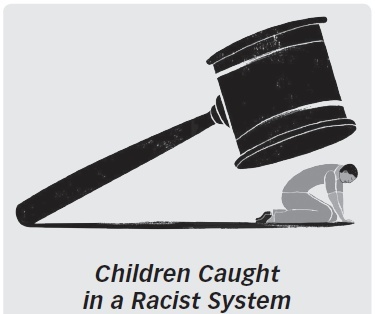
The Justice Department cast the St. Louis County, Missouri, law enforcement system in a harrowing light in March when it documented entrenched racism and unconstitutional policing in the town of Ferguson, which erupted in riots last year after a white police officer killed Michael Brown, an unarmed black teenager.
Now comes another Justice Department report documenting equally deplorable violations in the county’s juvenile court system, where children, often without basic legal representation, are routinely railroaded and mistreated.
The department opened the investigation in 2013 to protect the constitutional rights of children in the justice system and to discourage unnecessary incarceration. The department has undertaken similar investigations in Mississippi, Tennessee and Texas.
In St. Louis County, officials examined 33,000 juvenile court cases over a threeyear period and found that the system regularly treats black children more harshly than white children and routinely denies indigent children — no matter their race — basic constitutional rights.
Regardless of the severity of the offenses, the Justice Department analysis concluded that “black children are subjected to harsher treatment because of their race.” For example, black children were two-and-a-half times as likely as white children to be held in custody before their trials.
Black children were also more likely to be placed in the custody of the juvenile system than white children were and less likely to be diverted into communitybased programs. White children were significantly more likely to get less restrictive sentences, like probation with services provided to them at home. This disparate treatment may not be intentional, but it is clearly racist in its effect.
The Supreme Court has ruled that states must provide lawyers to defendants who can’t afford them and that juveniles have the same rights as adults. But the very structure of St. Louis County’s family court system seems designed to deny due process and representation.
For starters, there is only one public defender for juveniles in the entire county. A result is a staggering caseload for that one lawyer, who cannot possibly meet the needs of hundreds of children. For some who are not eligible for the public defender’s services, a family court judge will appoint a lawyer and order the parents to pay a “retainer”; often, cash-strapped parents persuade a child that no lawyer is necessary. Moreover, more than half of the lawyers who represented detained children entered the cases many days or weeks after the child’s detention hearing — too late to be of much help.
This appalling situation means that many juveniles are essentially representing themselves in complex legal proceedings that typically require them to plead guilty. Some of these children face the possibility of being transferred to adult courts, where a guilty verdict could have lifelong consequences. This is inconsistent with the Constitution and with basic principles of human decency.
The report offers dozens of recommendations for remaking this egregious system, starting with developing a strategic plan that sets clear goals to end discriminatory treatment at all points. As part of that process, the court has to train its employees to understand “the subtle ways that racial bias, conscious or unconscious,” affects policy and practice, the report says.
One absolutely essential step is for the county to create a defense system for poor juveniles that passes constitutional muster and affords them access to competent representation. The Justice Department should haul the county into court if it fails to make these changes.
(Adapted from www.thenytimes.com, August 08th ,2015)
In the phrase “Now comes another Justice Department report documenting equally deplorable violations in the county’s juvenile court system”, the words “now”:
Questão 43 123860
ESPM 2016/1‘Over 1,800 migrants have died in the Mediterranean since the beginning of 2015.’ Photograph: Jason Florio/ AFP/Getty Images
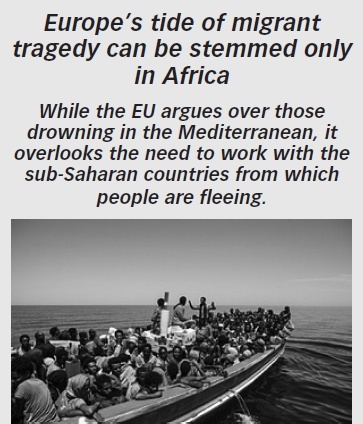
One day in October 2013, Enrico Letta, the then prime minister of Italy, stood in front of 302 coffins lined up inside a ventilated room on the island of Lampedusa. They contained the bodies of those who had perished at sea, in the biggest migrant disaster Europe had known at that point.
Some of the coffins were very small: they contained the bodies of children. It was a moment of deep reckoning. Letta suddenly realized that Europe’s indifference, and its powerlessness, had created a situation where thousands of human lives were put at risk. For Letta, that day marked the starting point of Mare Nostrum, an operation Italy launched to search and rescue migrants attempting the perilous crossing from Africa to Italy.
Letta tells this story in his recent book Andare insieme, andare lontano [Going Together, Going Far], in which he describes his experience as head of the Italian government in 2013-14. He says the migrant crisis became the “gravest issue” he had to deal with as prime minister. But, as Letta points out, doing something about those deaths wasn’t just about putting an end to our shame or sense of guilt. It had to do with a certain conception of civic and political duty. Those boat people in the Mediterranean came as a reminder that there were things that simply had to be done: there were moral obligations. But the fact is also that Italy ended up alone in bearing the brunt of the effort.
A lot of this came back to the fore in recent weeks, as even worse mass drownings have occurred off the Italian coast. More than 1,800 people have died in the Mediterranean since the beginning of the year. European ministers have scrambled to produce a list of possible measures, ranging from mandatory national quotas for refugees to the military targeting of trafficking networks in Libya, the country that acts as the biggest launchpad for migrants.
The deeper problem is that only the downstream aspect of the migrant tragedy is being addressed. The issues at the other end – where these migrants come from, and why – have hardly been studied in depth, or with strategic solutions in mind. There has been much focus on the resources for rescue operations, on the situation in Libya, its traffickers and its boats, and on how many asylum seekers will be taken in by European countries. But just as Letta wrote in his book, there is a much larger issue at play here, and one that no one seems quite ready to confront: the question of why millions of people decide to uproot themselves from Africa in search of a better life in Europe.
Concentrating on Syrian war refugees, many of whom now arrive in Europe via other routes, misses a bigger story: the largest group of people crossing the Mediterranean to get to Europe this year were those from sub-Saharan Africa. One Rome-based European official went as far as claiming that “90% to 95% of migrants” who arrived on Italian shores in recent months had come from countries in western and sub-Saharan Africa such as Senegal, Mali or Ivory Coast. These are not necessarily war refugees, but often young men fleeing poverty, unemployment, repression and corrupt
The pronoun this (boldfaced in the text), in the sentence “A lot of this came back to the fore in recent weeks, (…)”, refers to:
Questão 41 123858
ESPM 2016/1‘Over 1,800 migrants have died in the Mediterranean since the beginning of 2015.’ Photograph: Jason Florio/ AFP/Getty Images
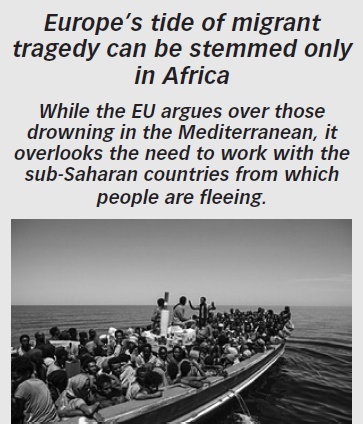
One day in October 2013, Enrico Letta, the then prime minister of Italy, stood in front of 302 coffins lined up inside a ventilated room on the island of Lampedusa. They contained the bodies of those who had perished at sea, in the biggest migrant disaster Europe had known at that point.
Some of the coffins were very small: they contained the bodies of children. It was a moment of deep reckoning. Letta suddenly realized that Europe’s indifference, and its powerlessness, had created a situation where thousands of human lives were put at risk. For Letta, that day marked the starting point of Mare Nostrum, an operation Italy launched to search and rescue migrants attempting the perilous crossing from Africa to Italy.
Letta tells this story in his recent book Andare insieme, andare lontano [Going Together, Going Far], in which he describes his experience as head of the Italian government in 2013-14. He says the migrant crisis became the “gravest issue” he had to deal with as prime minister. But, as Letta points out, doing something about those deaths wasn’t just about putting an end to our shame or sense of guilt. It had to do with a certain conception of civic and political duty. Those boat people in the Mediterranean came as a reminder that there were things that simply had to be done: there were moral obligations. But the fact is also that Italy ended up alone in bearing the brunt of the effort.
A lot of this came back to the fore in recent weeks, as even worse mass drownings have occurred off the Italian coast. More than 1,800 people have died in the Mediterranean since the beginning of the year. European ministers have scrambled to produce a list of possible measures, ranging from mandatory national quotas for refugees to the military targeting of trafficking networks in Libya, the country that acts as the biggest launchpad for migrants.
The deeper problem is that only the downstream aspect of the migrant tragedy is being addressed. The issues at the other end – where these migrants come from, and why – have hardly been studied in depth, or with strategic solutions in mind. There has been much focus on the resources for rescue operations, on the situation in Libya, its traffickers and its boats, and on how many asylum seekers will be taken in by European countries. But just as Letta wrote in his book, there is a much larger issue at play here, and one that no one seems quite ready to confront: the question of why millions of people decide to uproot themselves from Africa in search of a better life in Europe.
Concentrating on Syrian war refugees, many of whom now arrive in Europe via other routes, misses a bigger story: the largest group of people crossing the Mediterranean to get to Europe this year were those from sub-Saharan Africa. One Rome-based European official went as far as claiming that “90% to 95% of migrants” who arrived on Italian shores in recent months had come from countries in western and sub-Saharan Africa such as Senegal, Mali or Ivory Coast. These are not necessarily war refugees, but often young men fleeing poverty, unemployment, repression and corrupt
The main idea of the text is that:
Questão 19 123801
PUC- RJ G-(1,3,4) 2016/1Tsunami science:
advances since the 2004 indian ocean tragedy
The Indian Ocean tsunami was one of the worst
natural disasters in history. Enormous waves struck
countries in South Asia and East Africa with little to
no warning, killing 243,000 people. The destruction
played out on television screens around the world,
fed by shaky home videos. The outpouring of aid in
response to the devastation in Indonesia, Sri Lanka,
Thailand and elsewhere was unprecedented.
The disaster raised awareness of tsunamis and
prompted nations to pump money into research
and warning systems. Today (Dec. 26), on the 10th
anniversary of the deadly tsunami, greatly expanded
networks of seismic monitors and ocean buoys are on
alert for the next killer wave in the Indian Ocean, the
Pacific and the Caribbean. In fact, tsunami experts
can now forecast how tsunamis will flood distant
coastlines hours before the waves arrive. But hurdles
remain in saving lives for everyone under the threat of
tsunamis. No amount of warning will help those who
need to seek immediate shelter away from beaches,
disaster experts said.
Since 2004, geologists have uncovered evidence
of several massive tsunamis in buried sand layers
preserved in Sumatran caves. It turns out that the
deadly waves aren’t as rare in the Indian Ocean as
once thought. “We had five fatal tsunamis off the
coast of Sumatra prior to 2004,” said Paula Dunbar,
a scientist at NOAA’s National Geophysical Data
Center. Over the past 300 years, 69 tsunamis were
seen in the Indian Ocean, she said. Despite the risk,
there was no oceanwide tsunami warning system in
the region. Now, a $450 million early-alert network is
fully operational, though it is plagued with equipment
problems. Essentially built from scratch, the $450
million Indian Ocean Tsunami Warning System
includes more than 140 seismometers, about 100
sea-level gauges and several buoys that detect
tsunamis. More buoys were installed, but they have
been vandalized or accidentally destroyed. The
buoys and gauges help detect whether an earthquake
triggered a tsunami.
Getting the warnings down to people living in
remote coastal areas is one of the biggest hurdles
for the new system. Not all warnings reach the local
level. And not every tsunami earthquake is strong
enough to scare people away from shorelines. In
Sumatra’s Mentawai Islands, a 2010 tsunami killed
more than 400 people because residents failed to
evacuate in the short time between the earthquake
and the tsunami’s arrival. The shaking was simply not
strong enough to trigger people’s fear of tsunamis,
even though islanders had self-evacuated after a
2007 earthquake, according to an investigation by the
University of Southern California’s Tsunami Research
Center. There was also no clear-cut warning from the
regional tsunami alert system.
Another hurdle is learning how to accurately
forecast reflected tsunami waves. The 2004 Indian
Ocean tsunami ricocheted off island chains, and some
of the worst flooding arrived unexpectedly late in
places like Sri Lanka and Western Australia. “I found
a boat on the middle of the road, and at that point
knew it was a tsunami,” recalls Charitha Pattiaratchi,
a University of Western Australia tsunami expert who
was driving on a coastal Sri Lankan road on Dec. 26,
2004. “I came to the conclusion that I was safe. Well,
I was wrong. Twenty minutes later there was seven
meters of water where I had been standing, and two
hours later there were still more waves coming.”
A tsunami warning can go out just five minutes
after a submarine earthquake raises or lowers the
seafloor, thus launching a tsunami. For more detailed
predictions of the wave’s impact, such as the extent
of flooding, scientists rely on data collected by
seismometers, GPS stations, tide gauges and buoy
systems, which is relayed by satellite to warning
centers. Computer models then convert the data into
detailed tsunami simulations, which are based on
more than 2,000 real-life examples.
After an earthquake, scientists with NOAA’s
tsunami warning centers now spend about an hour
working out the details of a tsunami forecast, said
Vasily Titov, director of NOAA’s Center for Tsunami
Research. The results project when the wave will
arrive at shorelines and harbors, estimate tsunamiinduced
currents and gauge the height of the waves.
The agency’s goal is to dramatically reduce that hourlong
delay. “We’re now at the point where we want to
do it in five minutes,” Titov said. That means building
out the seismic network, getting a faster response
from the sea-level sensors and speeding up the
computer forecasts. “When these three components
come together, then we can save everybody,” Titov
said.
By Becky Oskin, Senior Writer. Adapted from http://www. livescience.com/49262-indian-ocean-tsunami-anniversary. html. December 26, 2014.
In the sentence “That means building out the seismic network,” (lines 89-90), building out means to
Questão 18 123800
PUC- RJ G-(1,3,4) 2016/1Tsunami science:
advances since the 2004 indian ocean tragedy
The Indian Ocean tsunami was one of the worst
natural disasters in history. Enormous waves struck
countries in South Asia and East Africa with little to
no warning, killing 243,000 people. The destruction
played out on television screens around the world,
fed by shaky home videos. The outpouring of aid in
response to the devastation in Indonesia, Sri Lanka,
Thailand and elsewhere was unprecedented.
The disaster raised awareness of tsunamis and
prompted nations to pump money into research
and warning systems. Today (Dec. 26), on the 10th
anniversary of the deadly tsunami, greatly expanded
networks of seismic monitors and ocean buoys are on
alert for the next killer wave in the Indian Ocean, the
Pacific and the Caribbean. In fact, tsunami experts
can now forecast how tsunamis will flood distant
coastlines hours before the waves arrive. But hurdles
remain in saving lives for everyone under the threat of
tsunamis. No amount of warning will help those who
need to seek immediate shelter away from beaches,
disaster experts said.
Since 2004, geologists have uncovered evidence
of several massive tsunamis in buried sand layers
preserved in Sumatran caves. It turns out that the
deadly waves aren’t as rare in the Indian Ocean as
once thought. “We had five fatal tsunamis off the
coast of Sumatra prior to 2004,” said Paula Dunbar,
a scientist at NOAA’s National Geophysical Data
Center. Over the past 300 years, 69 tsunamis were
seen in the Indian Ocean, she said. Despite the risk,
there was no oceanwide tsunami warning system in
the region. Now, a $450 million early-alert network is
fully operational, though it is plagued with equipment
problems. Essentially built from scratch, the $450
million Indian Ocean Tsunami Warning System
includes more than 140 seismometers, about 100
sea-level gauges and several buoys that detect
tsunamis. More buoys were installed, but they have
been vandalized or accidentally destroyed. The
buoys and gauges help detect whether an earthquake
triggered a tsunami.
Getting the warnings down to people living in
remote coastal areas is one of the biggest hurdles
for the new system. Not all warnings reach the local
level. And not every tsunami earthquake is strong
enough to scare people away from shorelines. In
Sumatra’s Mentawai Islands, a 2010 tsunami killed
more than 400 people because residents failed to
evacuate in the short time between the earthquake
and the tsunami’s arrival. The shaking was simply not
strong enough to trigger people’s fear of tsunamis,
even though islanders had self-evacuated after a
2007 earthquake, according to an investigation by the
University of Southern California’s Tsunami Research
Center. There was also no clear-cut warning from the
regional tsunami alert system.
Another hurdle is learning how to accurately
forecast reflected tsunami waves. The 2004 Indian
Ocean tsunami ricocheted off island chains, and some
of the worst flooding arrived unexpectedly late in
places like Sri Lanka and Western Australia. “I found
a boat on the middle of the road, and at that point
knew it was a tsunami,” recalls Charitha Pattiaratchi,
a University of Western Australia tsunami expert who
was driving on a coastal Sri Lankan road on Dec. 26,
2004. “I came to the conclusion that I was safe. Well,
I was wrong. Twenty minutes later there was seven
meters of water where I had been standing, and two
hours later there were still more waves coming.”
A tsunami warning can go out just five minutes
after a submarine earthquake raises or lowers the
seafloor, thus launching a tsunami. For more detailed
predictions of the wave’s impact, such as the extent
of flooding, scientists rely on data collected by
seismometers, GPS stations, tide gauges and buoy
systems, which is relayed by satellite to warning
centers. Computer models then convert the data into
detailed tsunami simulations, which are based on
more than 2,000 real-life examples.
After an earthquake, scientists with NOAA’s
tsunami warning centers now spend about an hour
working out the details of a tsunami forecast, said
Vasily Titov, director of NOAA’s Center for Tsunami
Research. The results project when the wave will
arrive at shorelines and harbors, estimate tsunamiinduced
currents and gauge the height of the waves.
The agency’s goal is to dramatically reduce that hourlong
delay. “We’re now at the point where we want to
do it in five minutes,” Titov said. That means building
out the seismic network, getting a faster response
from the sea-level sensors and speeding up the
computer forecasts. “When these three components
come together, then we can save everybody,” Titov
said.
By Becky Oskin, Senior Writer. Adapted from http://www. livescience.com/49262-indian-ocean-tsunami-anniversary. html. December 26, 2014.
The word dramatically in “The agency’s goal is to dramatically reduce that hour-long delay.” (lines 87-88), most nearly means
Questão 16 123798
PUC- RJ G-(1,3,4) 2016/1Tsunami science:
advances since the 2004 indian ocean tragedy
The Indian Ocean tsunami was one of the worst
natural disasters in history. Enormous waves struck
countries in South Asia and East Africa with little to
no warning, killing 243,000 people. The destruction
played out on television screens around the world,
fed by shaky home videos. The outpouring of aid in
response to the devastation in Indonesia, Sri Lanka,
Thailand and elsewhere was unprecedented.
The disaster raised awareness of tsunamis and
prompted nations to pump money into research
and warning systems. Today (Dec. 26), on the 10th
anniversary of the deadly tsunami, greatly expanded
networks of seismic monitors and ocean buoys are on
alert for the next killer wave in the Indian Ocean, the
Pacific and the Caribbean. In fact, tsunami experts
can now forecast how tsunamis will flood distant
coastlines hours before the waves arrive. But hurdles
remain in saving lives for everyone under the threat of
tsunamis. No amount of warning will help those who
need to seek immediate shelter away from beaches,
disaster experts said.
Since 2004, geologists have uncovered evidence
of several massive tsunamis in buried sand layers
preserved in Sumatran caves. It turns out that the
deadly waves aren’t as rare in the Indian Ocean as
once thought. “We had five fatal tsunamis off the
coast of Sumatra prior to 2004,” said Paula Dunbar,
a scientist at NOAA’s National Geophysical Data
Center. Over the past 300 years, 69 tsunamis were
seen in the Indian Ocean, she said. Despite the risk,
there was no oceanwide tsunami warning system in
the region. Now, a $450 million early-alert network is
fully operational, though it is plagued with equipment
problems. Essentially built from scratch, the $450
million Indian Ocean Tsunami Warning System
includes more than 140 seismometers, about 100
sea-level gauges and several buoys that detect
tsunamis. More buoys were installed, but they have
been vandalized or accidentally destroyed. The
buoys and gauges help detect whether an earthquake
triggered a tsunami.
Getting the warnings down to people living in
remote coastal areas is one of the biggest hurdles
for the new system. Not all warnings reach the local
level. And not every tsunami earthquake is strong
enough to scare people away from shorelines. In
Sumatra’s Mentawai Islands, a 2010 tsunami killed
more than 400 people because residents failed to
evacuate in the short time between the earthquake
and the tsunami’s arrival. The shaking was simply not
strong enough to trigger people’s fear of tsunamis,
even though islanders had self-evacuated after a
2007 earthquake, according to an investigation by the
University of Southern California’s Tsunami Research
Center. There was also no clear-cut warning from the
regional tsunami alert system.
Another hurdle is learning how to accurately
forecast reflected tsunami waves. The 2004 Indian
Ocean tsunami ricocheted off island chains, and some
of the worst flooding arrived unexpectedly late in
places like Sri Lanka and Western Australia. “I found
a boat on the middle of the road, and at that point
knew it was a tsunami,” recalls Charitha Pattiaratchi,
a University of Western Australia tsunami expert who
was driving on a coastal Sri Lankan road on Dec. 26,
2004. “I came to the conclusion that I was safe. Well,
I was wrong. Twenty minutes later there was seven
meters of water where I had been standing, and two
hours later there were still more waves coming.”
A tsunami warning can go out just five minutes
after a submarine earthquake raises or lowers the
seafloor, thus launching a tsunami. For more detailed
predictions of the wave’s impact, such as the extent
of flooding, scientists rely on data collected by
seismometers, GPS stations, tide gauges and buoy
systems, which is relayed by satellite to warning
centers. Computer models then convert the data into
detailed tsunami simulations, which are based on
more than 2,000 real-life examples.
After an earthquake, scientists with NOAA’s
tsunami warning centers now spend about an hour
working out the details of a tsunami forecast, said
Vasily Titov, director of NOAA’s Center for Tsunami
Research. The results project when the wave will
arrive at shorelines and harbors, estimate tsunamiinduced
currents and gauge the height of the waves.
The agency’s goal is to dramatically reduce that hourlong
delay. “We’re now at the point where we want to
do it in five minutes,” Titov said. That means building
out the seismic network, getting a faster response
from the sea-level sensors and speeding up the
computer forecasts. “When these three components
come together, then we can save everybody,” Titov
said.
By Becky Oskin, Senior Writer. Adapted from http://www. livescience.com/49262-indian-ocean-tsunami-anniversary. html. December 26, 2014.
In paragraph 5 (lines 57-69) tsunami expert, Charitha Pattiaratchi, recalls the critical moments she faced in a Sri Lankan road on Dec.26, 2004. Which of the following proverbs best applies to the statements “I came to the conclusion that I was safe. Well, I was wrong.” (lines 66-67):
06