


![[Marketing] Questao Topo - deslogado](https://storage.estuda.com.br/banners/0_6b7ebee90b03af1c560c73bb8bcce34a_banner_deslogado_70_dias.png)
Questões de Inglês
19.971 Questões
Questão 74 126478
FAMERP 2016Social life in youth may impact health decades later
Robert Preidt
August 6, 2015 
Having good social connections at age 20 can lead
to improved well-being later in life, a new study suggests.
Previous research has shown that people with poor social links
are at increased risk for early death. “In fact, having few social
connections is equivalent to tobacco use, and [the risk is]
higher than for those who drink excessive amounts of alcohol,
or who suffer from obesity,” study author Cheryl Carmichael,
who conducted the study while a doctoral candidate at the
University of Rochester in New York, said in a university news
release.
The study included 133 people who enrolled when
they were 20-year-old college students in the 1970s. The
participants kept track of their daily social interactions at
ages 20 and 30. At age 50, they completed an online survey
about the quality of their social lives and emotional well-being,
including questions about loneliness and depression, and
their relationships with close friends.
The findings showed that frequent social interactions at
age 20 and good-quality relationships – defined as intimate
and satisfying – at age 30 were associated with higher levels
of well-being at age 50. The study findings were published in
a recent issue of the journal Psychology and Aging.
A high number of social interactions at age 20 are
beneficial later in life because they help young adults
determine who they are, the researchers said. “It’s
often around this age that we meet people from diverse
backgrounds, with opinions and values that are different
from our own, and we learn how to best manage those
differences,” said Carmichael, now an assistant professor
of psychology at Brooklyn College. “Considering everything
else that goes on in life over those 30 years – marriage,
raising a family and building a career – it is extraordinary
that there appears to be a relationship between the kinds
of interactions college students and young adults have and
their emotional health later in life,” she concluded.
(www.nlm.nih.gov)
The data for the study
Questão 73 126477
FAMERP 2016Social life in youth may impact health decades later
Robert Preidt
August 6, 2015
Having good social connections at age 20 can lead
to improved well-being later in life, a new study suggests.
Previous research has shown that people with poor social links
are at increased risk for early death. “In fact, having few social
connections is equivalent to tobacco use, and [the risk is]
higher than for those who drink excessive amounts of alcohol,
or who suffer from obesity,” study author Cheryl Carmichael,
who conducted the study while a doctoral candidate at the
University of Rochester in New York, said in a university news
release.
The study included 133 people who enrolled when
they were 20-year-old college students in the 1970s. The
participants kept track of their daily social interactions at
ages 20 and 30. At age 50, they completed an online survey
about the quality of their social lives and emotional well-being,
including questions about loneliness and depression, and
their relationships with close friends.
The findings showed that frequent social interactions at
age 20 and good-quality relationships – defined as intimate
and satisfying – at age 30 were associated with higher levels
of well-being at age 50. The study findings were published in
a recent issue of the journal Psychology and Aging.
A high number of social interactions at age 20 are
beneficial later in life because they help young adults
determine who they are, the researchers said. “It’s
often around this age that we meet people from diverse
backgrounds, with opinions and values that are different
from our own, and we learn how to best manage those
differences,” said Carmichael, now an assistant professor
of psychology at Brooklyn College. “Considering everything
else that goes on in life over those 30 years – marriage,
raising a family and building a career – it is extraordinary
that there appears to be a relationship between the kinds
of interactions college students and young adults have and
their emotional health later in life,” she concluded.
(www.nlm.nih.gov)
No trecho do primeiro parágrafo “who conducted the study while a doctoral candidate”, o termo em destaque tem o sentido de
Questão 71 126456
FAMERP 2016Social life in youth may impact health decades later
Robert Preidt
August 6, 2015 
Having good social connections at age 20 can lead
to improved well-being later in life, a new study suggests.
Previous research has shown that people with poor social links
are at increased risk for early death. “In fact, having few social
connections is equivalent to tobacco use, and [the risk is]
higher than for those who drink excessive amounts of alcohol,
or who suffer from obesity,” study author Cheryl Carmichael,
who conducted the study while a doctoral candidate at the
University of Rochester in New York, said in a university news
release.
The study included 133 people who enrolled when
they were 20-year-old college students in the 1970s. The
participants kept track of their daily social interactions at
ages 20 and 30. At age 50, they completed an online survey
about the quality of their social lives and emotional well-being,
including questions about loneliness and depression, and
their relationships with close friends.
The findings showed that frequent social interactions at
age 20 and good-quality relationships – defined as intimate
and satisfying – at age 30 were associated with higher levels
of well-being at age 50. The study findings were published in
a recent issue of the journal Psychology and Aging.
A high number of social interactions at age 20 are
beneficial later in life because they help young adults
determine who they are, the researchers said. “It’s
often around this age that we meet people from diverse
backgrounds, with opinions and values that are different
from our own, and we learn how to best manage those
differences,” said Carmichael, now an assistant professor
of psychology at Brooklyn College. “Considering everything
else that goes on in life over those 30 years – marriage,
raising a family and building a career – it is extraordinary
that there appears to be a relationship between the kinds
of interactions college students and young adults have and
their emotional health later in life,” she concluded.
(www.nlm.nih.gov)
O estudo mencionado no texto
Questão 35 126394
FAMEMA 2016Scientists grow primitive human kidneys in a dish
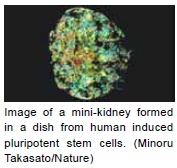
For the first time, primitive human kidneys have been created in a laboratory dish, by using stem cells. Although the kidneys cannot perform the functions of a fully formed adult kidney, the researchers hope the achievement will someday lead to new ways to treat people suffering from kidney failure. “It’s really exciting,” says Melissa Little, who heads the Kidney Research Laboratory at the Murdoch Children’s Research Institute in Australia. She led the research, which was published Wednesday in the journal Nature. “I think this is a really big advance.”
Kidneys are essential for life. They perform a host of crucial bodily functions, including filtering toxins from the blood and regulating blood pressure and bone density. But kidneys can fail for a variety of reasons, including poisonings, infections and other diseases.
“The problem is that if something goes wrong with your kidneys, there are only two options and these have been the same for 50 years: You either have a transplant or go ontodialysis,” Little says. “So we really need alternative options.” To find alternatives, Little and others have been trying for years to grow kidneys in the lab using cells known as induced pluripotent stem (iPS) cells. “Almost 10 years ago now it was shown that you could take any cell from anybody – like you or me – and actually convince it to go back into the state that’s essentially like the fertilized egg, so it is able to turn into any tissue type,” Little says.
While scientists have been able to use iPS cells to create many types of human cells, using them to create a kidney has proved difficult. The problem has been finding just the right combination of chemical signals to trigger iPS cells into making the various tissues in a kidney. “It’s like a recipe,” Little says. “We put different concentrations and types of growth factors in a certain order into the dish. And then when it gets to a certain size we take all the cells and make it into a ball.” After that, the cells talk to each other, she says. One type of cell will signal to its neighbor, and its neighbor will signal back, and that actually makes them form the appropriate shape.
(www.npr.org. Adaptado.)
No trecho final do quarto parágrafo “and that actually makes them form the appropriate shape”, o termo em destaque se refer
Questão 33 126392
FAMEMA 2016Scientists grow primitive human kidneys in a dish
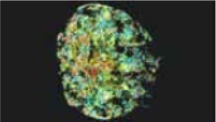
Image of a mini-kidney formed in a dish from human inducedpluripotent stem cells. (Minoru Takasato/Nature)
For the first time, primitive human kidneys have been created in a laboratory dish, by using stem cells. Although the kidneys cannot perform the functions of a fully formed adult kidney, the researchers hope the achievement will someday lead to new ways to treat people suffering from kidney failure. “It’s really exciting,” says Melissa Little, who heads the Kidney Research Laboratory at the Murdoch Children’s Research Institute in Australia. She led the research, which was published Wednesday in the journal Nature. “I think this is a really big advance.”
Kidneys are essential for life. They perform a host of crucial bodily functions, including filtering toxins from the blood and regulating blood pressure and bone density. But kidneys can fail for a variety of reasons, including poisonings, infections and other diseases.
“The problem is that if something goes wrong with your kidneys, there are only two options and these have been the same for 50 years: You either have a transplant or go ontodialysis,” Little says. “So we really need alternative options.” To find alternatives, Little and others have been trying for years to grow kidneys in the lab using cells known as induced pluripotent stem (iPS) cells. “Almost 10 years ago now it was shown that you could take any cell from anybody – like you or me – and actually convince it to go back into the state that’s essentially like the fertilized egg, so it is able to turn into any tissue type,” Little says.
While scientists have been able to use iPS cells to create many types of human cells, using them to create a kidney has proved difficult. The problem has been finding just the right combination of chemical signals to trigger iPS cells into making the various tissues in a kidney. “It’s like a recipe,” Little says. “We put different concentrations and types of growth factors in a certain order into the dish. And then when it gets to a certain size we take all the cells and make it into a ball.” After that, the cells talk to each other, she says. One type of cell will signal to its neighbor, and its neighbor will signal back, and that actually makes them form the appropriate shape.
(www.npr.org. Adaptado.)
No trecho do terceiro parágrafo “and actually convince it to go back into the state that’s essentially like the fertilized egg”, o termo “it” se refere a
Questão 32 126390
FAMEMA 2016Scientists grow primitive human kidneys in a dish
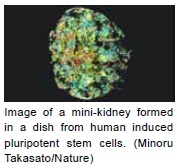
For the first time, primitive human kidneys have been created in a laboratory dish, by using stem cells. Although the kidneys cannot perform the functions of a fully formed adult kidney, the researchers hope the achievement will someday lead to new ways to treat people suffering from kidney failure. “It’s really exciting,” says Melissa Little, who heads the Kidney Research Laboratory at the Murdoch Children’s Research Institute in Australia. She led the research, which was published Wednesday in the journal Nature. “I think this is a really big advance.”
Kidneys are essential for life. They perform a host of crucial bodily functions, including filtering toxins from the blood and regulating blood pressure and bone density. But kidneys can fail for a variety of reasons, including poisonings, infections and other diseases.
“The problem is that if something goes wrong with your kidneys, there are only two options and these have been the same for 50 years: You either have a transplant or go ontodialysis,” Little says. “So we really need alternative options.” To find alternatives, Little and others have been trying for years to grow kidneys in the lab using cells known as induced pluripotent stem (iPS) cells. “Almost 10 years ago now it was shown that you could take any cell from anybody – like you or me – and actually convince it to go back into the state that’s essentially like the fertilized egg, so it is able to turn into any tissue type,” Little says.
While scientists have been able to use iPS cells to create many types of human cells, using them to create a kidney has proved difficult. The problem has been finding just the right combination of chemical signals to trigger iPS cells into making the various tissues in a kidney. “It’s like a recipe,” Little says. “We put different concentrations and types of growth factors in a certain order into the dish. And then when it gets to a certain size we take all the cells and make it into a ball.” After that, the cells talk to each other, she says. One type of cell will signal to its neighbor, and its neighbor will signal back, and that actually makes them form the appropriate shape.
(www.npr.org. Adaptado.)
According to the text, kidneys are essential for life because they
06