


![[Marketing] Questao Topo - deslogado](https://storage.estuda.com.br/banners/0_6b7ebee90b03af1c560c73bb8bcce34a_banner_deslogado_70_dias.png)
Questões de Inglês
19.971 Questões
Questão 91 144768
ENEM PPL 2° Dia 2016Are Twitter and Facebook Affecting How We Think?
Is constant use of electronic gadgets reshaping our brains and making our thinking shallower?
By Neil Tweedie
How many times do you click on your email icon in a day? Or look at Facebook, or Twitter? And how many times when reading on the internet do you click on a link navigating away from the text that was the original object of your enquiry? The web, it seems, is like an electronic sweet shop, forever tempting us in different directions. But does this mental promiscuity, this tendency to flit around online, make us, well, thicker?
Nicholas Carr, the American science writer, has mined this theme for his new book, The Shallows, in which he argues that new media are not just changing our habits but our brains. It turns out that the mature human brain is not an immutable seat of personality and intellect but a changeable thing, subject to "neuroplasticity". When our activities alter, so does the architecture of our brain. "I'm not thinking the way I used to think," writes Carr. "I feel it most strongly when I'm reading."
Disponível em: www.telegraph.co.uk. Acesso em: 27 fev. 2012
Neil Tweedie levanta vários questionamentos sobre a utilização de diferentes recursos tecnológicos disponíveis hoje em dia.
A partir desses questionamentos e dos argumentos do escritor norte-americano Nicholas Carr, o texto sugere que
Questão 45 144174
FMABC 2016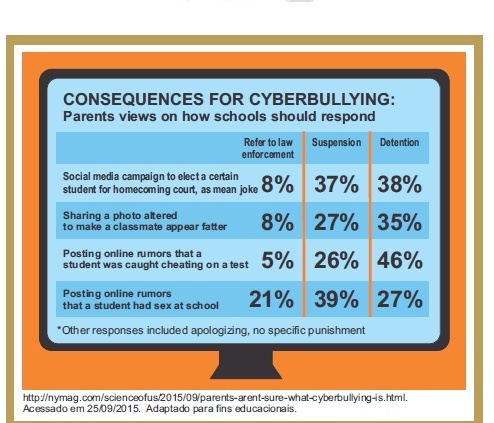
Examine o quadro acima e escolha a alternativa que melhor o representa.
Questão 44 144173
FMABC 2016Can email replace thank-you notes?
Manners Matter in the Digital World Answered by Peggy Post

Getty Images; Illustration by Alex Thebez for TIME http://time.com/4029806/peggy-post-can-email-replace-thank-you-notes/. Acessado em 17/09/2015. Adaptado para fins educacionais.
It used to be taboo to send thank-you notes by way of email. Now, you can even send them via text. But handwritten thank-you notes are still the way to go—for a wedding gift and after a job interview, for example. An initial, prompt emailed thanks is OK. But you should follow up with a paper version. An email just isn't as warm and special. There are bonuses for writing handwritten thank-you notes. It feels really good when you sit down and write your gratitude. It also makes the recipient feel appreciated.
No texto acima, Peggy Post defende que notas de agradecimento
Questão 43 144172
FMABC 2016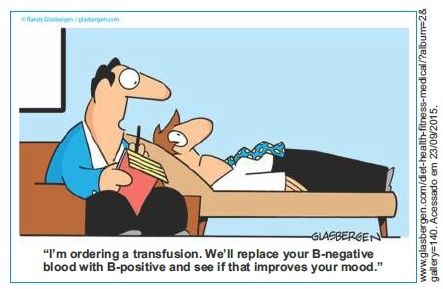
No quadrinho ao lado, o médico está pedindo uma transfusão de sangue para
Questão 41 144169
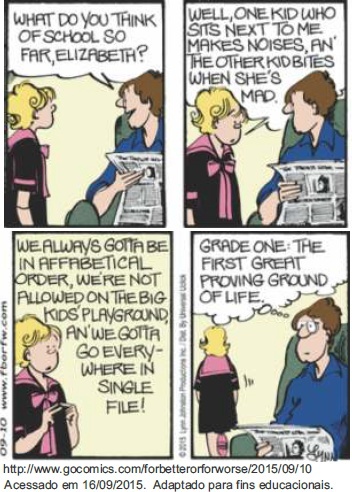
FMABC 2016Leia a tirinha abaixo e escolha a alternativa que corresponde ao comentário de um dos leitores sobre ela:
Questão 80 143960
IFMT 2016TEXTO I
EVEN GRAPHICS CAN SPEAK WITH A FOREIGN ACCENT
[1] Different cultures use color and other visual cues to send completely different messages.
Language is not just words. We communicate visually as well, but even our visual symbols are not a universal
language. And just as the same gesture can have different meanings from culture to culture, the way visual
information is used in graphics can have different meanings depending on the cultural context.
[5] Take the color of money, for instance. Charles Apple, an American visual journalist, was working for a
newspaper in South Africa when one consultant proposed using green for the business section. But the client
prefered blue. “Not every country has green money,” Apple says. And that's not all. “In the United States, red
usually has a connotation of losses or deficits," he says. But that's not true in all countries.”
Xan Sabaris, an Spanish infographic artist who has worked for the Beijing-based China Daily agrees: “For the
[10] Western culture, red has negative connotations. In China it's the opposite. You could see Chinese newspapers
where stock market charts use green for negative values and red for positive ones.”
Even Americans and Europeans have their differences when it comes to color. Nick Mrozoswski, an American
designer and former Creative Director of the Portuguese newspaper i, was surprised by the use of red and
green in his adopted country. “For an American audience, the combination is very deeply associated with
[15] Christmas. I don't know many American designers who would use it for anything other than a holiday card or
wrapping paper. In Portugal, however, red and green are the colors of the country's flag, so you see the
combination nearly everywhere you go. The only place you don't see it is on Christmas cards!”
For the Western culture, red has negative connotations. In China it's the opposite. In Brazil, the use of color is
also different from American tastes, but that's changing, says Felipe Memoria, Brazilian and a product design
[20] and development firm in New York City. “In Brazil, colors are typically brighter and the compositions are busier.
A lot of what you see feels a bit more visceral and emotional." At the same time, he says, global commerce has
meant that Brazilian design has gradually had increasing influence from the American culture, which is seen as
high-quality and polished.
Even shapes are influenced by culture. Antonio Farach, Honduran, and Adonis Durado, from Philippines, both
[25] work at the Times of Oman. Farach noticed how subtle details play a role: “In the Western culture, rounded
corners are more accepted than in Arabic countries. In typography, Arabs prefer blade-like typefaces instead of
beveled ones.” And sometimes the differences are not so subtle, says Durado. “The big difference is orientation.
Arabs write and read from right to left. Since we work for both English and Arabic newspapers, we do the flipping
of text flow and images in a very careful manner since not all images can just be flipped—such as maps or other
[30] images that are direction-oriented”. (...)
These journalists and designers had to adapt, but they’re also making their contributions to the cultures they've
adopted. “When I arrived in Oman, you wouldn't see any infographics in our newspaper or in our competitors,"
says Durado. "So when I set up our graphic section and started producing graphics, others follow suit.“
(Disponível em . Acesso em: 26.06.2015. Apdaptado).
Na frase, “...global commerce has meant that Brazilian design has gradually had increasing influence from the American culture, which is seen as high-quality and polished” (L. 21-23), o pronome relativo which pode ser substituído, sem prejuízo de sentido e a frase mantendo-se gramaticalmente correta, por:
06