


![[Marketing] Questao Topo - deslogado](https://storage.estuda.com.br/banners/0_6b7ebee90b03af1c560c73bb8bcce34a_banner_deslogado_70_dias.png)
Questões de Inglês
19.971 Questões
Questão 50 146472
URCA 2° Dia 2016/2How does social media use influence political participation and civic engagement? A metaanalysis
Academic research has consistently found that people Blank I consume more news media have a greater probability of being civically and politically engaged across a variety of measures. In an era whenthe public’s time and attention is increasingly directed toward platforms such as Facebook and Twitter, scholars are seeking to evaluate the stillemerging relationship between social media use and public engagement. The Obama presidential campaigns in 2008 and 2012 and the Arab Spring in 2011 catalyzed interest in networked digital connectivity and political action, but the data remain far from conclusive.
The largest and perhaps bestknown inquiry into this issue so far is a 2012 study published in the journal Nature, “A 61MillionPersonExperiment in Social Influence and Political Mobilization,” whichsuggested that messages on users’ Facebook feeds could significantly influence voting patterns. The study data — analyzed in collaboration with Facebook data scientists — suggested that certain messages promoted by friends “increased turnout directly by about 60,000 voters and indirectly through social contagion by another 280,000 voters, for a total of 340,000 additional votes.” Close friends with realworld ties were found to be much more influential than casual online acquaintances. (Following the study, concerns were raised about the potential manipulation of users and “digital gerrymandering.”)
There are now thousands of studies on the effects of social networking sites (SNS) on offline behavior, but isolating common themes is not easy. Researchers often use unique datasets, ask different questions and measure a range of outcomes. However, a 2015 meta study in the journal Information, Communication & Society, “Social Media Use and Participation: A Meta analysis of Current Research.” analyzes 36 studies on the relationship between SNS use and everything from civic engagement broadly speaking to tangibleactions such as voting and protesting. Some focus on youth populations, others on SNS use in countries outside the United States. Within these 36 studies, there were 170 separate “coefficients” — different factors potentially correlated with SNS use. The author, Shelley Boulianne of Grant MacEwan University (Canada), notes that the studies are all based on selfreported surveys, with the number of respondents ranging from 250 to more than 1,500. Twenty studies were conducted between 2008 and 2011, while eight were from 20122013.
(…)
http://journalistsresource.org/studies/politics/digitaldemocracy/socialmediainfluencepoliticsparticipationengagementmetaanalysis. Accessed on 05/03/2016
Blank I (first paragraph) may be filled with:
Questão 49 146471
URCA 2° Dia 2016/2How does social media use influence political participation and civic engagement? A metaanalysis
Academic research has consistently found that people Blank I consume more news media have a greater probability of being civically and politically engaged across a variety of measures. In an era whenthe public’s time and attention is increasingly directed toward platforms such as Facebook and Twitter, scholars are seeking to evaluate the stillemerging relationship between social media use and public engagement. The Obama presidential campaigns in 2008 and 2012 and the Arab Spring in 2011 catalyzed interest in networked digital connectivity and political action, but the data remain far from conclusive.
The largest and perhaps bestknown inquiry into this issue so far is a 2012 study published in the journal Nature, “A 61MillionPersonExperiment in Social Influence and Political Mobilization,” whichsuggested that messages on users’ Facebook feeds could significantly influence voting patterns.
The study data — analyzed in collaboration with Facebook data scientists — suggested that certain messages promoted by friends “increased turnout directly by about 60,000 voters and indirectly through social contagion by another 280,000 voters, for a total of 340,000 additional votes.” Close friends with realworld ties were found to be much more influential than casual online acquaintances. (Following the study, concerns were raised about the potential manipulation of users and “digital gerrymandering.”)
There are now thousands of studies on the effects of social networking sites (SNS) on offline behavior, but isolating common themes is not easy. Researchers often use unique datasets, ask different questions and measure a range of outcomes. However, a 2015 meta study in the journal Information, Communication & Society, “Social Media Use and Participation: A Meta analysis of Current Research.” analyzes 36 studies on the relationship between SNS use and everything from civic engagement broadly speaking to tangibleactions such as voting and protesting. Some focus on youth populations, others on SNS use in countries outside the United States. Within these 36 studies, there were 170 separate “coefficients” — different factors potentially correlated with SNS use. The author, Shelley Boulianne of Grant MacEwan University (Canada), notes that the studies are all based on selfreported surveys, with the number of respondents ranging from 250 to more than 1,500. Twenty studies were conducted between 2008 and 2011, while eight were from 20122013.
http://journalistsresource.org/studies/politics/digitaldemocracy/ socialmediainfluencepoliticsparticipationengagementmetaanalysis. Accessed on 05/03/2016
We can affirm about the studies on the effects of social networking that:
Questão 48 146470
URCA 2° Dia 2016/2How does social media use influence political participation and civic engagement? A metaanalysis
Academic research has consistently found that people Blank I consume more news media have a greater probability of being civically and politically engaged across a variety of measures. In an era whenthe public’s time and attention is increasingly directed toward platforms such as Facebook and Twitter, scholars are seeking to evaluate the stillemerging relationship between social media use and public engagement. The Obama presidential campaigns in 2008 and 2012 and the Arab Spring in 2011 catalyzed interest in networked digital connectivity and political action, but the data remain far from conclusive.
The largest and perhaps bestknown inquiry into this issue so far is a 2012 study published in the journal Nature, “A 61MillionPersonExperiment in Social Influence and Political Mobilization,” whichsuggested that messages on users’ Facebook feeds could significantly influence voting patterns.
The study data — analyzed in collaboration with Facebook data scientists — suggested that certain messages promoted by friends “increased turnout directly by about 60,000 voters and indirectly through social contagion by another 280,000 voters, for a total of 340,000 additional votes.” Close friends with realworld ties were found to be much more influential than casual online acquaintances. (Following the study, concerns were raised about the potential manipulation of users and “digital gerrymandering.”)
There are now thousands of studies on the effects of social networking sites (SNS) on offline behavior, but isolating common themes is not easy. Researchers often use unique datasets, ask different questions and measure a range of outcomes. However, a 2015 meta study in the journal Information, Communication & Society, “Social Media Use and Participation: A Meta analysis of Current Research.” analyzes 36 studies on the relationship between SNS use and everything from civic engagement broadly speaking to tangibleactions such as voting and protesting. Some focus on youth populations, others on SNS use in countries outside the United States. Within these 36 studies, there were 170 separate “coefficients” — different factors potentially correlated with SNS use. The author, Shelley Boulianne of Grant MacEwan University (Canada), notes that the studies are all based on selfreported surveys, with the number of respondents ranging from 250 to more than 1,500. Twenty studies were conducted between 2008 and 2011, while eight were from 20122013.
http://journalistsresource.org/studies/politics/digitaldemocracy/ socialmediainfluencepoliticsparticipationengagementmetaanalysis. Accessed on 05/03/2016
About the studies on the effects of social networking sites, it is possible to affirm that:
Questão 12 145710
UEA - Geral 2016Carbon dioxide levels reach a new peak
October 25, 2016

Across the globe, carbon dioxide (CO2) average levels are expected to reach the symbolic and significant milestone of 400 parts per million for the first time in 2016. The sudden jump in carbon dioxide levels can be blamed on the El Niño conditions, which developed in 2015 and had a large influence on the weather for the first half of 2016.
El Niño is the warming of the surface of the Pacific Ocean, which is known to have a dramatic effect on the weather around the globe. One of the impacts of El Niño is a drought in tropical parts of the world. In a drought, the growth of vegetation slows, which reduces its ability to absorb carbon dioxide.
Normally, tropical forests absorb significant amount of carbon dioxide. It is estimated that about half of all carbon dioxide emissions are absorbed by natural absorbers, known as ‘sinks’, such as forests, vegetation and the oceans. In a drought, less carbon dioxide is absorbed, so the levels of the gas in the atmosphere increases.
(www.aljazeera.com. Adaptado.)
No terceiro parágrafo, um exemplo de “natural absorbers” é
Questão 95 144777
ENEM PPL 2° Dia 2016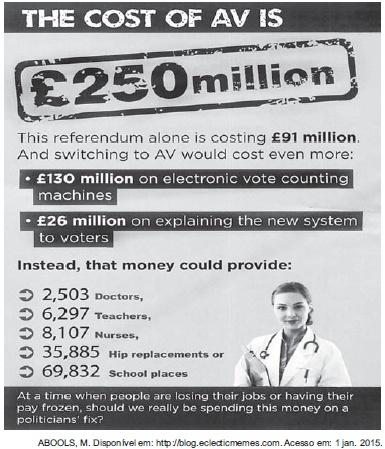
A sigla "AV", usada no texto, representa o alvo da crítica sobre a elevação do custo de uma(a)
Questão 94 144776
ENEM PPL 2° Dia 2016Hunger Games Review: Family Film Guide
Parent Concerns: There is definitely violence in this film. The central Hunger Games may not be as bloody and brutal as author Suzanne Collins describes in the novel, but there's a visceral reaction to seeing the kid-on-kid violence rather than conjuring it in your own imagination. The tributes kill each other in a host of ways, from spear, knife and arrow wounds to hand-to-hand battles that leave teens with their heads smashed in or necks snapped. The editing is quick and the shots never linger on anything overly graphic, but there is blood and twenty-two adolescents, aged 12-18, die in the annual blood sport pageant. Immature tweens, even if they've read the books, may not be ready to handle to the film just yet. A good rule of thumb: if they're not old enough to be reaped into the Hunger Games, they're probably not mature enough to see it.
ANGULO-CHEN, S. Disponível em http://news.moviefone.com. Acesso em: 28 jun. 2012
Produções literárias e cinematográficas estão, muitas vezes, articuladas. No caso do filme Hunger Games, a autora da resenha chama a atenção para a questão da violência, que é mais
06