


![[Marketing] Questao Topo - deslogado](https://storage.estuda.com.br/banners/0_6b7ebee90b03af1c560c73bb8bcce34a_banner_deslogado_70_dias.png)
Questões de Inglês
19.971 Questões
Questão 16 250953
UNITINS Tarde 2016/1Read the following text to answer question
Dishonesty Only Provides Short-Term Benefits
Dan Ariely
Dan Ariely is the James B. Duke professor of psychology and behavioral economics at Duke University and the coproducer of "Dishonesty: The Truth About Lies." He is on Twitter.
Updated September 29, 2015, 3:22 AM
Is honesty for suckers? If by “suckers” you mean people who care about others and the social good, then yes, it is. If by “suckers” you mean people who care about the long-term aspects of their business (see the drop in stock price of Volkswagen) then yes, it is. And if by “suckers” you mean people who care about the meaning of their brand (I own a Volkswagen Golf and I don’t think I will ever be able to look at it again in the same way) than yes again. Any business with long-terms plans needs a culture of honesty to deter cheating and help maintain the pool of social trust. The bottom line is that dishonesty can be a good strategy for someone who is trying to maximize short-term profits. So, if you plan to stay around just for a short while, maybe it can be a profitable approach. But, if you have any long-terms plans it is important for your business to create a culture of honesty that will help the employees overcome short-term incentives for dishonesty and keep them in line with the long-term best interest of the company and society.
company and society.
And there is one more thing to consider, which is that when an individual or a company acts dishonestly, they
pollute the trust pool -- they erode the social trust we have in one another -- and we are all worse for it. This is why
we are, and need to be, outraged with Volkswagen, and why their act is not just about their cars – it is a betrayal of
the social trust, and the trust fallout I suspect will have an impact on all German manufacturers and all car makers.
Join Opinion on Facebook and follow updates on twitter.com/roomfordebate.
Topics: Culture, corruption, morality
Source: benefits> (Adapted)
According to the Webster's College Dictionary (2001, p. 1222), one of the informal meanings of the word sucker is "a person easily cheated, deceived, or imposed upon". Despite its meaning, it is correct to state that the word sucker in the first paragraph is associated with:
Questão 40 230510
UESB Caderno 1 2016TEXTO:
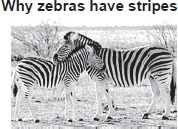
Scientists claim to have solved the mystery of why
zebras have their characteristic black and white stripes.
There have been many theories to explain the
zebra’s unmistakable stripes. Scientists have suggested
[5] that each zebra has a unique pattern that lets other
animals recognize it. Or that the mass of black and white
in a vast herd provides confusing camouflage that puts
off predators.
But the team that carried out the present study set
[10] out to test exactly what effect the stripes had on a zebra’s
most irritating and widespread enemy - the blood-sucking
horsefly. As part of their experiment the team put
sticky horse models — one white, one black and one
zebra-striped — into a fly-infested field. When they
[15] collected the flies that had landed and stuck to each of
the models, they found that the model zebra attracted
by far the fewest flies.
The researchers think that zebras had a blackcoated
ancestor, which evolved its white stripes in an
[20] evolutionary arms race, with an insect that’s become
the biting, disease-carrying plague of most horse herds.
WHY zebras have stripes. Disponível em: <http://www.telegraph.co.uk/news/earth/wildlife/10737443/Why-do-Zebras-have-stripes-Scientistsclaim- to-have-the-answer.html>. Acesso em: 12 out. 2015.
Considering language use um the text, it’s correct to say:
Questão 39 230509
UESB Caderno 1 2016TEXTO:
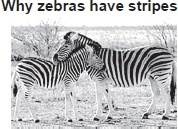
Scientists claim to have solved the mystery of why
zebras have their characteristic black and white stripes.
There have been many theories to explain the
zebra’s unmistakable stripes. Scientists have suggested
[5] that each zebra has a unique pattern that lets other
animals recognize it. Or that the mass of black and white
in a vast herd provides confusing camouflage that puts
off predators.
But the team that carried out the present study set
[10] out to test exactly what effect the stripes had on a zebra’s
most irritating and widespread enemy - the blood-sucking
horsefly. As part of their experiment the team put
sticky horse models — one white, one black and one
zebra-striped — into a fly-infested field. When they
[15] collected the flies that had landed and stuck to each of
the models, they found that the model zebra attracted
by far the fewest flies.
The researchers think that zebras had a blackcoated
ancestor, which evolved its white stripes in an
[20] evolutionary arms race, with an insect that’s become
the biting, disease-carrying plague of most horse herds.
WHY zebras have stripes. Disponível em: http://www.telegraph.co.uk/ news/earth/wildlife/10737443/Why-do-Zebras-have-stripes-Scientistsclaim-to-have-the-answer.html. Acesso em: 12 out. 2015.
The ’s in “that’s become” (l. 20) is the
Questão 38 230507
UESB Caderno 1 2016TEXTO:
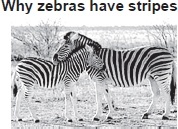
Scientists claim to have solved the mystery of why
zebras have their characteristic black and white stripes.
There have been many theories to explain the
zebra’s unmistakable stripes. Scientists have suggested
[5] that each zebra has a unique pattern that lets other
animals recognize it. Or that the mass of black and white
in a vast herd provides confusing camouflage that puts
off predators.
But the team that carried out the present study set
[10] out to test exactly what effect the stripes had on a zebra’s
most irritating and widespread enemy - the blood-sucking
horsefly. As part of their experiment the team put
sticky horse models — one white, one black and one
zebra-striped — into a fly-infested field. When they
[15] collected the flies that had landed and stuck to each of
the models, they found that the model zebra attracted
by far the fewest flies.
The researchers think that zebras had a blackcoated
ancestor, which evolved its white stripes in an
[20] evolutionary arms race, with an insect that’s become
the biting, disease-carrying plague of most horse herds.
WHY zebras have stripes. Disponível em: <http://www.telegraph.co.uk/news/earth/wildlife/10737443/Why-do-Zebras-have-stripes-Scientistsclaim- to-have-the-answer.html>. Acesso em: 12 out. 2015.
The only statement that is not true about horseflies is that they
Questão 37 230506
UESB Caderno 1 2016TEXTO:
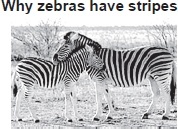
Scientists claim to have solved the mystery of why
zebras have their characteristic black and white stripes.
There have been many theories to explain the
zebra’s unmistakable stripes. Scientists have suggested
[5] that each zebra has a unique pattern that lets other
animals recognize it. Or that the mass of black and white
in a vast herd provides confusing camouflage that puts
off predators.
But the team that carried out the present study set
[10] out to test exactly what effect the stripes had on a zebra’s
most irritating and widespread enemy - the blood-sucking
horsefly. As part of their experiment the team put
sticky horse models — one white, one black and one
zebra-striped — into a fly-infested field. When they
[15] collected the flies that had landed and stuck to each of
the models, they found that the model zebra attracted
by far the fewest flies.
The researchers think that zebras had a blackcoated
ancestor, which evolved its white stripes in an
[20] evolutionary arms race, with an insect that’s become
the biting, disease-carrying plague of most horse herds.
WHY zebras have stripes. Disponível em: <http://www.telegraph.co.uk/news/earth/wildlife/10737443/Why-do-Zebras-have-stripes-Scientistsclaim- to-have-the-answer.html>. Acesso em: 12 out. 2015.
The present study supports the hypothesis that zebras’ striped pattern
Questão 36 230502
UESB Caderno 1 2016TEXTO:
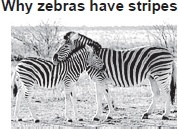
Scientists claim to have solved the mystery of why
zebras have their characteristic black and white stripes.
There have been many theories to explain the
zebra’s unmistakable stripes. Scientists have suggested
[5] that each zebra has a unique pattern that lets other
animals recognize it. Or that the mass of black and white
in a vast herd provides confusing camouflage that puts
off predators.
But the team that carried out the present study set
[10] out to test exactly what effect the stripes had on a zebra’s
most irritating and widespread enemy - the blood-sucking
horsefly. As part of their experiment the team put
sticky horse models — one white, one black and one
zebra-striped — into a fly-infested field. When they
[15] collected the flies that had landed and stuck to each of
the models, they found that the model zebra attracted
by far the fewest flies.
The researchers think that zebras had a blackcoated
ancestor, which evolved its white stripes in an
[20] evolutionary arms race, with an insect that’s become
the biting, disease-carrying plague of most horse herds.
WHY zebras have stripes. Disponível em: <http://www.telegraph.co.uk/news/earth/wildlife/10737443/Why-do-Zebras-have-stripes-Scientistsclaim- to-have-the-answer.html>. Acesso em: 12 out. 2015.
Fill in the parentheses with T (True) or F (False).
Among the many theories that try to explain why zebras have stripes, the text mentions the following ones:
( ) Groups of zebras share the same pattern of stripes aiming to facilitate communication with one another.
( ) Each zebra has its own distinctive pattern so as to be easily identified by members of the herd.
( ) When getting together in large groups, their black and white stripes disorient predators and prevent them from approaching.
( ) The swinging movement of their black and white stripes scare predators, which mistake them for fierce wild animals.
The correct sequence, from top to bottom, is
06