


![[Marketing] Questao Topo - deslogado](https://storage.estuda.com.br/banners/0_6b7ebee90b03af1c560c73bb8bcce34a_banner_deslogado_70_dias.png)
Questões de Inglês
19.971 Questões
Questão 16 363975
UNIMONTES 1° Etapa 2016Zika linked to baby joint deformities
[1] Zika infection during pregnancy may cause limb joint deformities in the baby, experts now fear.
Brazilian researchers from Recife, the city at the centre of the Zika epidemic, describe seven suspect cases
in the journal The BMJ.
The virus, which has been spreading across much of the Americas and has deterred some people
[5] from visiting the Olympic host country, is already known to cause a serious baby brain defect.
Mothers-to-be are urged to be vigilant. Pregnant women should not travel to areas with Zika, and
those living in Zika zones should avoid the biting mosquitoes that carry and spread the disease.
Experts now agree that Zika is capable of causing lasting brain damage to babies in the womb. The
virus can cross the placenta from the mother to her unborn child. And there is growing evidence that it can
[10] trigger a rare, weakening condition of the nerves, called Guillian-Barre syndrome, in adults.
Dr. Vanessa van der Linden and her team in Brazil say they are now seeing limb joint problems in
newborn babies that might be caused by Zika too. The seven babies with suspected Zika infection that they
studied in hospital had been born with hip, knee, ankle, elbow, wrist and/or finger joint problems that fit
with a medical diagnosis called arthrogryposis.
[15] The deformities of arthrogryposis, or crooked joints, are caused by faulty muscles – some too tight
or contracted and some too flaccid – that have pulled and held the baby’s growing body in unnatural
positions.
Dr. Linden’s team suspect the Zika virus attacks brain nerve centres supplying the muscles around
the joints, rather than the joints themselves. Scans of the babies’ brains appear to support this idea.
[20] All of the seven babies they examined tested negative for other
congenital (pre-birth) infections, such as rubella and HIV, that might have
been a possible cause of their deformities. Most had microcephaly as well as
the limb deformities. Dr. Linden says that, since writing up her findings, she
has seen 14 more babies with similar problems and is running more tests.
[25] Prof. Jimmy Whitworth, from the London School of Hygiene and
Tropical Medicine, said that while not concrete proof, the evidence that Zika might be to blame was “pretty
compelling”. “Microcephaly is the most obvious sign of congenital infection with Zika, but it’s becoming
clear that’s just part of the whole spectrum of damage that can be caused by the virus.” He said the
challenge was stopping the spread of the infection and caring for those who will be affected in the long as
[30] well as the short term.
“Studies suggest the current epidemic could go on for three or four years,” Prof. Whitworth said.
“We think there’s going to be tens of thousands of babies who could be affected by Zika. Meeting their
physical and psychosocial needs will be the real challenge.”

Fonte: ROBERTS, Michelle. Zika linked to baby joint deformities. 10 ago. 2016. Disponível em: http://www.bbc.com/news/health-37010221. Acesso em: 17 set. 2016. Adaptado.
Segundo o texto, é CORRETO afirmar:
Questão 27 342899
UNICENTRO 2016Read the following text and answer question.
Southern Europe’s Immigration
Test Immigrants have been making their way to Europe for tens of thousands of years. The first modern humans – the first real immigrants – came north from Africa through the Middle East. Since then, periodic waves of migrants have helped redefine Europe’s population, its food, its knowledge. After World War II, most migrants headed to northern Europe but as the south has prospered over the past 20 years, it has drawn in growing numbers of people looking for a better life. By the mid-2000s, migrants headed for southern Europe accounted for more than 60% of the continent’s new arrivals. They swung the hammers during Spain’s construction boom, changed diapers in Greece and worked Italy’s fields. European immigration policy has become more bureaucratic over the years. In south, where enforcement of rules has been more lax and informal economies are large, working illegally is often easier than getting proper permits. The economic crisis will slow the flow but is unlikely to undo the demographic shift, not least because the birthrate among immigrants is much higher than the general population’s. “If there’s a lesson that can be learned from the northern European experience, it’s that temporary migrants tend to remain,” says Joaquín Arango, professor of sociology at the Complutense University of Madrid. Here’s another: when a society marginalizes its newest members, trouble ensues. Southern Europe needed its immigrants. Now it needs to find a place for them.
(Adapted from: <www.content.time.com/article/0,28804,1964957_1964>. Accessed on: April 1st 2015.)
provide historical information on immigration in some European countries over the past few years.
I. Society should not marginalize immigrants to avoid serious social problems.
II. The economic crisis will not stop the flow of new immigrants.
III. The migrants population tends to decrease because they are not welcome in Southern Europe.
IV. Historically, migrants usually do not go back to their countries of origin.
Choose the correct alternative.
Questão 25 342894
UNICENTRO 2016Read the following text and answer question.
Who Painted the Meidum Geese?

ENNA, SICILY – Francesco Tiradritti of Kore University of Enna and director of the Italian archaeological mission to Egypt thinks that the Meidum Geese, a painting supposedly found in a tomb near the Meidum Pyramid in 1871 by Luigi Vassalli, may be a forgery. Vassalli is credited with removing the painting, now housed in the Egyptian Museum in Cairo, and putting it in the Museum Bulaq, where he was a curator. The painting depicts three kinds of geese: white-fronted geese, bean geese, and red-breasted geese. Tiradritti told Live Science that when he realized that the bean goose and the red breasted goose were unlikely to have been seen in Egypt, he took a more critical look at the painting, considered by many to be a masterpiece of Egyptian art. He found that some of the colors in the painting are unique, and the way that the geese are drawn, so that they appear to be the same size, is also unusual. The ancient Egyptians drew animals and people in different sizes, sometimes in order to convey their importance. Tiradritti adds that the cracks in the painting “are not compatible with the supposed ripping of the painting from the wall.” He thinks the geese were painted by Vassalli, who was a trained artist. “The only thing that, in my opinion, still remains to ascertain is what was (or ‘is’) painted under them. But that can be only established through a noninvasive analysis,” he said.
(Adapted from: . Accessed on: April 1st 2015.)
Reread the following sentences extracted from the text.
The painting depicts three kinds of geese:...
The ancient Egyptians drew animals and people in different sizes, sometimes in order to convey their importance.
Choose the equivalent to the words underlined.
Questão 23 342890
UNICENTRO 2016Read the following text and answer question.
Who Painted the Meidum Geese?
ENNA, SICILY – Francesco Tiradritti of Kore University of Enna and director of the Italian archaeological mission to Egypt thinks that the Meidum Geese, a painting supposedly found in a tomb near the Meidum Pyramid in 1871 by Luigi Vassalli, may be a forgery. Vassalli is credited with removing the painting, now housed in the Egyptian Museum in Cairo, and putting it in the Museum Bulaq, where he was a curator. The painting depicts three kinds of geese: white-fronted geese, bean geese, and red-breasted geese. Tiradritti told Live Science that when he realized that the bean goose and the red breasted goose were unlikely to have been seen in Egypt, he took a more critical look at the painting, considered by many to be a masterpiece of Egyptian art. He found that some of the colors in the painting are unique, and the way that the geese are drawn, so that they appear to be the same size, is also unusual. The ancient Egyptians drew animals and people in different sizes, sometimes in order to convey their importance. Tiradritti adds that the cracks in the painting “are not compatible with the supposed ripping of the painting from the wall.” He thinks the geese were painted by Vassalli, who was a trained artist. “The only thing that, in my opinion, still remains to ascertain is what was (or ‘is’) painted under them. But that can be only established through a noninvasive analysis,” he said.
(Adapted from: . Accessed on: April 1st 2015.)
At the end of the text, Francesco Tiradritti suggests that a noninvasive analysis should be made in the Meidum Geese painting. Why?
Questão 24 329722
CESMAC Medicina 1° Dia 2016/2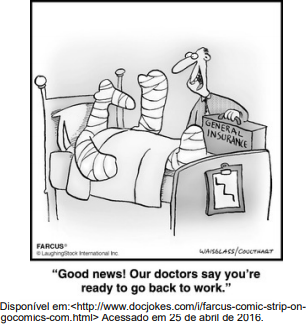
The message above implies that health insurance companies
Questão 23 329721
CESMAC Medicina 1° Dia 2016/2Global sleeping patterns revealed by app data.
It showed the Dutch have nearly an hour more in bed every night than people in Singapore or Japan.
The study, published in Science Advances, also found women routinely get more sleep than men, with middle-aged men getting the least of all.
The researchers say the findings could be used to deal with the "global sleep crisis".
The study found people in Japan and Singapore had an average of seven hours and 24 minutes sleep while the people in the Netherlands had eight hours and 12 minutes.
People in the UK averaged just under eight hours - a smidgen less than the French.
The later a country stays up into the night, the less sleep it gets. But what time a country wakes up seems to have little effect on sleep duration.
Prof Daniel Forger, one of the researchers, said there was a conflict between our desire to stay up late and our bodies urging us to get up in the morning.
The study also showed women had about 30 minutes more per night in bed than men, particularly between the ages of 30 and 60.
And that people who spend the most time in natural sunlight tended to go to bed earlier.
A strong effect of age on sleep was also detected. A wide range of sleep and wake-up times was found in young people but "that really narrows in old age," said Prof Forger.
"It highlights that although our body clocks are programming us to do certain things, we can't as we're ruled by social circumstances.
"We won't know the long-term consequences of this for many years."
Adaptado de: http://www.bbc.com/news/health-36226874 Acessado em 7 de maio de 2016.
In the sentence: “The researchers say the findings could be used to deal with the "global sleep crisis". the modal verb could expresses:
06