


![[Marketing] Questao Topo - deslogado](https://storage.estuda.com.br/banners/0_6b7ebee90b03af1c560c73bb8bcce34a_banner_deslogado_70_dias.png)
Questões de Inglês
19.971 Questões
Questão 81 8457494
UECE 1ª Fase 2023/1T E X T
Nearly Half of Covid Patients Haven’t Fully Recovered Months Later, Study Finds
A study of tens of thousands of people in
Scotland found that one in 20 people who had been sick
with Covid reported not recovering at all, and another
four in 10 said they had not fully recovered from their
[5] infections many months later.
The authors of the study, published in the journal
Nature Communications, tried to home in on the longterm risks of Covid by comparing the frequency of
symptoms in people with and without previous Covid
[10] diagnoses.
People with previous symptomatic Covid
infections reported certain persistent symptoms, such
as breathlessness, palpitations and confusion or
difficulty concentrating, at a rate roughly three times as
[15] high as uninfected people in surveys from six to 18
months later, the study found. Those patients also
experienced elevated risks of more than 20 other
symptoms relating to the heart, respiratory health,
muscle aches, mental health and the sensory system.
[20] The findings strengthened calls from scientists
for more expansive care options for long Covid patients
in the United States and elsewhere, while also offering
some good news.
The study did not identify greater risks of long
[25] term problems in people with asymptomatic
coronavirus infections. It also found, in a much more
limited subset of participants who had been given at
least one dose of Covid vaccine before their infections,
that vaccination appeared to help reduce if not
[30] eliminate the risk of some long Covid symptoms.
People with severe initial Covid cases were at
higher risk of long-term problems, the study found. “The
beauty of this study is they have a control group, and
they can isolate the proportion of symptomatology that
[35] is attributable to Covid infection,” said Dr. Ziyad Al-Aly,
chief of research at the V.A. St. Louis Health Care System
and a clinical epidemiologist at Washington University in
St. Louis, who was not involved in the research. “It also
tracks with the broader idea that long Covid is truly a
[40] multisystem disorder,” Dr. Al-Aly said, one that resides
“not only in the brain, not only in the heart — it’s all of
the above.”
Jill Pell, a professor of public health at the
University of Glasgow who led the research, said the
[45] findings reinforced the importance of long Covid
patients being offered support that extends beyond
health care and also addresses needs related to jobs,
education, poverty and disability. “It told us that Covid
can appear differently in different individuals, and it can
[50] have more than one impact on your life,” Dr. Pell said.
“Any approach to supporting people has to be, firstly,
personalized and also holistic. The answer doesn’t just
lie within the health care sector.
Long Covid refers to a constellation of problems
[55] that can plague patients for months or longer after an
infection. Over the last year, researchers have given
more attention to understanding the daunting
aftereffects as the number of Covid cases exploded and
health systems learned to better manage the initial
[60] stages of an infection. U.S. government estimates have
indicated that between 7.7 million and 23 million people
in the United States could have long Covid.
Globally, “the condition is devastating people’s
lives and livelihoods,” Tedros Adhanom Ghebreyesus,
[65] the director general of the World Health Organization,
wrote in an article for The Guardian. He called on all
countries to devote “immediate and sustained action
equivalent to its scale.”
The authors of the study in Scotland tracked
[70] 33,000 people who had tested positive for the virus
starting in April 2020 and 63,000 who had never been
diagnosed with Covid. In six-month intervals, those
people were asked about any symptoms they had,
including tiredness, muscle aches, chest pain and
neurological problems, and about any difficulties with
[75] daily life.
Of those with previous Covid cases, 6 percent
said on their most recent follow-up survey that they had
not recovered at all and 42 percent said that they had
[80] only partly recovered. Women, older people and those
living in poorer areas faced more serious aftereffects
from a Covid infection. So, too, did those with preexisting health problems, including respiratory disease
and depression.
[85] Only a small portion of the study participants —
about 4 percent — had been vaccinated before their
infections, and many of those with only a single dose.
“We’re now really heavily reliant upon vaccination,” Dr.
Pell said, “which does confer some protection, but it’s
[90] not absolute.”
Adapted from: https://www.nytimes.com/2022/10/12/
Another finding of the research refers to groups of people more seriously affected by long Covid.
Among those groups are
Questão 79 8457488
UECE 1ª Fase 2023/1T E X T
Nearly Half of Covid Patients Haven’t Fully Recovered Months Later, Study Finds
A study of tens of thousands of people in
Scotland found that one in 20 people who had been sick
with Covid reported not recovering at all, and another
four in 10 said they had not fully recovered from their
[5] infections many months later.
The authors of the study, published in the journal
Nature Communications, tried to home in on the longterm risks of Covid by comparing the frequency of
symptoms in people with and without previous Covid
[10] diagnoses.
People with previous symptomatic Covid
infections reported certain persistent symptoms, such
as breathlessness, palpitations and confusion or
difficulty concentrating, at a rate roughly three times as
[15] high as uninfected people in surveys from six to 18
months later, the study found. Those patients also
experienced elevated risks of more than 20 other
symptoms relating to the heart, respiratory health,
muscle aches, mental health and the sensory system.
[20] The findings strengthened calls from scientists
for more expansive care options for long Covid patients
in the United States and elsewhere, while also offering
some good news.
The study did not identify greater risks of long
[25] term problems in people with asymptomatic
coronavirus infections. It also found, in a much more
limited subset of participants who had been given at
least one dose of Covid vaccine before their infections,
that vaccination appeared to help reduce if not
[30] eliminate the risk of some long Covid symptoms.
People with severe initial Covid cases were at
higher risk of long-term problems, the study found. “The
beauty of this study is they have a control group, and
they can isolate the proportion of symptomatology that
[35] is attributable to Covid infection,” said Dr. Ziyad Al-Aly,
chief of research at the V.A. St. Louis Health Care System
and a clinical epidemiologist at Washington University in
St. Louis, who was not involved in the research. “It also
tracks with the broader idea that long Covid is truly a
[40] multisystem disorder,” Dr. Al-Aly said, one that resides
“not only in the brain, not only in the heart — it’s all of
the above.”
Jill Pell, a professor of public health at the
University of Glasgow who led the research, said the
[45] findings reinforced the importance of long Covid
patients being offered support that extends beyond
health care and also addresses needs related to jobs,
education, poverty and disability. “It told us that Covid
can appear differently in different individuals, and it can
[50] have more than one impact on your life,” Dr. Pell said.
“Any approach to supporting people has to be, firstly,
personalized and also holistic. The answer doesn’t just
lie within the health care sector.
Long Covid refers to a constellation of problems
[55] that can plague patients for months or longer after an
infection. Over the last year, researchers have given
more attention to understanding the daunting
aftereffects as the number of Covid cases exploded and
health systems learned to better manage the initial
[60] stages of an infection. U.S. government estimates have
indicated that between 7.7 million and 23 million people
in the United States could have long Covid.
Globally, “the condition is devastating people’s
lives and livelihoods,” Tedros Adhanom Ghebreyesus,
[65] the director general of the World Health Organization,
wrote in an article for The Guardian. He called on all
countries to devote “immediate and sustained action
equivalent to its scale.”
The authors of the study in Scotland tracked
[70] 33,000 people who had tested positive for the virus
starting in April 2020 and 63,000 who had never been
diagnosed with Covid. In six-month intervals, those
people were asked about any symptoms they had,
including tiredness, muscle aches, chest pain and
neurological problems, and about any difficulties with
[75] daily life.
Of those with previous Covid cases, 6 percent
said on their most recent follow-up survey that they had
not recovered at all and 42 percent said that they had
[80] only partly recovered. Women, older people and those
living in poorer areas faced more serious aftereffects
from a Covid infection. So, too, did those with preexisting health problems, including respiratory disease
and depression.
[85] Only a small portion of the study participants —
about 4 percent — had been vaccinated before their
infections, and many of those with only a single dose.
“We’re now really heavily reliant upon vaccination,” Dr.
Pell said, “which does confer some protection, but it’s
[90] not absolute.”
Adapted from: https://www.nytimes.com/2022/10/12/
According to Dr. Ziyad Al-Aly, long Covid is a health disorder that affects
Questão 9 8416310
UNISC Medicina Verão 2023How to advance your career when working remotely
Hybrid and remote work are here to stay. Many associations are choosing to stay hybrid or full time remote, citing continued productivity, increased flexibility for employees, and increased employee satisfaction. Employees are even willing to take a pay cut to stay remote. While remote work offers many benefits, one common concern is how remote work could hinder career advancement due to a lack of in-person face time, communication challenges, and more limited networking opportunities. In particular, some past studies demonstrate that remote workers might be at a disadvantage when it comes to getting a promotion, especially in a hybrid environment where some employees are in-person.
As remote and hybrid work shifts from a temporary to permanent arrangement for many workers, it’s important to set strategies that can help remote employees advance their career and professional development. According to Jennifer Brummet, PhD, CAE, and Research Manager at the American Epilepsy Society, establishing clear lines of communication, connecting colleagues, tracking progress, and discussing expectations are some tips which may help to continue building your career and network while working from home. Making sure colleagues can reach you through agreed upon communication methods and identifying new projects or professional development opportunities are also essential. Additionally, pursuing accomplishments and job responsibilities will help to be successful in the current role and will help to prepare for the next career move, whether internal or external.
https://forummagazine.org. Acesso em 30 de setembro de 2022 (adaptado).
According to the text remote work offers many benefits such as
Questão 75 8345741
FUVEST (USP) 2023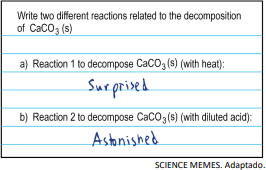
No meme, a inadequação da resposta à questão está baseada no efeito de sentido proveniente da presença de
Questão 70 8345632
FUVEST (USP) 2023TEXTO PARA A QUESTÃO.
The expression “dark doldrums” chills the hearts of renewable-energy engineers, who use it to refer to the lulls when solar panels and wind turbines are thwarted by clouds, night, or still air. On a bright, cloudless day, a solar farm can generate prodigious amounts of electricity. But at night solar cells do little, and in calm air turbines sit useless.
The dark doldrums make it difficult for us to rely totally on renewable energy. Power companies need to plan not just for individual storms or windless nights but for difficulties that can stretch for days. Last year, Europe experienced a weekslong “wind drought,” and in 2006 Hawaii endured six weeks of consecutive rainy days. On a smaller scale, communities that want to go all-renewable need to fill the gaps. The obvious solution is batteries, which power everything from mobile phones to electric vehicles; they are relatively inexpensive to make and getting cheaper. But typical models exhaust their stored energy after only three or four hours of maximum output, and—as every smartphone owner knows—their capacity dwindles with each recharge. Moreover, it is expensive to collect enough batteries to cover longer discharges.
We already have one kind of renewable energy storage: more than ninety per cent of the world’s energy-storage capacity is in reservoirs, as part of a technology called pumped-storage hydropower, used to smooth out sharp increases in electricity demand. Motors pump water uphill from a river or a reservoir to a higher reservoir; when the water is released downhill, it spins a turbine, generating power. A pumped-hydro installation is like a giant, permanent battery, charged when water is pumped uphill and depleted as it flows down. Some countries are expanding their use of pumped hydro, but the right geography is hard to find, permits are difficult to obtain, and construction is slow and expensive. The hunt is on for new approaches to energy storage.
The New Yorker. Abril, 2022. Adaptado.
Segundo o texto, quando a geração de energia por células solares ou turbinas eólicas é insuficiente para atender à demanda, uma fonte de energia alternativa envolveria a conversão de
Questão 69 8345629
FUVEST (USP) 2023TEXTO PARA A QUESTÃO.
The expression “dark doldrums” chills the hearts of renewable-energy engineers, who use it to refer to the lulls when solar panels and wind turbines are thwarted by clouds, night, or still air. On a bright, cloudless day, a solar farm can generate prodigious amounts of electricity. But at night solar cells do little, and in calm air turbines sit useless.
The dark doldrums make it difficult for us to rely totally on renewable energy. Power companies need to plan not just for individual storms or windless nights but for difficulties that can stretch for days. Last year, Europe experienced a weekslong “wind drought,” and in 2006 Hawaii endured six weeks of consecutive rainy days. On a smaller scale, communities that want to go all-renewable need to fill the gaps. The obvious solution is batteries, which power everything from mobile phones to electric vehicles; they are relatively inexpensive to make and getting cheaper. But typical models exhaust their stored energy after only three or four hours of maximum output, and—as every smartphone owner knows—their capacity dwindles with each recharge. Moreover, it is expensive to collect enough batteries to cover longer discharges.
We already have one kind of renewable energy storage: more than ninety per cent of the world’s energy-storage capacity is in reservoirs, as part of a technology called pumped-storage hydropower, used to smooth out sharp increases in electricity demand. Motors pump water uphill from a river or a reservoir to a higher reservoir; when the water is released downhill, it spins a turbine, generating power. A pumped-hydro installation is like a giant, permanent battery, charged when water is pumped uphill and depleted as it flows down. Some countries are expanding their use of pumped hydro, but the right geography is hard to find, permits are difficult to obtain, and construction is slow and expensive. The hunt is on for new approaches to energy storage.
The New Yorker. Abril, 2022. Adaptado.
Na frase “But typical models exhaust their stored energy after only three or four hours of maximum output, and—as every smartphone owner knows—their capacity dwindles with each recharge.” (2º parágrafo), “dwindles” poderia ser substituído, sem prejuízo de sentido, por
06