


![[Marketing] Questao Topo - deslogado](https://storage.estuda.com.br/banners/0_6b7ebee90b03af1c560c73bb8bcce34a_banner_deslogado_70_dias.png)
Questões de Inglês
19.971 Questões
Questão 24 7154057
PAS - UFLA 1° Etapa - 2° Dia 2016PASSAGE
SEX EDUCATION FOR CHILDREN: WHY PARENTS SHOULD TALK TO THEIR KIDS ABOUT SEX STARTING EARLY WITH AGE-APPROPRIATE INFORMATION ABOUT SEX IS A GOOD IDEA
Curiosity about sex is a natural step from learning about the body. Sex education helps kids understand
about the body and helps them feel positive about their own bodies. Younger kids are interested in pregnancy
and babies, rather than the mechanics of sex.
Discussing sex is also part of starting open communication with your child. Early, honest, and open
[05] communication between parents and kids is very important, especially when your child becomes an adolescent. If
open communication is normal, kids are more likely to speak with parents about all the other trials of
adolescence, such as depression, relationships, and the abuse of drugs and alcohol, as well as sexual issues.
Beginning a conversation about sex early and continuing that conversation as the child grows is the best
sex education strategy. It lets parents avoid giving one big, and likely uncomfortable talk when the child reaches
[10] adolescence (and will have already gotten information and misinformation from their friends). These
conversations are easier when they come out of a life experience, like seeing a pregnant woman or a baby.
When parents talk with their children about sex, they can make sure that they are getting the right
information. Parents should be a child’s first source of information about sex. Understanding correct information
can protect children from risky behaviour as they grow up.
Available at: http://www.ifrc.org/PageFiles/89397/the%20phenomenon%20of%20migration_TYPEFI_final_En.pdf Access on: 5/27/2015.
The word "trials" (line 6) is closest in meaning to
Questão 69 6853673
FEMA Medicina 2016Leia o texto para responder à questão.
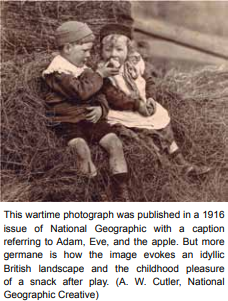
Food is more than survival
With it we make friends, court lovers, and count our blessings
Victoria Pope
The sharing of food has always been part of the human story. From Qesem Cave near Tel Aviv comes evidence of ancient meals prepared at a 300,000-year-old hearth, the oldest ever found, where diners gathered to eat together. Retrieved from the ashes of Vesuvius: a circular loaf of bread with scoring marks, baked to be divided. “To break bread together,” a phrase as old as the Bible, captures the power of a meal to forge relationships, bury anger, provoke laughter. Children make mud pies, have tea parties, trade snacks to make friends, and mimic the rituals of adults. They celebrate with sweets from the time of their first birthday, and the association of food with love will continue throughout life – and in some belief systems, into the afterlife. Consider the cultures that leave delicacies graveside to let the departed know they are not forgotten. And even when times are tough, the urge to celebrate endures. In the Antarctic in 1902, during Robert Falcon Scott’s Discovery expedition, the men prepared a fancy meal for Midwinter Day, the shortest day and longest night of the year. Hefty provisions had been brought on board. Forty-five live sheep were slaughtered and hung from the rigging, frozen by the elements until it was time to feast. The cold, the darkness, and the isolation were forgotten for a while. “With such a dinner,” Scott wrote, “we agreed that life in the Antarctic Regions was worth living.”
(www.nationalgeographic.com. Adaptado.)
Segundo o texto,
Questão 67 6853660
FEMA Medicina 2016Leia a tira para responder à questão.
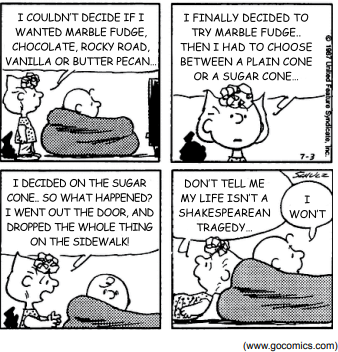
No terceiro quadrinho, a palavra “dropped” tem sentido semelhante, em português, a
Questão 66 6853653
FEMA Medicina 2016Leia a tira para responder à questão.
According to the comic strip, it is correct to say that
Questão 65 6853641
FEMA Medicina 2016Leia o texto para responder à questão.
Stephen Hawking warns artificial intelligence could end mankind
Rory Cellan-Jones
December 2, 2014
“The development of full artificial intelligence (AI) could spell the end of the human race”, said Professor Hawking. His warning came in response to a question about a revamp of the technology he uses to communicate, which involves a basic form of AI. But others are less gloomy about AI’s prospects. The theoretical physicist, who has the motor neurone disease amyotrophic lateral sclerosis (ALS), is using a new system developed by Intel to speak. Machine learning experts from the British company Swiftkey were also involved in its creation. Their technology, already employed as a smartphone keyboard app, learns how the professor thinks and suggests the words he might want to use next. Prof Hawking says the primitive forms of AI developed so far have already proved very useful, but he fears the consequences of creating something that can match or surpass humans. “It would take off on its own, and re-design itself at an ever increasing rate,” he said. “Humans, who are limited by slow biological evolution, couldn’t compete, and would be superseded.”
But others are less pessimistic. “I believe we will remain in charge of the technology for a decently long time and the potential of it to solve many of the world problems will be realised,” said Rollo Carpenter, creator of Cleverbot. Cleverbot’s software learns from its past conversations, and has gained high scores in the Turing test, fooling a high proportion of people into believing they are talking to a human. Mr Carpenter says we are a long way from having the computing power or developing the algorithms needed to achieve full artificial intelligence, but believes it will come in the next few decades. “We cannot quite know what will happen if a machine exceeds our own intelligence, so we can’t know if we’ll be infinitely helped by it, or ignored by it and sidelined, or conceivably destroyed by it,” he says. But he is betting that AI is going to be a positive force.
Prof Hawking is not alone in fearing for the future. In the short term, there are concerns that clever machines capable of undertaking tasks done by humans until now will swiftly destroy millions of jobs. In the longer term, the technology entrepreneur Elon Musk has warned that AI is “our biggest existential threat”.
In his BBC interview, Prof Hawking also talks of the benefits and dangers of the internet. He quotes the director of GCHQ’s (Government Communications Headquarters) warning about the net becoming the command centre for terrorists: “More must be done by the internet companies to counter the threat, but the difficulty is to do this without sacrificing freedom and privacy.”
He has, however, been an enthusiastic early adopter of all kinds of communication technologies and is looking forward to being able to write much faster with his new system. But one aspect of his own tech – his computer generated voice – has not changed in the latest update. Prof Hawking concedes that it’s slightly robotic, but insists he didn’t want a more natural voice. “It has become my trademark, and I wouldn’t change it for a more natural voice with a British accent,” he said. “I’m told that children who need a computer voice, want one like mine.”
(www.bbc.com. Adaptado.)
Segundo o último parágrafo do texto,
Questão 63 6853629
FEMA Medicina 2016Leia o texto para responder à questão.
Stephen Hawking warns artificial intelligence could end mankind
Rory Cellan-Jones
December 2, 2014
“The development of full artificial intelligence (AI) could spell the end of the human race”, said Professor Hawking. His warning came in response to a question about a revamp of the technology he uses to communicate, which involves a basic form of AI. But others are less gloomy about AI’s prospects. The theoretical physicist, who has the motor neurone disease amyotrophic lateral sclerosis (ALS), is using a new system developed by Intel to speak. Machine learning experts from the British company Swiftkey were also involved in its creation. Their technology, already employed as a smartphone keyboard app, learns how the professor thinks and suggests the words he might want to use next. Prof Hawking says the primitive forms of AI developed so far have already proved very useful, but he fears the consequences of creating something that can match or surpass humans. “It would take off on its own, and re-design itself at an ever increasing rate,” he said. “Humans, who are limited by slow biological evolution, couldn’t compete, and would be superseded.”
But others are less pessimistic. “I believe we will remain in charge of the technology for a decently long time and the potential of it to solve many of the world problems will be realised,” said Rollo Carpenter, creator of Cleverbot. Cleverbot’s software learns from its past conversations, and has gained high scores in the Turing test, fooling a high proportion of people into believing they are talking to a human. Mr Carpenter says we are a long way from having the computing power or developing the algorithms needed to achieve full artificial intelligence, but believes it will come in the next few decades. “We cannot quite know what will happen if a machine exceeds our own intelligence, so we can’t know if we’ll be infinitely helped by it, or ignored by it and sidelined, or conceivably destroyed by it,” he says. But he is betting that AI is going to be a positive force.
Prof Hawking is not alone in fearing for the future. In the short term, there are concerns that clever machines capable of undertaking tasks done by humans until now will swiftly destroy millions of jobs. In the longer term, the technology entrepreneur Elon Musk has warned that AI is “our biggest existential threat”.
In his BBC interview, Prof Hawking also talks of the benefits and dangers of the internet. He quotes the director of GCHQ’s (Government Communications Headquarters) warning about the net becoming the command centre for terrorists: “More must be done by the internet companies to counter the threat, but the difficulty is to do this without sacrificing freedom and privacy.”
He has, however, been an enthusiastic early adopter of all kinds of communication technologies and is looking forward to being able to write much faster with his new system. But one aspect of his own tech – his computer generated voice – has not changed in the latest update. Prof Hawking concedes that it’s slightly robotic, but insists he didn’t want a more natural voice. “It has become my trademark, and I wouldn’t change it for a more natural voice with a British accent,” he said. “I’m told that children who need a computer voice, want one like mine.”
(www.bbc.com. Adaptado.)
No trecho do segundo parágrafo “we can’t know if we’ll be infinitely helped by it”, o termo em destaque se refere a
06